
Pharmacy Robotics: Revolutionizing Healthcare Automation (2026)
Discover how pharmacy robotics is transforming healthcare, boosting patient safety, efficiency, and pharmacist workflow. Explore 2026's latest automation trends and solutions.

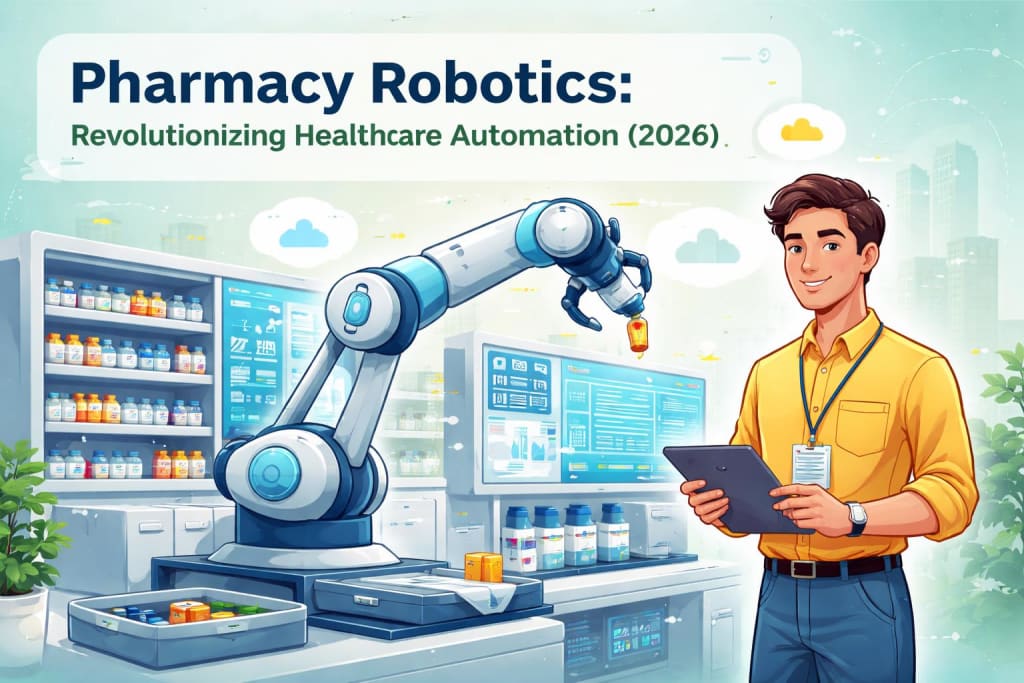
The Apothecary’s Old Ghost vs. The Shiny New Metal
I reckon we’ve all been there. You walk into a local chemist, wait forty minutes for a prescription that should take five, and watch a stressed-out pharmacist scramble through plastic bins like they’re looking for a lost earring in a shag carpet. It’s dodgy, right? Well, fast forward to right now in 2026, and that chaotic scene is becoming a relic. We are officially in the era where pharmacy robotics has moved from a "maybe one day" sci-fi dream to the literal backbone of how we get our meds without a side order of human error.
Real talk, the transition hasn’t been without its hiccups. I was talking to a mate in Newcastle who swore the first time his hospital installed a dispensing bot, he expected it to start demanding "your clothes, your boots, and your motorcycle." Instead, it just quietly sorted three thousand vials without breaking a sweat or needing a coffee break. It’s hella impressive how fast the "uncanny valley" of healthcare tech became just another Tuesday at the office. We’re seeing a shift where healthcare automation isn't just about speed, it is about keeping people alive by removing the "oops" factor from the equation.
The Death of the Counting Tray
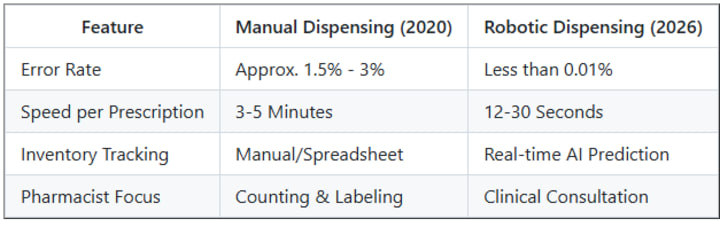
Remember those little blue plastic trays and the spatulas? Seeing a pharmacist count pills by fives feels proper ancient now. In 2026, if you aren't using a robotic counting system, you’re basically trying to run a marathon in clogs. These modern systems don't just count; they verify chemical signatures. They know if a pill is a 20mg statin or a sugar pill just by looking at it under hyperspectral sensors. The accuracy rates are sitting at roughly 99.9% across the board, which is a far cry from the days when "close enough" was a terrifying reality.
Why Manual Systems Are Fixin' to Vanish
The math just doesn't add up for manual labor anymore. Human pharmacists are brilliant, but they get tired. They get distracted by Brenda asking about her bunion cream for the fifth time. Robots don't get Brenda-distracted. According to recent data from the Mordor Intelligence Pharmacy Automation Report, the market is hitting nearly $8.5 billion this year because the return on investment is undeniable. You stop wasting money on "shrinkage"—which is just a fancy word for pills falling under the counter—and you start saving lives.
Thing is, it’s not just about the big robots in the back of the room. It’s the software connecting everything. This is similar to what you see with mobile app development ohio where teams are building the interfaces that allow patients to track their robotic dispensing in real-time. On that note, the integration between the physical bot and the user’s phone is where the real magic happens nowadays.
The Heavy Lifters: Types of Bots Dominating 2026
It’s not a one-size-fits-all situation. We’ve got different flavors of pharmacy robotics depending on whether you’re a massive hospital or a small-town corner shop. You’ve got your automated storage and retrieval systems (ASRS) that look like giant vending machines for grown-ups, and then you’ve got the tabletop counting bots that are no bigger than a microwave but twice as smart.
"The integration of robotics into the pharmacy workflow isn't just a luxury; it's a fundamental shift in patient safety. We are seeing a 50% reduction in medication-related adverse events in facilities that have fully embraced these systems." — Dr. Jane Thorne, Chief of Innovation at BD Rowa
Automated Storage and Retrieval (ASRS)
These are the big boys. Imagine a wall of 40,000 medication packs. A robotic arm zips across the X and Y axes, grabs the exact box, and drops it down a chute. No more "let me check the back room" excuses. In 2026, these systems are so quiet you could take a nap right next to them. They also handle the "first-in, first-out" logic perfectly, so nothing ever expires on the shelf. That’s fair dinkum efficiency right there.
The Rise of the Oncology Robot
Handling chemotherapy drugs is proper dangerous. These meds are toxic to the touch and the breath. Enter the specialized IV-compounding robots. They work in a sterile, negative-pressure environment, mixing precise dosages down to the microgram. This keeps the humans away from the 'hot' stuff and ensures the patient gets the exact cocktail they need. It’s one area where I’m stoked to see robots taking over the heavy lifting.
💡 Mark Sterling (@HealthTechMark): "Saw an oncology bot mix 40 infusions this morning without a single break. No PPE waste, no exposure risk, just pure precision. If you're still doing this manually, you're living in the dark ages." — HealthTech Insights
Prescription Picking and Packaging
For outpatient pharmacies, the "pouch pack" is king. Instead of five different orange bottles, the robot spits out a long strip of plastic pouches, each labeled with the day and time you need to take those specific pills. It’s a game-changer for my grandma, who used to treat her pill organizer like a very confusing game of Sudoku. Now, she just tears the next pouch off the roll. No worries, mate.
The AI Brain Inside the Metal Body
Get this: the hardware is cool, but the AI is the real MVP. In 2026, pharmacy robotics doesn't just wait for an order. It predicts. Using machine learning, the system looks at historical data, local flu outbreaks, and even weather patterns to realize that, "Hey, we're fixin' to run out of albuterol inhalers by Thursday." It automatically places the order with the wholesaler before the human even knows there’s a shortage.
Telepharmacy Integration
We’re seeing a lot of "hub and spoke" models. One central robotic hub can service ten different "spoke" clinics in rural areas. A patient walks into a kiosk in the middle of nowhere, talks to a pharmacist via video link, and a robot inside the kiosk dispenses the meds on the spot. It’s proper brilliant for accessibility. It means you don't have to drive three hours into the city just to get your blood pressure meds.
The "Ghost" Pharmacy Phenomenon
You’ve heard of ghost kitchens? Now we have ghost pharmacies. These are massive, fully automated warehouses that don't serve walk-in customers. They only handle mail-order prescriptions. They can process 100,000 orders a day with a skeleton crew of just three or four pharmacists overseeing the whole operation. It’s a bit cynical to think about the lost jobs, but the cost savings passed down to the patients—when the insurance companies feel like being nice—is substantial.
"The goal was never to replace the pharmacist, but to evolve their role. By delegating the mechanical tasks to robotics, we allow pharmacists to finally act as the clinical consultants they were trained to be." — Robert Adams, VP of Omnicell
The Growing Pains and Sarcastic Realities
Look, I'm not saying it's all sunshine and rainbows. These robots are expensive. Like, "sell your firstborn and your house" expensive for a small independent pharmacy. There’s a massive divide happening right now in 2026 between the big chains that can afford the shiny toys and the "mom and pop" shops that are still using a clipboard and a prayer. It’s a bit gnarly to see the local guy struggle while the big green wall of CVS tech hums along.
Maintenance Nightmares
When the robot breaks down—and they do, because everything made by humans eventually decides to stop working—the whole pharmacy grinds to a halt. I saw a tweet the other day from a tech in Sydney who said their robotic arm got stuck "holding a bottle of Viagra like it was King Arthur’s sword" and they couldn't get it to let go for six hours. No cap, that’s a bad day at the office. You need specialized technicians who charge a fortune just to show up.
Cybersecurity: The New Drug Heist
In the old days, you worried about someone hopping the counter. In 2026, you worry about a hacker in another country locking your dispensing bot behind ransomware. If the robot is connected to the cloud, it’s a target. We’ve seen at least three major "digital heists" this year where patient data was held for ransom. It turns out that making everything automated also makes it vulnerable to a whole new class of dodgy characters.
💡 Sarah Chen (@PharmacyFuturist): "Automation is great until the Wi-Fi goes down and you realize nobody under the age of 30 knows how to read a handwritten prescription from a doctor with shaky hands." — LinkedIn Healthcare Forum
What’s Coming Down the Pipe (2026-2027)
We are currently looking at the "Last Mile" problem. While the pharmacy robotics inside the building is sorted, getting the meds to your door is the next frontier. We’re fixin' to see a massive rollout of autonomous delivery droids and drones. In suburban areas, you’ll likely see small six-wheeled bots trundling down the sidewalk to drop off your heart meds. The data signals from 2025 pilot programs suggest that by late 2026, drone delivery for urgent meds like EpiPens or Narcan will be standard in most major metro areas. The market for these "pharmacy-to-door" robotic solutions is projected to grow at a CAGR of 18% over the next two years as regulatory hurdles finally clear up. Grand View Research indicates that the synergy between AI-driven fulfillment and drone delivery will be the defining trend of 2027.
Micro-Fulfillment Centers
Instead of one giant warehouse, we’re seeing "micro-hubs" popping up in abandoned retail spaces. These are 100% robotic and service a five-mile radius. It’s about getting that "Amazon Prime" speed for healthcare. If you can get a toothbrush in two hours, why shouldn't you get your antibiotics just as fast? It’s a proper shift in expectations that’s forcing the whole industry to level up.
Wearable-to-Robot Pipelines
This is the bit that feels a little too "Big Brother" for some, but your smartwatch is already talking to the pharmacy. If your heart rate data looks dodgy over a week, the AI at the pharmacy can flag it to your doctor, who then approves a dosage change, and the robot prepares the new meds before you’ve even made an appointment. It’s a seamless loop that is honestly a bit frightening, but hey, if it keeps me from croaking, I reckon I'm okay with it.
The Final Word on Our New Metal Overlords
At the end of the arvo, pharmacy robotics is doing exactly what it was supposed to do: it’s making the boring stuff fast and the dangerous stuff safe. I’ll miss the occasional chat with my pharmacist about the local footy scores, but I’d much rather they have the time to tell me exactly how my new meds will interact with my obsession with grapefruit juice than watch them count pills for twenty minutes. We’ve traded human touch for robotic precision, and in the world of medicine, that’s a fair dinkum trade-off every single time. The "pharmacy robotics" revolution isn't just coming; it’s already parked in the driveway, and it’s brought your prescription with it.
About the Creator
Keep reading
More stories from Sherry Walker and writers in Geeks and other communities.
Augmented Reality Mobile App Development: Your Partner (2026)
Augmented Reality is no longer a futuristic concept reserved for sci-fi movies or experimental tech labs. In 2026, AR has quietly embedded itself into everyday mobile experiences—from how people shop and learn to how businesses train teams and engage customers. What once felt like a novelty has now become a practical, revenue-driven technology.
By Sherry Walker3 days ago in Geeks
No Other Choice (2025)
It is only February, so other films may well surpass “No Other Choice”, but I think this is the best film I’ve seen so far this year. And that surprises me, because, it is a subtitled film and while I am pretentious enough to choose to watch foreign-language films, I was also very tired and that was an extra commitment from me. But more importantly, let me warn you, this film is gruesome and violent. There were times I had to turn away from the screen to avoid the worst of it (including some self-inflicted dentistry).
By Rachel Robbins4 days ago in Geeks
The Ultimate Crypto Token Launch Checklist for Founders
Launching a crypto token today is technically simple. With widely available smart contract templates and multi-chain infrastructure, anyone can create a token within minutes. However, building a successful token, one that sustains value, earns trust, and supports a growing ecosystem, is significantly more complex. The difference between short-lived hype tokens and long-term blockchain projects lies not in code alone, but in strategy, economics, compliance, and execution.
By Henry james5 days ago in Geeks
Super Bowl LX Recap: A Team Called Hawks
Sixty. The Super Bowl turned 60! Still amazes me that this was the sixtieth Super Bowl played in NFL history. It seems like yesterday that I watched Super Bowl XXVII, the first SB I ever watched. The QB who won Super Bowl XXVII has since called a few SBs, and will call next year's game, but that's another story. Super Bowl LX took place at Levi's Stadium in Santa Clara, California, the home stadium of the San Francisco 49ers. However, it was one of their division foes who represented the NFC, as the Seattle Seahawks faced off against the New England Patriots.
By Clyde E. Dawkins7 days ago in Unbalanced




Comments
There are no comments for this story
Be the first to respond and start the conversation.