

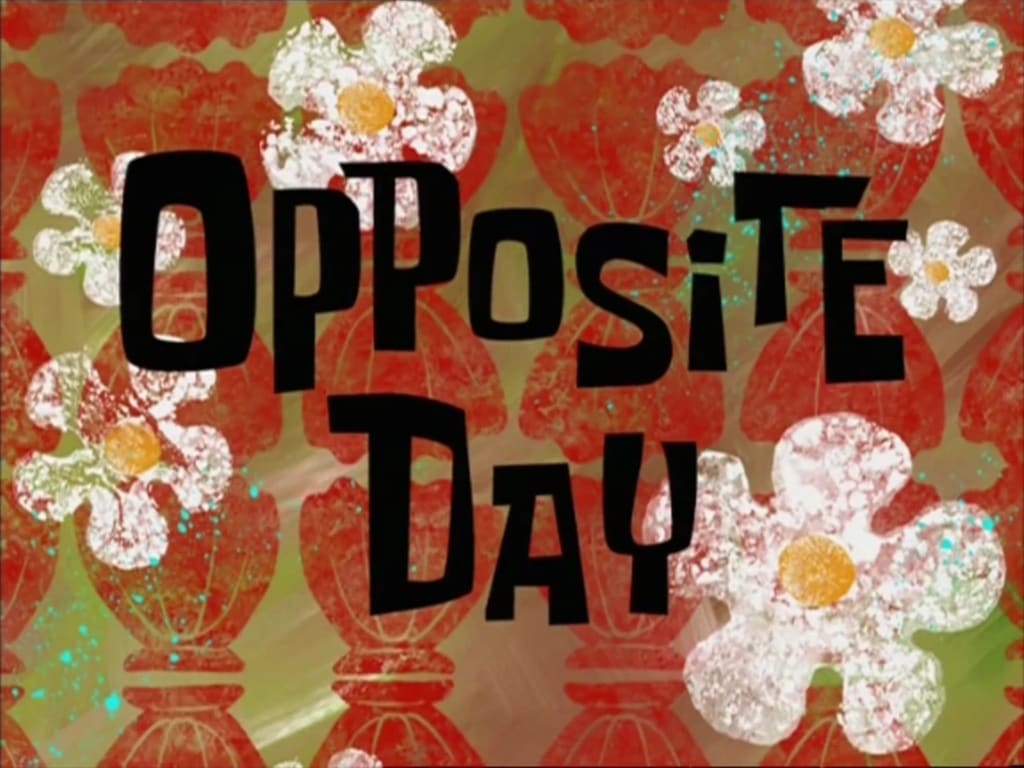
“SpongeBob SquarePants” aired its whimsical installment “Opposite Day,” an episode that flipped the familiar rhythm of Bikini Bottom on its head. The story opens with Squidward’s melodramatic proclamation that the town will observe “Opposite Day,” prompting an absurd inversion of everyday norms: whereas he is anything but grumpy and more cheerful than usual, while SpongeBob, ever the optimist, dutifully recites a litany of pessimistic affirmations. The episode’s premise, simple yet subversive, is framed by a rapid-fire dialogue that showcases the series’ hallmark wit, while its animation subtly accentuates the visual irony through exaggerated facial expressions and color palettes that shift from bright to muted tones as the day progresses.
The narrative arc follows SpongeBob’s participation in a social experiment that quickly spirals into chaotic anarchy. It begins as Spongebob and Patrick celebrate Squidward’s birthday, but it’s not his birthday. The next day, he calls Bikini Reality to sell his house but one of the requirements to do so is that his house does not have bad neighbors. He quickly thinks of "Opposite Day" to Spongebob who later brings it up to Patrick, who has trouble with it at first and they both pretend to be Squidward. Spongebob decides to fix, or in this case, destroy his house, prompting Squidward to fix it himself. Meanwhile, the realtor stops by Squidward’s house and is greeted by Spongebob, still pretending to be Squidward. Patrick joins in on the fun, telling her there are two Squidwards. But after the real Squidward fixes Spongebob’s house, he sees the realtor’s car outside his and he freaks out. He tells her he is the real Squidward but she doesn’t buy it and leaves. His plans to move are ruined and he chases both Spongebob and Patrick.
The episode delves into a commentary on conformity and dissent, employing the underwater setting as an allegorical stage for human behavioral studies. Notably, the script incorporates a meta‑textual moment in which the characters acknowledge the absurdity of their reversed roles, a device that both acknowledges the audience’s familiarity with the series and invites them to question the elasticity of identity within the cartoon’s canon. Critics have highlighted this self‑reflexivity as a sophisticated narrative technique rarely seen in children’s programming, noting its capacity to engage both younger viewers and nostalgic adults.
From a production standpoint, “Opposite Day” represents a convergence of classic hand‑drawn animation and contemporary digital polishing, a duality that mirrors the episode’s thematic dualism. The storyboard deliberately accentuates visual juxtaposition: scenes that would traditionally feature bright, saturated hues are rendered in desaturated blues and grays, while moments of “normal” behavior burst with the series’ signature neon vibrancy. Moreover, voice actor Tom Kenny’s performance as SpongeBob oscillates between his trademark high‑spirited optimism and an unusually subdued, almost sardonic tone, underscoring the episode’s tonal elasticity. Sound design also plays a pivotal role; background scores shift from buoyant, bouncy motifs to eerie, minimalist compositions whenever the “opposite” rule is invoked, reinforcing the viewers’ sense of disorientation while simultaneously providing an auditory cue for the episode’s structural beats.
The cultural resonance of “Opposite Day” extends beyond its initial airdate, having spurred a wave of internet memes, fan art, and scholarly discourse on the fluidity of narrative expectations in animated media. Social‑media analytics indicate that clips from the episode have amassed over 30 million views across platforms such as YouTube and TikTok, with particular emphasis on the scene in which SpongeBob earnestly declares, “I hate you, Patrick!”—a line that has become a shorthand for ironic affection in digital vernacular. Academic commentators have cited the episode in discussions of post‑modern humor, arguing that its deliberate subversion of character archetypes functions as a critique of the static tropes that have long defined Saturday‑morning cartoons. In sum, “Opposite Day” stands as a testament to the series’ enduring capacity to reinvent its own mythos, delivering a narrative that is simultaneously playful, incisive, and emblematic of the broader evolution of animated storytelling.
About the Creator
Forest Green
Hi. I am a writer with some years of experiences, although I am still working out the progress in my work. I make different types of stories that I hope many will enjoy. I also appreciate tips, and would like my stories should be noticed.
Keep reading
More stories from Forest Green and writers in Geeks and other communities.
SpongeBob Review
The episode "Nature Pants" opens with SpongeBob SquarePants experiencing a profound, almost spiritual crisis, violently rejecting the sanitized comforts of his pineapple home and the structured rhythms of Bikini Bottom. He becomes consumed by a romanticized, Rousseauian vision of primordial existence, believing his modern life with its fluffy pillows, fondue sets, and meticulously organized socks has corrupted his natural essence. A mishap while working at the Krustry Krab kitchen which was a fire that he had helped put out made him think about wanting more out of life. He quits his jobs and hands his possessions to his friends and leaves to live in Jellyfish Fields.
By Forest Greenabout 12 hours ago in Geeks
Goodbye, Mr. Duvall
It is turning out to be an interesting year. I was in the middle of teaching a class when a pop-up appeared on the screen announcing the death of Mr. Robert Seldon Duvall (yes, that was his full name). I was in the middle of a discussion on the obsession we have with winning when it comes to sports (the Winter Olympics was a theme), and I felt as though things were coming full circle. We had already lost Gene Hackman last year, and along with that titan, it feels though one particular golden age has closed off to be replaced by...?
By Kendall Defoe 4 days ago in Geeks
Book Review: "Agatha Christie" by Lucy Worsley (Pt.2)
This review covers chapter 13 through to the end of chapter 23. *** After the birth of her daughter, Rosalind - Agatha Christie seemingly sinks deep into domestic life. She learns to make foods, and the author makes a wry comment about how cooking was now considered too interesting for servants alone and how Virginia Woolf accidentally baked her wedding ring into a dish. Agatha Christie and Virginia Woolf were contemporaries yes, but they are two very different women. For example: Agatha Christie was not yet part of a great writing circle, whereas the richly born and richly married Woolf was part of the Bloomsbury Group. But nonetheless, Agatha Christie would continue to cook and write and yet, her husband was not too interested in her cooking at all.
By Annie Kapurabout 7 hours ago in Geeks
There's A Hole in My Bucket
It’s a well-known fact that Liza Dufresne was always the brains in the family. She was the one who always came up with the brilliant schemes the Dufresne kids carried out when they were younger. Like when they tricked Mrs. Claybourn into paying for a trip to Disney World. Liza convinced her that their parents had been kidnapped and were being held for ransom for the total price of three tickets. In reality, they were away on a weekend getaway for their anniversary. When they returned, Liza told the Claybourns that they did not like to talk about the ordeal. Their parents never found out how they got the money. Mrs. Claybourn never found out that the Dufresne parents were never really in any danger.
By David E. Perry2 days ago in Fiction

Comments
There are no comments for this story
Be the first to respond and start the conversation.