

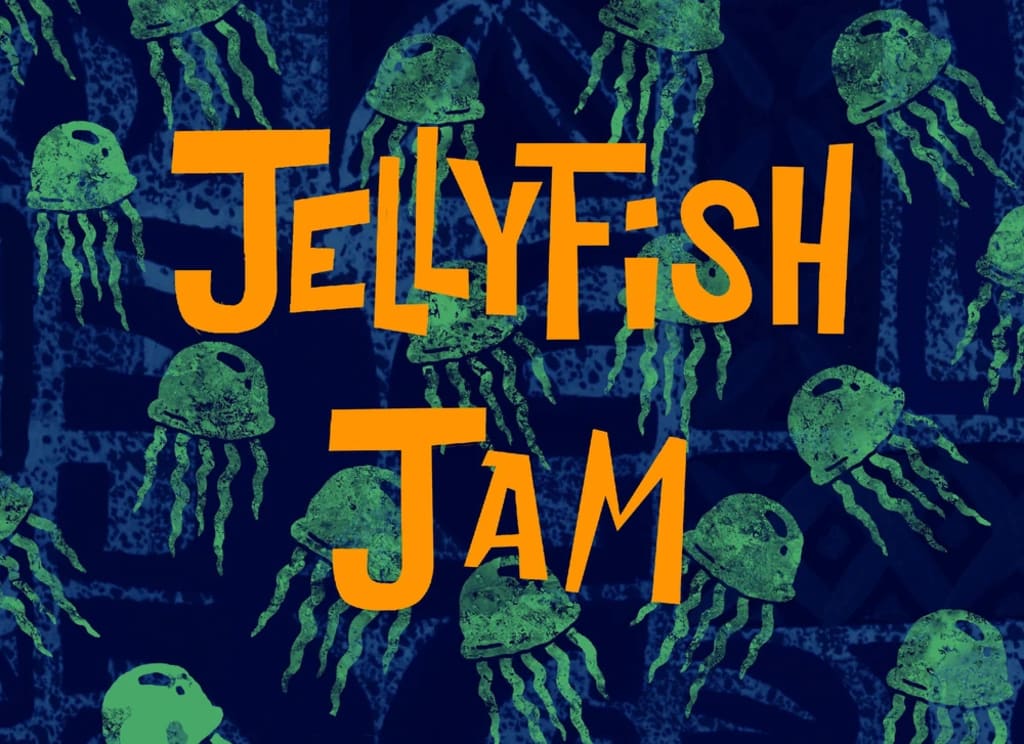
“Jellyfish Jam,” the second half the seventh episode of SpongeBob SquarePants’ first season, unfolds as a tightly woven narrative that juxtaposes the carefree exuberance of Bikini Bottom’s most beloved insect with the chaotic consequences of an unfiltered dreamscape. The episode opens with SpongeBob’s ordinary routine—blissfully chasing jellyfish after work—only to have his bliss disrupted when a sudden storm forces him to seek shelter in a nearby sea‑cave. Inside, a bolt of lightning flickers, the cavern’s natural acoustics reverberate, and SpongeBob drifts into a vivid, psychedelic slumber. In his dream, the jellyfish swarm becomes an electrified rave, complete with pulsating neon lights, a thumping bassline, and an endless loop of Jellyfish Jam‑style dancing. When SpongeBob awakens, the dream’s residue lingers in the real world, turning the mundane act of jellyfishing into an almost hallucinogenic marathon. The episode’s structure cleverly layers diegetic and non‑diegetic elements, allowing the audience to experience the same disorienting blend of reality and fantasy that SpongeBob does, thereby reinforcing the show’s core thematic preoccupation with the thin line between imagination and everyday life.
The episode shines brightest in its exploration of character dynamics, particularly the symbiotic relationship between SpongeBob and his jellyfish companions. SpongeBob’s unbridled enthusiasm is amplified by the jellyfish’s almost sentient responsiveness, turning them from simple background fauna into co‑protagonists that mirror his emotional trajectory. Meanwhile, Squidward’s role as the reluctant foil is executed with a precision that underscores his perennial disdain for SpongeBob’s hyperactive tendencies. His deadpan sarcasm—delivered in a gravelly timbre by Rodger Bumpass—acts as a counterbalance, grounding the episode’s increasingly surreal tone. Voice direction in this episode is notably meticulous: Tom Kenny’s vocal modulation captures SpongeBob’s oscillation between childlike giddiness and momentary bewilderment, while the jellyfish’s buzzing is rendered through layered sound design that evokes both a musical instrument and an otherworldly chorus, thereby elevating the creatures from mere plot devices to narrative agents.
From a visual standpoint, “Jellyfish Jam” is a masterclass in the series’ capacity for experimental animation within a conventional broadcast budget. The dream sequences employ a kaleidoscopic color palette—electric blues, pulsating magentas, and fluorescent greens—that starkly contrast with the more muted tones of Bikini Bottom’s everyday setting. This chromatic shift is not merely decorative; it visualizes SpongeBob’s altered mental state, with animated light flares and motion‑blur techniques that mimic the sensory overload of a rave. The animators also integrate a subtle but effective use of “squash‑and‑stretch” on the jellyfish, giving them a rhythmic elasticity that syncs with the episode’s central musical motif—a thumping electro‑pop track composed by the series’ longtime music director, Jeremy Wakefield. The soundtrack itself is a blend of synth arpeggios and percussive beats that echo the show’s iconic “Bubble Bass” theme while introducing a fresh, contemporary groove. The synchronization of visual beats with audio cues creates an immersive auditory‑visual experience that feels almost synesthetic, reinforcing the episode’s central premise that music can transform even the most ordinary activities—like jellyfishing—into a transcendent collective jam session.
Beyond its surface-level hilarity, “Jellyfish Jam” offers a nuanced commentary on the power of escapism and the communal nature of shared experiences. SpongeBob’s inadvertent induction of a dream‑induced party illustrates how individual joy can ripple outward, converting a solitary pastime into a public spectacle that brings together disparate characters—squid, starfish, and even the jellyfish in a spontaneous celebration of rhythm and movement. This thematic thread resonates with contemporary cultural trends around viral dance challenges and spontaneous flash mobs, positioning the episode as an early, albeit subconscious, reflection of the digital age’s fascination with collective, music‑driven experiences. Moreover, the episode’s blend of surrealism and heartfelt camaraderie has cemented its status among fans as a quintessential example of the show’s ability to balance absurdist comedy with genuine emotional depth. Critical reception at the time highlighted its inventive use of sound design and its willingness to push the boundaries of conventional children’s programming, and decades later, “Jellyfish Jam” continues to be cited in scholarly analyses of animation as an art form that can simultaneously entertain, innovate, and subtly critique societal proclivities toward escapist entertainment.
About the Creator
Forest Green
Hi. I am a writer with some years of experiences, although I am still working out the progress in my work. I make different types of stories that I hope many will enjoy. I also appreciate tips, and would like my stories should be noticed.
Keep reading
More stories from Forest Green and writers in Geeks and other communities.
Spongebob Review
The "Hall Monitor" episode of SpongeBob SquarePants has a simple yet classic premise: SpongeBob, having finally earned his hall monitor badge after an exhaustive test, is brimming with an almost terrifying enthusiasm for enforcing school rules. His transformation from cheerful fry cook to a rigid, power-drunk authority figure is instantaneous and absolute. He immediately begins patrolling the halls of the boating school with militaristic precision, his once-friendly demeanor replaced by a stern, pencil-pushing rigidity as he mercilessly issues citations for the most minor infractions, from improper shoe-tying to walking in a straight line. This rapid descent into bureaucratic tyranny sets the stage for the episode’s central chaos, showcasing how a good-natured character can become dangerously comical when given a tiny sliver of power, all while his friend Patrick looks on with bemused confusion.
By Forest Greenabout 14 hours ago in Geeks
Goodbye, Mr. Duvall
It is turning out to be an interesting year. I was in the middle of teaching a class when a pop-up appeared on the screen announcing the death of Mr. Robert Seldon Duvall (yes, that was his full name). I was in the middle of a discussion on the obsession we have with winning when it comes to sports (the Winter Olympics was a theme), and I felt as though things were coming full circle. We had already lost Gene Hackman last year, and along with that titan, it feels though one particular golden age has closed off to be replaced by...?
By Kendall Defoe 3 days ago in Geeks
The Art of War
I bought The Art of War because I was angry. Not at the world. At myself. I was stuck in a job I secretly resented, constantly frustrated, constantly reactive. Every meeting felt like a battlefield. Every disagreement felt personal. I kept losing arguments — not out loud, but internally. I would replay conversations in my head at night, thinking of better comebacks I never said.
By John Smith3 days ago in Geeks
Craft Over Catharsis Challenge Winners
Craft Over Catharsis? What the hell does that even mean? The phrase came out of a curation meeting as a genuine question. We had been noticing that many challenge entries, across prompts, naturally gravitate toward trauma, grief, and personal reckoning. That makes sense. Writing is often cathartic. It's one of the ways we process what we've lived through.
By Vocal Curation Teama day ago in Resources



Comments
There are no comments for this story
Be the first to respond and start the conversation.