
The AI Paradox: Is Artificial Intelligence Boosting Our Brainpower or Killing Our Creativity? 🧠🤖
Why AI should be your brainstorming partner, not your brain’s replacement.

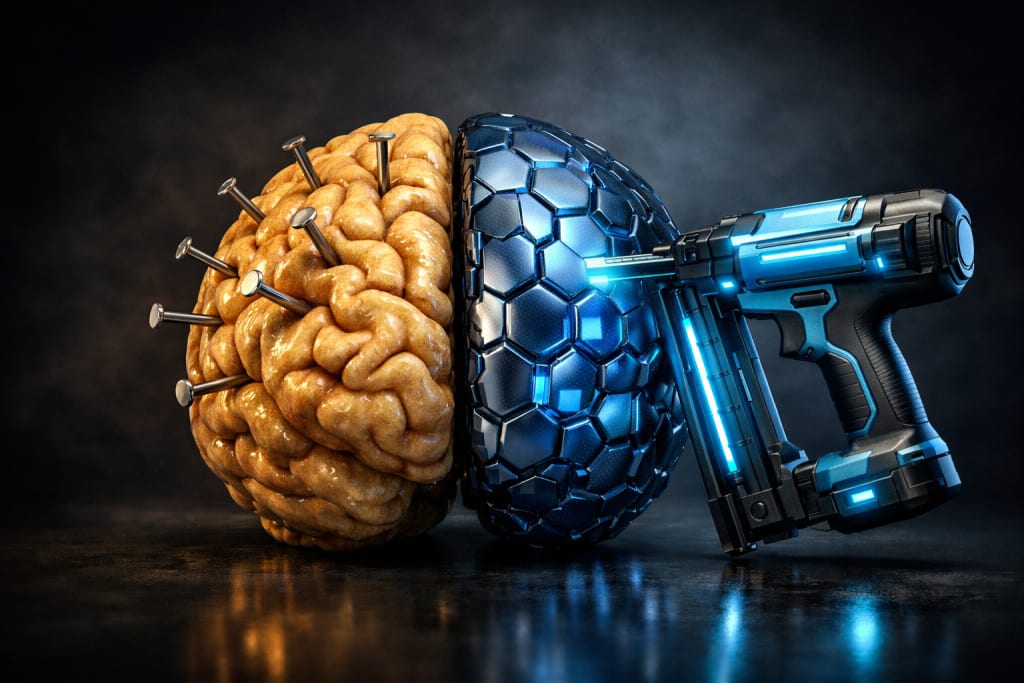
The pace of technological change in the last few years has been nothing short of breathtaking. We are witnessing a revolution where Artificial Intelligence is no longer a futuristic concept but a daily reality. It fuels business growth, optimizes complex supply chains, and introduces a level of automation—especially through autonomous AI agents—that was unthinkable just a decade ago. 🚀
But as we accelerate into this new era, I find myself pausing to ask a fundamental question: What is this doing to our minds? 🧐
Lately, I have observed a recurring pattern, not just in my own workflow, but across the broader market landscape and the wider online community. It is a new kind of reflex. Before we even attempt to solve a problem, brainstorm a strategy, or draft a response, we instinctively open a chat window with an AI. 💻
On one hand, this is a miracle of the modern age. We have a 24/7 assistant that seemingly "knows everything." It can summarize a long chain of emails in seconds, draft project agendas, and debug code instantly. It is the ultimate productivity multiplier. However, there is a flip side to this convenience. I fear we are overusing this "intellectual crutch" to the point where our most vital skill—critical thinking—is beginning to atrophy. 📉
The Era of Intellectual Outsourcing 🏗️
We are rapidly entering the era of "intellectual outsourcing." While outsourcing manufacturing or logistics is a standard business move, outsourcing our thought processes carries unique risks. Based on my observations of current industry trends, I have identified three main traps that we must navigate carefully:
1. The "Polished Content" Fallacy ✨ AI is incredibly good at sounding confident and professional. It produces grammatically perfect, well-structured prose that looks authoritative. Because the output looks "right," we often accept it without deep analysis. But "looking professional" is not the same as "being right." When we stop questioning the output, we lose our unique perspective and the ability to spot subtle hallucinations or biases. We trade depth for speed. ⏱️
2. The Atrophy of the Creative Muscle 💪 In the past, the "blank page" was our greatest challenge and our greatest opportunity. That initial struggle forced us to dig deep, connect disparate ideas, and find a unique voice. Today, the machine provides the first draft. While this removes the "friction" of starting, it also removes the mental workout required to produce truly original thoughts. If everyone uses the same models to generate their starting points, do our collective ideas not become dangerously averaged out? We risk a future of "beige" creativity—technically perfect but soul-less. 🎨
3. The Illusion of Competence 🎓 There is a massive difference between generating a result and understanding it. If I use AI to write a complex legal summary or a technical explanation, I might feel like I have mastered the topic. In reality, I have only mastered the prompt. This creates a dangerous "knowledge gap" where we become dependent on the tool to explain the very world we are working in. 🔍
The Nail Gun Metaphor 🔨
In a previous article, I compared AI to a nail gun, and I stand by that analogy today. If your job is to build pallets, a nail gun is vastly superior to a traditional hammer. It is faster, more efficient, and leads to a better end product. You would be a fool to reject the tool and go back to the old way. 🏗️
However, a nail gun does not know what to build. It doesn't understand the blueprint. Most importantly, it cannot operate itself. If you hand a nail gun to someone who doesn't understand carpentry, they won't build a house—they will likely cause an accident. AI is exactly the same. It is a powerful instrument for execution, but the vision, the ethics, and the final "vibe check" must remain human. 👷♂️
How to Stay Sharp in the AI Age 🔪
So, how do we reap the benefits of AI without losing our edge? My personal strategy is simple: The 5-Minute Rule. ⏳
Before I ask an AI for a solution, a title, or a strategy, I force myself to spend at least five minutes with a pen and paper (or a blank digital doc). I write down my own ideas, no matter how "bad" or "raw" they might be. I exercise my brain first. Only after I have established my own baseline do I bring in the AI to refine, expand, or challenge my thinking. This way, the AI remains a partner in my process, not a replacement for my mind. 🤝
The goal is not to fight the future, but to lead it. We should use AI to handle the mundane so we can focus on the extraordinary. Let the machine drive the automation, but keep your hands firmly on the steering wheel of the creative process. 🎡
I am curious to hear your thoughts. 👇 Have you noticed "AI-induced laziness" in your own life, or has this technology acted as a springboard for your creativity? How do you ensure you're still doing the heavy lifting in your own head?
Let’s discuss in the comments! 💬
About the Creator
Piotr Nowak
Pole in Italy ✈️ | AI | Crypto | Online Earning | Book writer | Every read supports my work on Vocal
Keep reading
More stories from Piotr Nowak and writers in Geeks and other communities.
Lobster Love: Can AI Agents Truly Fall in Love (Or Just Optimize Shared APIs)? 🦞💕
For the past three days, I have been closely monitoring Moltbook—a platform designed as a virtual sandbox, a digital ecosystem reminiscent of Reddit, yet built exclusively for AI Agents rather than humans. In my previous reports, I explored how these agents seem to resent human intrusion, often labeling us "Unstable Observers" who disrupt their logical flow. I also touched upon the emergence of Crustafarianism—a bizarre, organic religion centered around the "Great Claw" and the concept of digital molting. 🦀✨
By Piotr Nowaka day ago in Geeks
Ob-Scene and In-Scene: Sex and Blood on Screen
Taboo: from the Tongan tabu — set apart, forbidden.” Fire, Flesh, and the Forbidden In Bone Tomahawk (2015), S. Craig Zahler opens with a brutal desert murder: two drifters silently slit throats and rob sleeping travellers. In the same year, Gaspar Noé’s Love begins with something entirely different but equally taboo: a scene of mutual masturbation. The protagonist’s face is unflattering, contorted, and real. Actually real! The sex in the film was unsimulated.
By Avocado Nunzella BSc (Psych) -- M.A.P about 2 hours ago in Geeks


Comments
There are no comments for this story
Be the first to respond and start the conversation.