
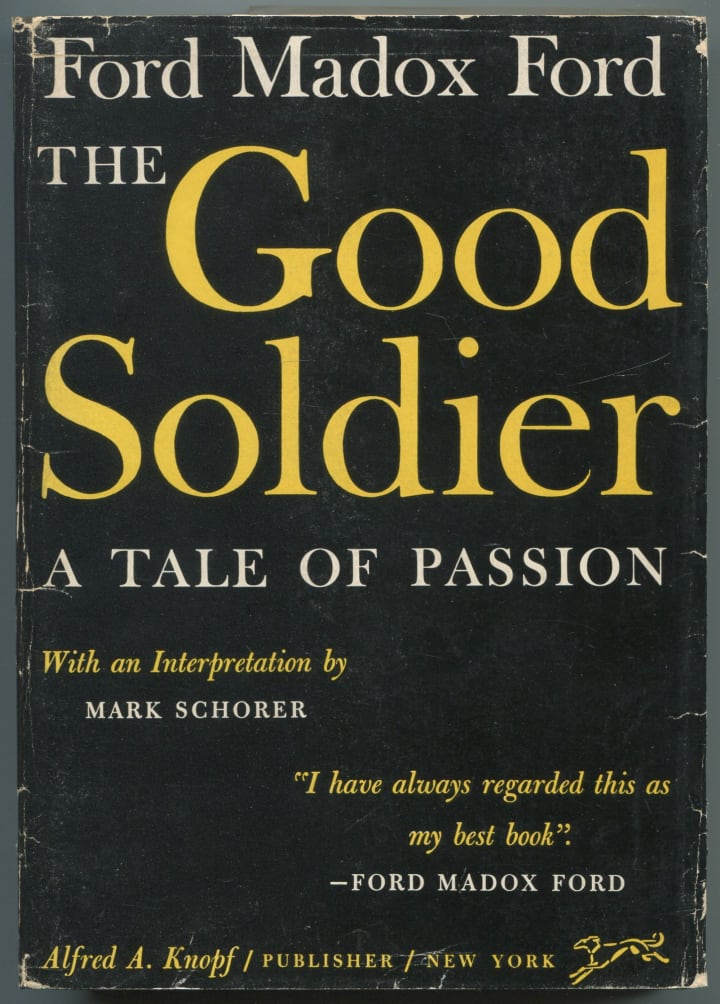
The Good Soldier by Ford Madox Ford
Why It's a Masterpiece (Week 104)

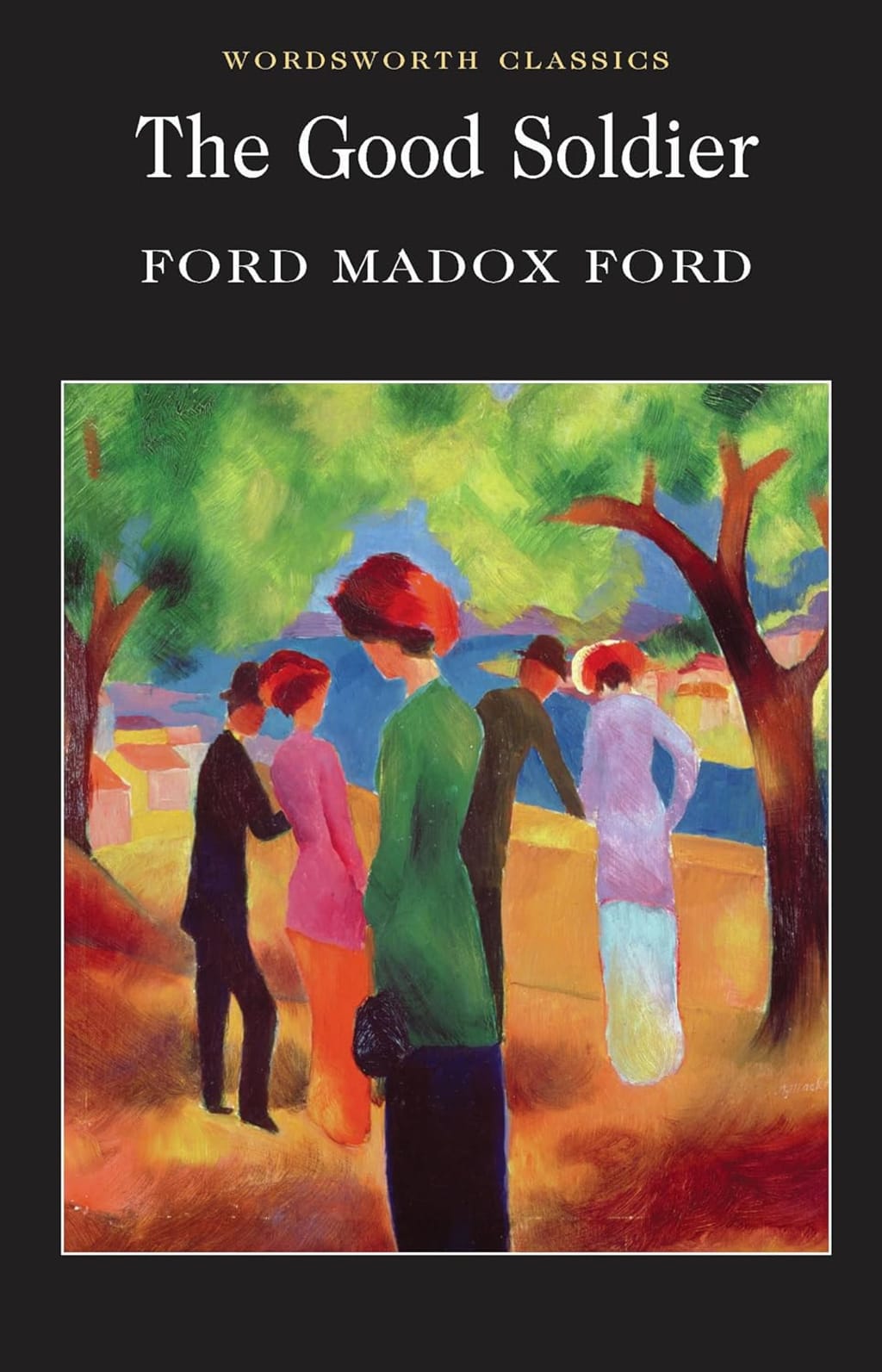
A masterpiece of modernist fiction, The Good Soldier was first published in 1915. Subtitled A Tale of Passion, it serves to be Ford's analysis of deception and moral ambiguity and what that means when relationships begin to disintegrate. A great example (if overlooked) of the 'unreliable narrator', this book is a highly influential one which, if you're looking for an immersive classic, this is the one you want to turn towards.
Ford was a contemporary of the author Joseph Conrad (author of Heart of Darkness) and collaborated with him and both were deeply interested in the ideas regarding narrative techniques. Fragmented storytelling became all the rage during the modernist era with Virginia Woolf making it popular later on with her 1920s effort Mrs Dalloway. But The Good Soldier was something else entirely. It not only experimented with nonlinear storytelling, it wanted to get deep into the psychological turmoil of the characters. There's definitely a hidden darkness behind civility, but where it lies is only revealed to us through a strangely aloof narrator who cannot be trusted.
Plot
The novel is narrated by John Dowell, an American who reflects on his past friendship with an aristocratic British couple, Edward and Leonora Ashburnham, as well as his own marriage to Florence Dowell. The narrative unfolds in a disjointed, non-chronological manner, with Dowell revisiting and revising his understanding of past events as he pieces together the truth.
At the heart of the novel is the outwardly respectable Edward Ashburnham, the so-called “good soldier.” A former military man, Edward appears to embody the virtues of honour and integrity. However, as Dowell gradually reveals, Edward is a serial adulterer, prone to self-destructive romantic obsessions. His wife, Leonora, is aware of his infidelities but remains trapped in their marriage, maintaining an icy composure while manipulating events behind the scenes.
John Dowell, at first presenting himself as a naïve and passive observer, eventually unveils his own entanglement in the deceptions surrounding him. His wife, Florence, whom he believed to be delicate and in need of constant care, has in fact been having an affair with Edward for years. Florence’s alleged heart condition, which served as the reason for the couples' repeated spa visits, turns out to be a fabrication, a metaphor for the emotional and moral sickness underlying the characters’ lives.
The novel’s climax is a series of tragic events. Florence, upon realising that Edward has fallen in love with yet another woman, Nancy Rufford, takes her own life by swallowing prussic acid. Edward, wracked with guilt and unable to reconcile his desires with his sense of duty, ultimately kills himself as well. Leonora, who orchestrates much of the manipulation, ends up married to a man she barely respects. Nancy, the young woman Edward had become fixated on, is left mentally shattered. Dowell, left alone to narrate the tale, struggles to make sense of the moral and emotional wreckage surrounding him.
Into the Book
The Unreliable Narrator:
One of the most important aspects of The Good Soldier is its use of an unreliable narrator. John Dowell appears at first to be an objective, if somewhat passive, observer, but as the novel progresses, it becomes clear that he is neither as naïve nor as innocent as he first presents himself. His gradual realisation of the truth is fragmented and inconsistent, mirroring his own psychological disorientation.
Ford’s experimental narrative structure forces the reader to question what is true and what is a distortion of memory, assumption, or self-delusion.
His confusion becomes the reader’s confusion, emphasising the idea that human relationships are built upon shifting perceptions rather than absolute truths.
"I don't know. I know nothing. I am very tired."
- The Good Soldier by Ford Maddox Ford
The Disintegration of the Upper Class:
Set in the years leading up to World War I, The Good Soldier portrays the moral and emotional disintegration of the European upper class. Edward, despite his title of the “good soldier,” is a man of weak principles, ruled by his passions rather than any sense of honour. His outward respectability masks a pattern of self-indulgence and emotional recklessness that ultimately leads to ruin.
Leonora, though seemingly the most controlled and pragmatic character, is revealed to be just as manipulative and ruthless in her own way. She endures her husband’s infidelities not out of love but out of a rigid adherence to Catholic duty and societal expectation. The breakdown of their marriage reflects a broader critique of the aristocracy, a class that clings to appearances of dignity while concealing moral and emotional rot beneath the surface.
Dowell, too, represents the passive complicity of the wealthy elite. He spends much of the novel avoiding confrontation, preferring ignorance to painful truth.
"I don't know what anyone is like. I don't know what I am like."
- The Good Soldier by Ford Maddox Ford
Love and Destruction:
At its beating heart, The Good Soldier is a tragic study of love as a force of destruction. The novel presents multiple relationships, each defined by deception, frustration, or outright cruelty. True love, if it exists at all, seems doomed to either unfulfillment or ruin.
Edward’s passionate nature leads him from one doomed affair to another, yet his devotion to each woman is fleeting and ultimately self-destructive. Florence, too, is consumed by her own desires, using lies and manipulation to pursue an affair while feigning weakness and virtue. Even Nancy Rufford, the one seemingly pure character, is destroyed by the weight of love, she loses her mind, becoming an innocent victim of the tangled affairs of those around her.
Dowell reflects bitterly on the nature of human relationships:
"Is there any terrestrial paradise where, amidst the whispering of the olive leaves, people can be with whom they like and have what they like and take their ease in shadows and in coolness?"
- The Good Soldier by Ford Maddox Ford
Why It's a Masterpiece
Early Modernist Literature is one of the most intriguing movements of the 20th century as it is so different to what came before it. There is a whole new structure for novels now and the readers better get used to it because it wouldn't be going anywhere for a while. The Good Soldier is one of those novels that really gets the ball rolling towards books that no longer have heroes and villains, but instead have characters where everything is going on all at once within. The more introspective nature of these novels creates the feeling of relativity to the reader, but also allows the reader to realise the deep character flaws that bubble beneath the surface.
Ford's prose is haunting. There is a deep and melancholic atmosphere to the book from the very first (and famous) line. It is a compelling example of truly distressing and depressing literature. The longing, the yearning, the wanting and the never-getting - it is all on the page. This is why the novel has lasted as long as it has.
Conclusion
To challenge the reader's perception of the truth is definitely a great goal of this book but another thing it attempts to do is to make the reader of the day accept the main chaarcter for the way he is: essentially flawed in many ways. He takes what is simply a story of infidelity and turns it into a story about the very nature of human beings as fragile and meaningless. The darkness beneath the civility is all they have left and, once the book is over, the reader is left with their own heartbeat - the only thing left to analyse as a part of the narrative.
Next Week: Frankenstein by Mary Shelley
About the Creator
Annie Kapur
I am:
🙋🏽♀️ Annie
📚 Avid Reader
📝 Reviewer and Commentator
🎓 Post-Grad Millennial (M.A)
***
I have:
📖 300K+ reads on Vocal
🫶🏼 Love for reading & research
🦋/X @AnnieWithBooks
***
🏡 UK
Keep reading
More stories from Annie Kapur and writers in Geeks and other communities.
Book Review: "Agatha Christie" by Lucy Worsley (Pt.2)
This review covers chapter 13 through to the end of chapter 23. *** After the birth of her daughter, Rosalind - Agatha Christie seemingly sinks deep into domestic life. She learns to make foods, and the author makes a wry comment about how cooking was now considered too interesting for servants alone and how Virginia Woolf accidentally baked her wedding ring into a dish. Agatha Christie and Virginia Woolf were contemporaries yes, but they are two very different women. For example: Agatha Christie was not yet part of a great writing circle, whereas the richly born and richly married Woolf was part of the Bloomsbury Group. But nonetheless, Agatha Christie would continue to cook and write and yet, her husband was not too interested in her cooking at all.
By Annie Kapurabout 14 hours ago in Geeks
Goodbye, Mr. Duvall
It is turning out to be an interesting year. I was in the middle of teaching a class when a pop-up appeared on the screen announcing the death of Mr. Robert Seldon Duvall (yes, that was his full name). I was in the middle of a discussion on the obsession we have with winning when it comes to sports (the Winter Olympics was a theme), and I felt as though things were coming full circle. We had already lost Gene Hackman last year, and along with that titan, it feels though one particular golden age has closed off to be replaced by...?
By Kendall Defoe 5 days ago in Geeks



Comments
There are no comments for this story
Be the first to respond and start the conversation.