
The Haunting Allure of Blue Eyed Girl
A haunting exploration of memory, myth, and the fragile truths we carry

Some films linger not because they are loud, spectacular, or drenched in special effects, but because they whisper to us long after the final frame fades out. Blue Eyed Girl is one of those rare cinematic experiences—a film that appears deceptively simple on its surface yet unravels into something far more haunting and emotionally intricate the deeper you wander into its world.
At its core, Blue Eyed Girl is a story about the shadows of memory: the pieces we cling to, the ones we bury, and the dangerous illusions born in the spaces between. Directed with feverish elegance and narrative restraint, the film blends psychological drama, folklore, and slow-burn suspense into an unsettling portrait of a young woman trying to reclaim the fragments of a life she can’t fully remember.
Though it functions as a mystery, Blue Eyed Girl operates more like a dream—a place where truth bends, identity blurs, and the past refuses to stay buried.
A Story Told in Echoes
Blue Eyed Girl follows Mira Dalton, a 23-year-old artist struggling with recurring nightmares and a series of unexplained memory gaps. After a breakdown forces her to return to her secluded childhood hometown, Mira becomes obsessed with uncovering the truth behind a girl who appears in her dreams: a blue-eyed child with a smile that is equal parts innocent and unnerving.
At first, Mira believes the visions are manifestations of trauma she’s tried—and failed—to forget. But subtle clues begin to surface: an old photograph burned at the edges, a recurring lullaby her mother refuses to explain, locals who bristle when the girl is mentioned.
The film’s first act plays heavily with ambiguity. Is the blue-eyed girl a symbol? A memory? A ghost? Or something far more sinister?
What makes Blue Eyed Girl so captivating is that it never rushes to answer. Instead, it lets Mira—and the audience—sit in the discomfort of not knowing. Time itself becomes slippery. Scenes unfold like recovered memories, stitched together with an eerie tenderness that hints at both longing and dread.
A Visual Language of Trauma
Visually, Blue Eyed Girl is a masterpiece of restraint. Rather than relying on jump scares or spectacle, the film builds unease through quiet details: a swing creaking in an empty playground, a smear of cobalt paint on a windowpane, the lingering close-ups on Mira’s eyes as they search for recognition in the faces around her.
The cinematography uses light almost as a character. In daylight, the town feels washed out, bleached of vitality—like a memory that has lost its sharpness. But at night, everything becomes hyperreal: shadows stretch too long, colors intensify, and mirrors warp the edges of rooms.
The motif of blue recurs throughout the film—the color of the girl’s eyes, the ocean near Mira’s childhood home, the paint she obsessively uses in her artwork. Blue becomes a symbol of both clarity and concealment, truth and illusion. The film uses it to blur the boundary between who Mira was, who she is, and who she fears she may become.
It’s this visual intentionality that elevates Blue Eyed Girl beyond the familiar rhythms of psychological thrillers. Every frame feels like it hides a meaning—or a memory—just out of reach.
A Study of Grief, Identity, and Inherited Silence
Though the film features mystery and elements of folklore, Blue Eyed Girl is ultimately a story about the messiness of grief and the silence that families often carry for generations. Mira’s return home is not a journey triggered by a single trauma, but by the accumulation of many—losses her family never confronted, truths they twisted into myths, and the heavy burden of protection that often does more harm than good.
Her mother, Elise, is one of the film’s most complex characters. Played with devastating subtlety, she is both fiercely protective and frustratingly evasive. She wants to shield Mira from a truth she believes will destroy her, yet her secrecy becomes the very thing pulling Mira deeper into the darkness.
The film asks difficult questions:
- How much truth can a person bear?
- Is forgetting an act of mercy or an act of erasure?
- What happens when the stories we’re told to protect us become cages?
Instead of providing easy answers, Blue Eyed Girl allows its characters—and its audience—to sit with the pain of ambiguity. Healing isn’t depicted as a cinematic breakthrough, but as a slow, uneven, deeply personal process.
The Blue-Eyed Girl Herself
The titular blue-eyed girl remains a spectral presence for much of the film, appearing only in flashes—standing by a cliff, humming, staring through the cracks of a door. Her stillness is what makes her terrifying; her presence is both gentle and uncanny, like a child caught between worlds.
Without giving away the film’s central twist, the blue-eyed girl is not one thing—she is many. She is innocence and danger, memory and myth, truth and hallucination. She is the embodiment of Mira’s fractured past and the key to unlocking the darkness that has shaped her life.
By the time the film reveals who she truly is, the revelation feels both shocking and inevitable. It’s the kind of twist that doesn’t rely on gimmick but on emotional resonance—one that reframes everything we thought we knew while deepening the tragedy at the story’s heart.
Why Blue Eyed Girl Stays With You
Some films end. Blue Eyed Girl haunts.
It lingers because it taps into something universal: the fear that our memories might lie to us, and the equal fear that they might not. It captures the way trauma distorts time, the way grief warps relationships, and the way truth can be both liberating and devastating.
The film is not for viewers seeking fast-paced thrills. It’s for those who appreciate cinema that unravels slowly, thoughtfully, and with emotional precision. Its power comes from its quietness—its willingness to sit in the tension between memory and myth.
The final shot, in particular, is one that viewers will debate long after leaving the theater. It’s a moment that doesn’t offer closure so much as possibility—a reminder that healing is not a destination but an ongoing negotiation with the past.
A Modern Psychological Folk Tale
In the end, Blue Eyed Girl feels like a modern folklore wrapped in psychological realism. It blends the supernatural with the deeply human, the symbolic with the literal. Like the best myths, it uses the fantastical to tell the truth about the wounds we carry and the stories we build to survive them.
It is a film about remembering—not just what happened, but who we are when the stories fall apart.
And maybe that is why Blue Eyed Girl resonates so deeply. It reminds us that even when the past casts its longest shadows, there is beauty in the act of searching—of choosing to face what haunts us, even when the truth is the last thing we want to see.
About the Creator
Keep reading
More stories from James S Pope and writers in Geeks and other communities.
Nancy Guthrie: Is a miracle still possible after close to two weeks?
Close to two weeks since Nancy Guthrie's abduction As of February 12, 2026, Nancy Guthrie remains classified as missing for 12 days, but there is no official confirmation that she is deceased. Blood matching Guthrie’s DNA was found on her front porch, indicating she likely suffered an injury during the abduction.
By Cheryl E Preston4 days ago in Geeks
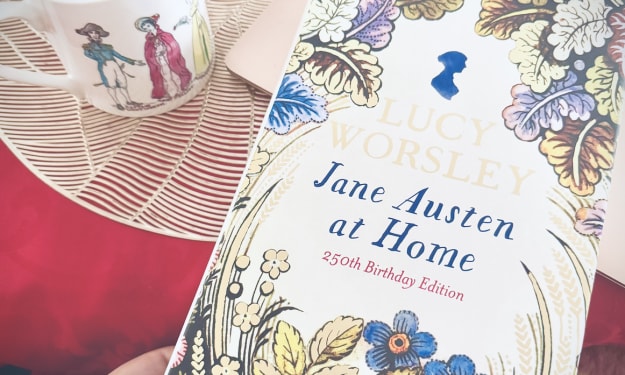
"Jane Austen at Home" by Lucy Worsley (Pt.3)
This review covers chapters 19 through to 26. *** As we continue through the story of Jane, Lucy Worsley gives us something to chew on. We get the story of the first writing of my personal favourite Austen novel, Northanger Abbey - originally entitled Susan. The 'chewing' is to decide exactly when it was being forged. There are known bursts of it in 1798 and 1799, but as the author states, there is certain inspiration from another book that wasn't published until 1801. It is a direct representation that though we may know much about Jane Austen's life from her letters, her everyday mapped out for us, her dislikes and likes seen clearly - we still don't really have the minutae of her writings. It is a bit here and there. Again, maybe this was done on purpose. Jane Austen was clever enough to keep those who didn't need to know in the dark about her actual intentions for the writings and when they were held out.
By Annie Kapur2 days ago in Geeks



Comments
There are no comments for this story
Be the first to respond and start the conversation.