
Today’s NYT Connections Hints, Answers & Strategy Guide for February 16, 2026 (#981)
Here are some hints and the answers for the NYT Connections puzzle for Feb. 16 #981.

If you’re searching for Today’s NYT Connections hints and answers for February 16 (#981), you’re in the right place. This puzzle features a clever mix of wordplay, sound-based connections, and psychological triggers that may have caught even experienced players off guard.
Whether you’re stuck on one tricky group or just want to double-check your results, here’s a complete breakdown of today’s puzzle — including category hints, full answers, explanations, and strategy insights to help you improve your game.
________________________________________
What Is NYT Connections?
For anyone new to the game, NYT Connections is a daily word puzzle from The New York Times. Each puzzle presents 16 words. Your goal? Sort them into four groups of four based on a shared theme.
The challenge lies in misdirection. Many words seem like they belong together — but only one combination is correct per category.
The categories are color-coded by difficulty:
• Yellow – Easiest
• Green – Moderate
• Blue – Challenging
• Purple – Hardest (often abstract or unexpected)
Puzzle #981 leans heavily on sound-based clues and subtle semantic shifts — especially in the Green and Purple categories.
________________________________________
NYT Connections Hints for February 16, 2026 (#981)
If you want a nudge without seeing the full solution yet, here are spoiler-free hints for today’s groupings:
• 🟡 Yellow Group Hint: That joke was hilarious!
• 🟢 Green Group Hint: Same sound, different spelling.
• 🔵 Blue Group Hint: Think farmyard noises.
• 🟣 Purple Group Hint: How people react under pressure.
If you’re still stuck, keep reading for the full breakdown.
________________________________________
Today’s NYT Connections Answers for Feb. 16 (#981)
Here are the official groupings and explanations.
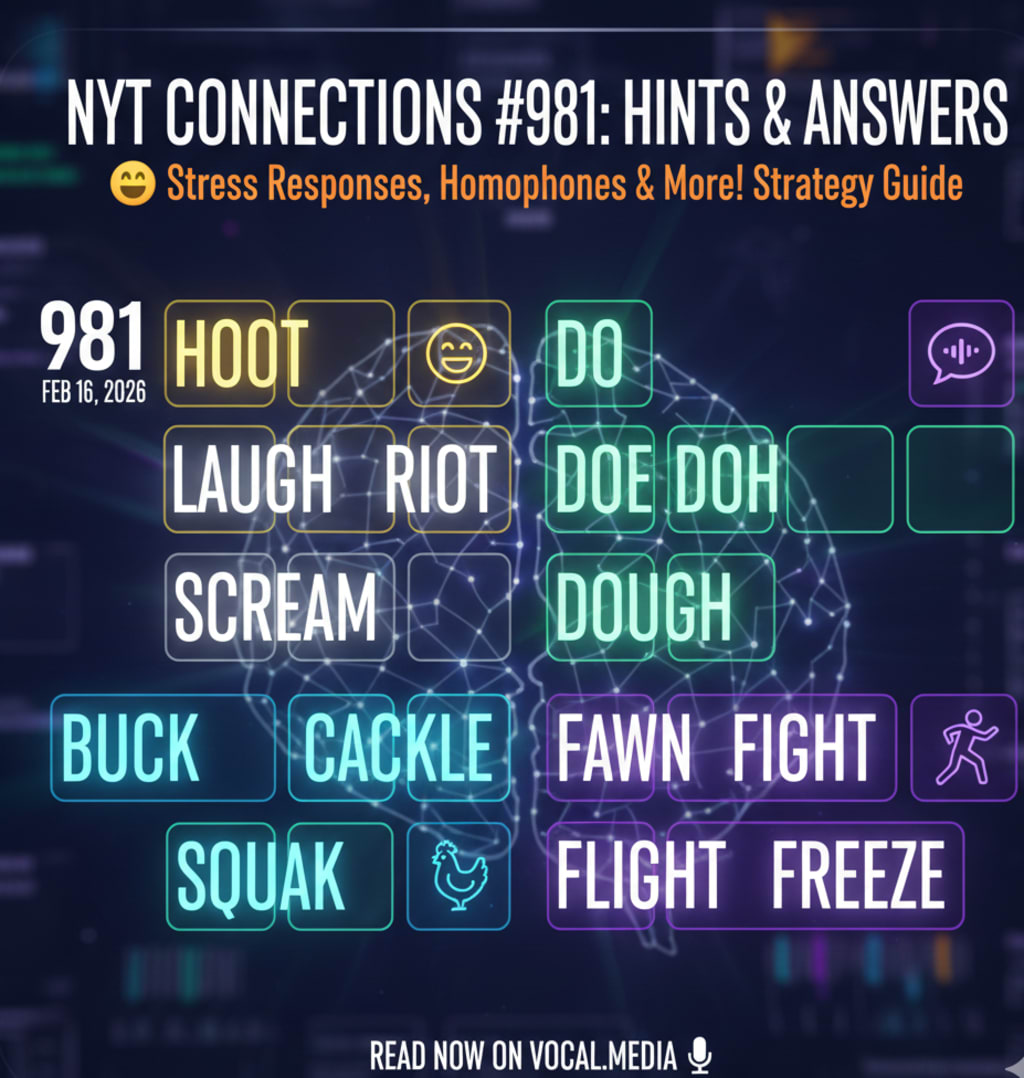
🟡 Yellow Group – Knee Slapper
Answers:
Hoot
Laugh
Riot
Scream
Why This Works:
All four words describe something extremely funny. If a movie is “a riot” or “a scream,” it’s hilarious. A “hoot” also means something amusing, and “laugh” is self-explanatory.
This was the most straightforward category today — once you spotted the comedy theme.
________________________________________
🟢 Green Group – Homophones
Answers:
Do
Doe
Doh
Dough
Why This Works:
Each word sounds the same but has a different meaning and spelling — making them homophones.
• Do – to perform
• Doe – a female deer
• Doh – Homer Simpson’s catchphrase
• Dough – bread mixture or slang for money
This category required listening more than reading. It’s a classic Connections trap: words that look unrelated but share pronunciation.
________________________________________
🔵 Blue Group – Sounds a Chicken Makes
Answers:
Buck
Cackle
Cluck
Squawk
Why This Works:
These are all vocalizations associated with chickens.
• Cluck – the classic chicken sound
• Cackle – loud hen noise
• Squawk – harsh bird cry
• Buck – less obvious, but used in poultry contexts
This group may have been tricky because “buck” commonly relates to deer or money, creating misdirection.
________________________________________
🟣 Purple Group – Stress Responses
Answers:
Fawn
Fight
Flight
Freeze
Why This Works:
These represent the four primary biological stress responses:
1. Fight
2. Flight
3. Freeze
4. Fawn
Most players know the first three. “Fawn” is the newer psychological addition — referring to people-pleasing behavior in response to trauma or stress.
This was likely the toughest category because:
• The words don’t visually resemble one another.
• The theme is psychological rather than literal.
• “Fawn” can easily be mistaken for the deer-related homophone group.
________________________________________
Why Puzzle #981 Was Tricky
Today’s difficulty came from cross-category bait:
• Doe and Fawn both relate to deer.
• Laugh and Cackle could both suggest humor.
• Buck overlaps animal and money themes.
Connections puzzles often rely on this type of intentional misdirection. The goal is to tempt you into grouping words based on surface-level associations.
The key is asking:
“Is this the most precise connection possible?”
If the theme feels vague, it’s probably wrong.
________________________________________
Strategy Tips to Improve at NYT Connections
If you struggled today, here are practical tactics to sharpen your skills:
1. Say the Words Out Loud
Sound-based categories (like homophones) become much easier when spoken.
2. Watch for Overlapping Meanings
If a word fits two possible groups, pause. It likely belongs to the more specific category.
3. Identify Obvious Sets First
Secure the Yellow group early. It reduces mental clutter.
4. Look for Abstract Themes in Purple
Purple groups often relate to:
• Psychological concepts
• Wordplay
• Cultural references
• Hidden patterns
________________________________________
Some of the Toughest Connections Puzzles So Far
If you enjoy challenging brain teasers, here are a few of the most notoriously difficult past categories:
#5 – “Things You Can Set”
Included: Mood, Record, Table, Volleyball
#4 – “One in a Dozen”
Included: Egg, Juror, Month, Rose
#3 – “Streets on Screen”
Included: Elm, Fear, Jump, Sesame
#2 – “Power ___”
Included: Nap, Plant, Ranger, Trip
#1 – “Things That Can Run”
Included: Candidate, Faucet, Mascara, Nose
These puzzles show how broad themes can mask surprisingly tight connections.
________________________________________
Why NYT Connections Is So Addictive
Unlike Wordle, which focuses on vocabulary deduction, Connections tests pattern recognition and cognitive flexibility. It forces players to:
• Shift perspectives
• Abandon incorrect assumptions
• Recognize semantic nuance
• Balance logic with intuition
That blend of logic and psychology makes it uniquely satisfying — and occasionally maddening.
________________________________________
Final Thoughts on Today’s Puzzle
NYT Connections #981 delivered a clever mix of humor, phonetics, animal sounds, and psychology. The Purple “stress responses” category likely separated casual players from seasoned solvers.
If you solved it without mistakes — congratulations. If not, don’t worry. The best way to improve is consistency. Patterns start repeating over time.
Be sure to check back tomorrow for the next round of hints, strategies, and answers.
Until then — keep grouping wisely.
About the Creator
Adil Ali Khan
I’m a passionate writer who loves exploring trending news topics, sharing insights, and keeping readers updated on what’s happening around the world.
Keep reading
More stories from Adil Ali Khan and writers in Geeks and other communities.
Harry Potter villain becomes a new-year mascot in China
As the Year of the Horse approaches, an unexpected and whimsical face has emerged across China’s Lunar New Year festivities: none other than Harry Potter’s infamous teen villain, Draco Malfoy. Known worldwide as the privileged, sly Slytherin student who rivaled Harry Potter at Hogwarts, Malfoy is now bringing a very different kind of magic—good fortune—to celebrants in China.
By Adil Ali Khan2 days ago in Geeks
Nancy Guthrie: Is a miracle still possible after close to two weeks?
Close to two weeks since Nancy Guthrie's abduction As of February 12, 2026, Nancy Guthrie remains classified as missing for 12 days, but there is no official confirmation that she is deceased. Blood matching Guthrie’s DNA was found on her front porch, indicating she likely suffered an injury during the abduction.
By Cheryl E Preston4 days ago in Geeks
Emerald Fennell Defends Her Changes to Wuthering Heights: “You’ve Got to Make Those Hard Decisions”
Director and screenwriter Emerald Fennell has defended her creative choices in adapting the literary classic Wuthering Heights, arguing that modern film audiences require bold interpretation rather than strict loyalty to the original text. Fennell, known for her distinctive visual style and emotionally complex storytelling, has faced growing criticism from literary purists after early details emerged about her forthcoming film version of the 1847 novel. Changes to character structure, dialogue, and narrative focus have prompted debate about whether the adaptation strays too far from Emily Brontë’s dark and tragic romance. Speaking in a recent interview, Fennell said that adapting a revered novel comes with inevitable controversy. “You’ve got to make those hard decisions,” she explained. “Film is a different language. What works on the page doesn’t always work on screen, and if you want the story to live again, you have to reimagine it.” A Bold New Interpretation According to production insiders, Fennell’s version of Wuthering Heights places greater emphasis on psychological trauma and power dynamics between the central characters, rather than the traditional gothic romance tone. Some scenes have reportedly been condensed or restructured, and certain minor characters have been removed altogether. The director has also shifted narrative perspective, focusing more closely on the inner world of Catherine Earnshaw rather than relying on the layered storytelling framework of the novel, which uses multiple narrators. Fennell said this decision was essential to connect with contemporary viewers. “The novel is incredibly modern in its emotional violence,” she said. “But the way it’s told is distant and formal. I wanted to bring the audience right inside the characters’ minds — to feel their rage, obsession, and grief in a visceral way.” Critics and Fans Divided Reaction to the changes has been sharply divided. Some literary scholars argue that altering the structure risks losing the unique voice of Emily Brontë’s original work. “This is a novel built on storytelling within storytelling,” said one university literature professor. “Removing that framework may simplify the plot, but it also strips away its moral complexity.” Fans on social media have also voiced concern, particularly over rumors that certain iconic scenes have been modernized or shortened. However, others welcome the director’s willingness to take risks. “Every generation needs its own Wuthering Heights,” wrote one film critic. “If we keep remaking it exactly the same way, it becomes a museum piece instead of a living story.” The Pressure of a Classic Fennell acknowledged that adapting one of the most studied novels in English literature brings enormous pressure. “You’re standing on the shoulders of a giant,” she said. “But you’re also responsible for creating something that stands on its own. Otherwise, why make the film at all?” She compared her approach to past reinterpretations of Shakespeare and Jane Austen, arguing that fidelity to emotional truth matters more than literal accuracy. “The spirit of the book is about obsession, cruelty, and love that destroys people,” she said. “That’s what I’ve protected. The rest is scaffolding.” Casting and Visual Style The production has drawn attention for its unconventional casting choices and stark visual design. Fennell has reportedly chosen a darker, more minimalist aesthetic than previous adaptations, with bleak landscapes and intimate close-ups replacing the sweeping romantic imagery traditionally associated with the story. Sources close to the project say the film will highlight class conflict and emotional isolation, themes Fennell believes resonate strongly in today’s society. “This is a story about outsiders,” she noted. “About what happens when people are denied dignity and belonging. That feels painfully current.” A Broader Debate About Adaptation The controversy reflects a wider debate in the film industry about how much freedom directors should take when adapting literary classics. In recent years, filmmakers have increasingly reworked famous novels to reflect modern values and perspectives, sometimes provoking backlash from traditionalists. Film historian Mark Reynolds said Fennell’s defense highlights the tension between preservation and innovation. “Some viewers want historical authenticity; others want relevance,” he said. “Both are valid. The challenge is finding a balance that honors the original while speaking to a new generation.” Looking Ahead Despite the criticism, studio executives remain confident in the project, pointing to Fennell’s previous successes and her reputation for fearless storytelling. The film is scheduled for release next year and is already expected to spark intense discussion upon its debut at major film festivals. Fennell says she welcomes debate. “If people argue about it, that means they care,” she said. “That’s a good thing. Emily Brontë wrote a story that refuses to be quiet. I hope this film does the same.” As anticipation grows, the director stands firm in her belief that adaptation is an act of interpretation, not imitation. “You can’t please everyone,” she added. “But you can be honest to the story you’re telling. And sometimes that means changing things.” Whether audiences embrace her vision or reject it, Fennell’s Wuthering Heights is already proving that classic literature still has the power to provoke passion nearly two centuries after it was first published.
By Fiaz Ahmed 3 days ago in Geeks




Comments
There are no comments for this story
Be the first to respond and start the conversation.