
Top Features Investors Demand in DeFi Staking Platforms in 2026
A Comprehensive Guide to Building Secure, Scalable, and Investor-Ready DeFi Staking Platforms in 2026

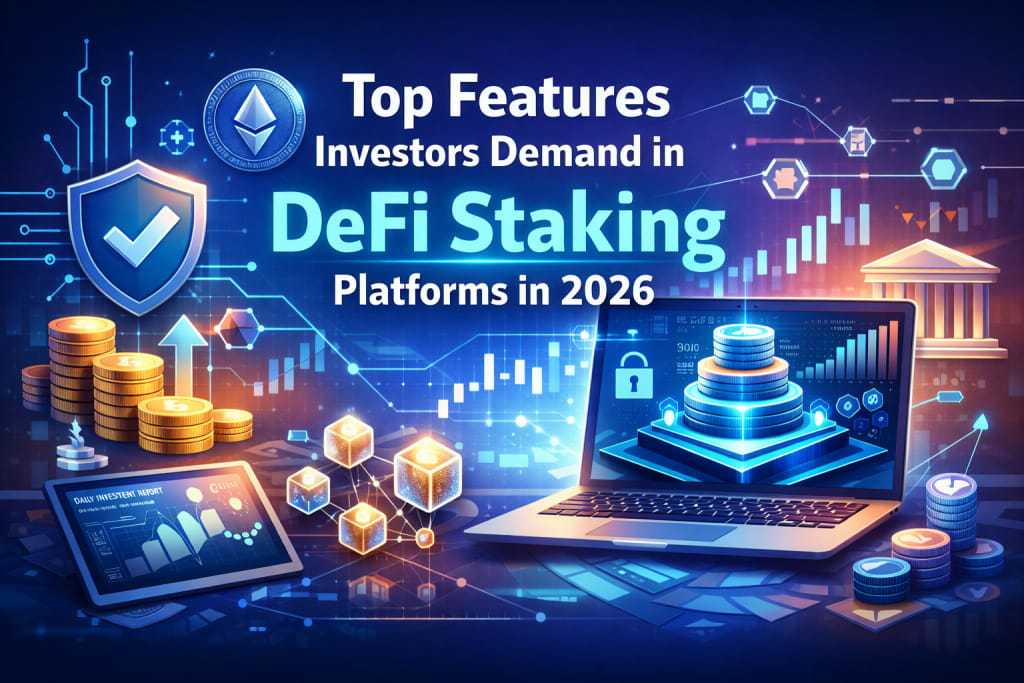
Decentralized Finance (DeFi) has evolved far beyond its early experimental phase. What once revolved around aggressive yield farming and speculative token emissions has matured into a sophisticated ecosystem of structured yield strategies, institutional participation, and infrastructure-grade staking solutions. In 2026, DeFi staking is no longer just a way to earn passive income it has become a critical pillar of blockchain network security and digital asset portfolio management.
As the market matures, investor expectations have shifted dramatically. High APYs alone no longer attract serious capital. Instead, investors ranging from retail participants to hedge funds and digital asset managers prioritize platforms that demonstrate strong security, capital efficiency, real-time risk management, cross-chain functionality, and user-centric design.
This blog explores what DeFi staking is, why it continues to gain popularity in 2026, and most importantly, the top features investors demand before committing their capital.
What Is DeFi Staking?
DeFi staking refers to the process of locking digital assets into smart contracts to support blockchain network operations or decentralized protocol mechanisms in exchange for rewards. In Proof-of-Stake (PoS) blockchains, staked tokens help validate transactions, secure the network, and maintain consensus. In return, participants earn staking rewards, typically derived from transaction fees and network emissions.
However, staking in 2026 is far more advanced than the simple “lock and earn” model of earlier years. Modern DeFi staking platforms now integrate:
Liquid staking mechanisms that issue derivative tokens representing staked assets
- Automated reward compounding
- Multi-chain staking dashboards
- Restaking opportunities for enhanced yield
- Risk monitoring and insurance integration
Staking has evolved into a flexible yield infrastructure layer that allows investors to generate returns while maintaining strategic control over liquidity and exposure.
Why Are DeFi Staking Platforms Gaining Popularity in 2026?
Reliable Source of Passive Income
In volatile crypto markets, staking offers a relatively stable yield compared to trading or speculative token strategies. While returns vary by network and protocol, staking provides a structured way to generate income from long-term holdings.
Investors appreciate the predictability of staking rewards, especially when platforms provide transparent reward models and historical performance analytics. In a market where price volatility remains high, yield consistency is a powerful draw.
Flexibility Through Liquid Staking
One of the most transformative innovations in staking has been liquid staking. Instead of locking tokens entirely, investors receive liquid staking tokens (LSTs) representing their staked position.
This allows capital to remain productive. Investors can:
- Use LSTs as collateral in lending protocols
- Provide liquidity in decentralized exchanges
- Participate in yield strategies while still earning staking rewards
This dual-earning structure increases capital efficiency and makes staking far more attractive to sophisticated investors.
Rising Institutional & Long-Term Investor Participation
Institutional participation in DeFi staking has grown steadily due to improvements in custody solutions, compliance frameworks, and risk modeling tools. Asset managers now view staking as a legitimate yield-generating strategy within diversified crypto portfolios.
Institutional investors typically require:
- Transparent governance structures
- Qualified custodian integrations
- Segregated accounts
- Clear tax reporting mechanisms
- Robust audit documentation
Platforms that meet these criteria are seeing significantly larger capital inflows.
Improved Security & User Experience
Security incidents in earlier DeFi cycles led to significant losses and forced platforms to strengthen their infrastructure. By 2026, investors expect multiple audits, bug bounty programs, formal verification processes, and real-time monitoring systems.
Simultaneously, user interfaces have become more intuitive. Clear reward dashboards, transparent fee breakdowns, and simplified staking workflows reduce friction and improve adoption. In a competitive market, usability is no longer optional it is essential.
Lower Entry Barriers & Global Accessibility
DeFi staking platforms reduce many traditional barriers to participation. Investors can stake assets without relying on centralized intermediaries, and minimum staking thresholds have decreased in many ecosystems.
This accessibility expands participation globally, strengthening network decentralization while increasing total value locked (TVL) across staking platforms.
Governance Participation
Staking often grants governance rights. Token holders can vote on proposals that influence protocol upgrades, emission schedules, validator selection, and treasury allocations.
For long-term investors, governance participation is crucial. It provides influence over the direction of the ecosystem and ensures alignment between capital providers and protocol development.
Integration with the Broader DeFi Ecosystem
Modern staking platforms are no longer isolated yield products. They integrate seamlessly with lending markets, liquidity pools, derivatives platforms, and structured yield vaults.
This composability transforms staked assets into financial building blocks, allowing investors to build diversified and optimized strategies within a unified ecosystem.
What Investors Demand in a DeFi Staking Platform
As staking matures, investor demands have become more precise. Below are the core features that platforms must offer to remain competitive in 2026.
Cross-Chain Staking
The blockchain landscape is inherently multi-chain. Investors rarely concentrate exposure in a single network. As a result, cross-chain staking support has become a highly sought-after feature.
Platforms offering unified dashboards for staking across multiple networks provide convenience and portfolio-level visibility. However, investors also evaluate how cross-chain integrations are implemented.
They look for:
- Minimal reliance on risky bridges
- Native chain integrations
- Transparent per-chain risk reporting
- Isolated exposure structures
Diversification reduces network-specific risk, but only if infrastructure remains secure.
Modular Reward Engine
A modular reward engine allows staking platforms to adapt their reward structures without destabilizing the ecosystem. Investors value flexibility, especially when it comes to adjusting emission rates, lock-up durations, performance tiers, or validator incentives.
This adaptability supports long-term sustainability. Platforms that rely solely on fixed emission models may struggle during market downturns. A modular structure ensures reward models can evolve alongside network growth and economic conditions.
Transparency in reward calculations is equally important. Investors demand clarity on how yields are generated, distributed, and adjusted over time.
Real-Time Risk Monitoring
Risk awareness is now central to staking decisions. Investors want access to real-time data on validator uptime, slashing exposure, liquidity conditions, and reward fluctuations.
Advanced platforms provide:
- Validator performance dashboards
- Slashing probability metrics
- Reward variance tracking
- Stress-testing simulations
These tools empower investors to make data-driven decisions rather than relying on marketing claims. In a maturing ecosystem, transparency builds trust.
Automated Liquidity Tools
Automation enhances capital efficiency and reduces operational overhead. Investors increasingly favor platforms that offer automated reward compounding, portfolio rebalancing, and liquidity routing.
Automation helps maintain optimal yield strategies while minimizing manual intervention. However, sophisticated investors also expect transparency and control. Automated systems should clearly explain how funds are allocated and allow users to customize parameters.
The goal is efficiency without sacrificing clarity.
Simple & Intuitive UX
User experience is often underestimated in technical discussions, but it directly impacts adoption and retention. Even institutional users prefer clean interfaces, detailed dashboards, and straightforward workflows.
Key UX elements investors expect include:
- Clear lock-up and unstaking timelines
- Transparent fee structures
- Real-time reward tracking
- Transaction previews before confirmation
- Comprehensive documentation
Complexity should exist in the backend, not the frontend. A well-designed interface reduces errors and builds confidence.
Conclusion
The evolution of DeFi staking in 2026 reflects a broader maturation of the digital asset ecosystem, where investors prioritize security, transparency, capital efficiency, and sustainable reward models over short-term yield spikes. Modern platforms must deliver cross-chain functionality, real-time risk monitoring, modular reward engines, automated liquidity management, and seamless user experiences to attract both retail and institutional capital. As competition intensifies, success will depend on building an infrastructure that is resilient, compliant, and adaptable to regulatory and market changes. Ultimately, forward-thinking DeFi Staking Platform Development is no longer just about enabling staking it is about architecting scalable, secure, and investor-centric financial infrastructure that can support the next generation of decentralized finance.
About the Creator
Henry james
A specialist in blockchain token development, focusing on secure smart contract engineering and the implementation of robust token economic models.
Keep reading
More stories from Henry james and writers in Geeks and other communities.
The Ultimate Crypto Token Launch Checklist for Founders
Launching a crypto token today is technically simple. With widely available smart contract templates and multi-chain infrastructure, anyone can create a token within minutes. However, building a successful token, one that sustains value, earns trust, and supports a growing ecosystem, is significantly more complex. The difference between short-lived hype tokens and long-term blockchain projects lies not in code alone, but in strategy, economics, compliance, and execution.
By Henry james2 days ago in Geeks
No Other Choice (2025)
It is only February, so other films may well surpass “No Other Choice”, but I think this is the best film I’ve seen so far this year. And that surprises me, because, it is a subtitled film and while I am pretentious enough to choose to watch foreign-language films, I was also very tired and that was an extra commitment from me. But more importantly, let me warn you, this film is gruesome and violent. There were times I had to turn away from the screen to avoid the worst of it (including some self-inflicted dentistry).
By Rachel Robbinsabout 14 hours ago in Geeks



Comments
There are no comments for this story
Be the first to respond and start the conversation.