
With Nina Dobrev's Finale Return, 'The Vampire Diaries' Comes Full Circle
Since Elena launched the series as the fresh-faced human torn between the two Salvatore brothers, it's only fitting that she returns to Mystic Falls before the credits roll for the last time.

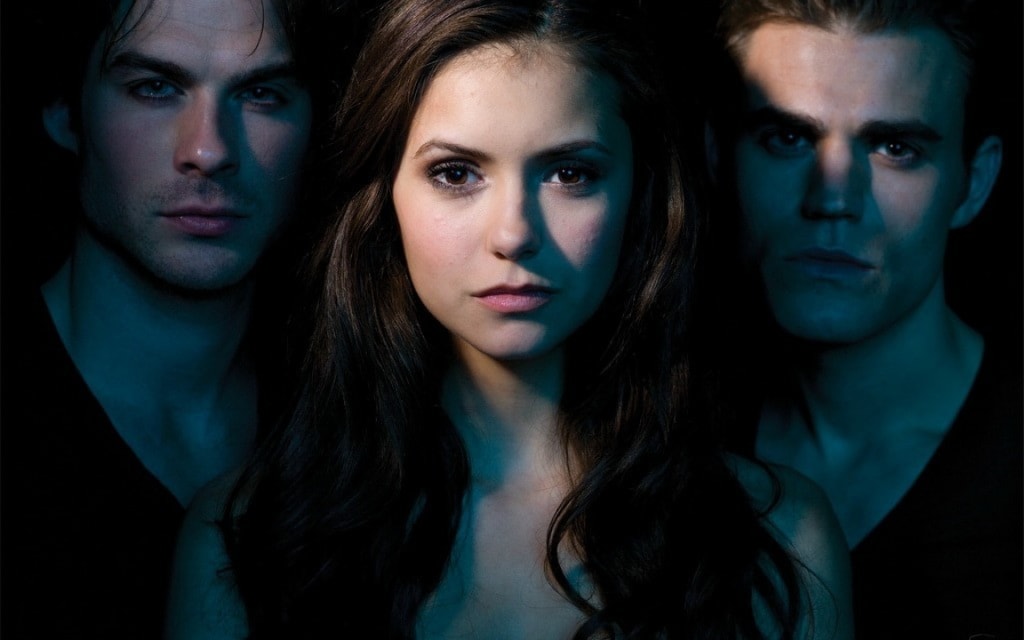
Nina Dobrev is returning to The Vampire Diaries! Granted, it's only for the final hour of the final season, but fans will take it. Since Elena launched the series as the fresh-faced human torn between the two Salvatore brothers, it's only fitting that she returns to Mystic Falls before the credits roll for the last time.
Elena has been in a magic-induced coma since the end of season 6.
This made viewers breathe a little sigh of relief. Though #NinaDobrev opted to leave the show, at least she hadn't been killed, leaving the possibility for a return.
Of course, in Mystic Falls, death wasn't really much of a obstacle anyway. (How many times has Bonnie died now?) Still, heartbroken fans didn't want to see Damon suffer the soul-crushing agony of watching his beloved die.
Now as the series winds to its finale on March 10th, fans will wait with breathless anticipation for the reunion between Damon and Elena (#delena).
But closure brings its own risks.
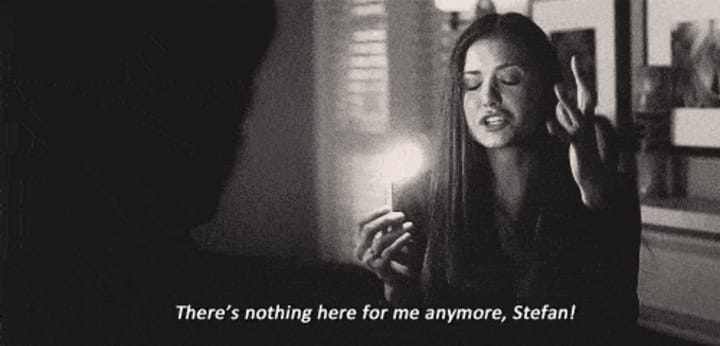
After all, the two lovers have had a bumpy relationship since day one. Can we expect a happily ever after?
Remember the colossal elephant in the room after Elena drank the cure that turned her back into a human? She wanted Damon to be human again. That didn't happen, so their future happiness is still on shaky ground. (But honestly, did anyone ever expect Damon to become a human again? The show is called The Vampire Diaries, after all!)
Viewers are already asking the question: When Elena awakens, will she remain a human or become a vampire again to stay with Damon?
How Elena Is Key To The Series Finale
Now that the show is ending, there is no need for Damon to remain a vampire, which opens up the possibility for a future with Elena as a human. In fact, series creator Julie Plec told TV Guide that Damon remains ready to do that. Now that would be the perfect ending to a series that has been fraught with evil, mayhem, and sorcery.
However Elena's return plays out, her highly anticipated return will send The Vampire Diaries off in style — as the innocent teenager turned vampire turned human rejoins her Mystic Falls family.
About the Creator
Rachel Carrington
I write a little bit of everything because I love to write. 53 novels. Over 2,500 articles. Essays. Short Stories. Book Reviews. Movie Reviews. And more. You can find a lot of that stuff here. rachelcarrington.com. X: @rcarrington2004
Keep reading
More stories from Rachel Carrington and writers in Geeks and other communities.
With TNT Passing On 'Let The Right One In', Where Will The Vampire Drama Go?
With the loss of The Vampire Diaries, viewers are down to one weekly dose of vampires in The Originals—well, two if you count The Strain. Let the Right One In, a television series based upon the Swedish romantic horror movie of the same name, was supposed to help fill that void. So when TNT announced it had ordered the pilot for the grim teen drama, vampire lovers had something to look forward to.
By Rachel Carrington8 years ago in Geeks
Emerald Fennell Defends Her Changes to Wuthering Heights: “You’ve Got to Make Those Hard Decisions”
Director and screenwriter Emerald Fennell has defended her creative choices in adapting the literary classic Wuthering Heights, arguing that modern film audiences require bold interpretation rather than strict loyalty to the original text. Fennell, known for her distinctive visual style and emotionally complex storytelling, has faced growing criticism from literary purists after early details emerged about her forthcoming film version of the 1847 novel. Changes to character structure, dialogue, and narrative focus have prompted debate about whether the adaptation strays too far from Emily Brontë’s dark and tragic romance. Speaking in a recent interview, Fennell said that adapting a revered novel comes with inevitable controversy. “You’ve got to make those hard decisions,” she explained. “Film is a different language. What works on the page doesn’t always work on screen, and if you want the story to live again, you have to reimagine it.” A Bold New Interpretation According to production insiders, Fennell’s version of Wuthering Heights places greater emphasis on psychological trauma and power dynamics between the central characters, rather than the traditional gothic romance tone. Some scenes have reportedly been condensed or restructured, and certain minor characters have been removed altogether. The director has also shifted narrative perspective, focusing more closely on the inner world of Catherine Earnshaw rather than relying on the layered storytelling framework of the novel, which uses multiple narrators. Fennell said this decision was essential to connect with contemporary viewers. “The novel is incredibly modern in its emotional violence,” she said. “But the way it’s told is distant and formal. I wanted to bring the audience right inside the characters’ minds — to feel their rage, obsession, and grief in a visceral way.” Critics and Fans Divided Reaction to the changes has been sharply divided. Some literary scholars argue that altering the structure risks losing the unique voice of Emily Brontë’s original work. “This is a novel built on storytelling within storytelling,” said one university literature professor. “Removing that framework may simplify the plot, but it also strips away its moral complexity.” Fans on social media have also voiced concern, particularly over rumors that certain iconic scenes have been modernized or shortened. However, others welcome the director’s willingness to take risks. “Every generation needs its own Wuthering Heights,” wrote one film critic. “If we keep remaking it exactly the same way, it becomes a museum piece instead of a living story.” The Pressure of a Classic Fennell acknowledged that adapting one of the most studied novels in English literature brings enormous pressure. “You’re standing on the shoulders of a giant,” she said. “But you’re also responsible for creating something that stands on its own. Otherwise, why make the film at all?” She compared her approach to past reinterpretations of Shakespeare and Jane Austen, arguing that fidelity to emotional truth matters more than literal accuracy. “The spirit of the book is about obsession, cruelty, and love that destroys people,” she said. “That’s what I’ve protected. The rest is scaffolding.” Casting and Visual Style The production has drawn attention for its unconventional casting choices and stark visual design. Fennell has reportedly chosen a darker, more minimalist aesthetic than previous adaptations, with bleak landscapes and intimate close-ups replacing the sweeping romantic imagery traditionally associated with the story. Sources close to the project say the film will highlight class conflict and emotional isolation, themes Fennell believes resonate strongly in today’s society. “This is a story about outsiders,” she noted. “About what happens when people are denied dignity and belonging. That feels painfully current.” A Broader Debate About Adaptation The controversy reflects a wider debate in the film industry about how much freedom directors should take when adapting literary classics. In recent years, filmmakers have increasingly reworked famous novels to reflect modern values and perspectives, sometimes provoking backlash from traditionalists. Film historian Mark Reynolds said Fennell’s defense highlights the tension between preservation and innovation. “Some viewers want historical authenticity; others want relevance,” he said. “Both are valid. The challenge is finding a balance that honors the original while speaking to a new generation.” Looking Ahead Despite the criticism, studio executives remain confident in the project, pointing to Fennell’s previous successes and her reputation for fearless storytelling. The film is scheduled for release next year and is already expected to spark intense discussion upon its debut at major film festivals. Fennell says she welcomes debate. “If people argue about it, that means they care,” she said. “That’s a good thing. Emily Brontë wrote a story that refuses to be quiet. I hope this film does the same.” As anticipation grows, the director stands firm in her belief that adaptation is an act of interpretation, not imitation. “You can’t please everyone,” she added. “But you can be honest to the story you’re telling. And sometimes that means changing things.” Whether audiences embrace her vision or reject it, Fennell’s Wuthering Heights is already proving that classic literature still has the power to provoke passion nearly two centuries after it was first published.
By Fiaz Ahmed about a minute ago in Geeks
Blessed 33
So I woke up on the morning of February 5, 2026 and guess what and you know what I realized? It’s my 33rd birthday. Do you know what that means? Yes, technically I’m getting old, but what I couldn’t have guessed was this would be one of the best days of my life.
By Joe Patterson6 days ago in Confessions


Comments
There are no comments for this story
Be the first to respond and start the conversation.