
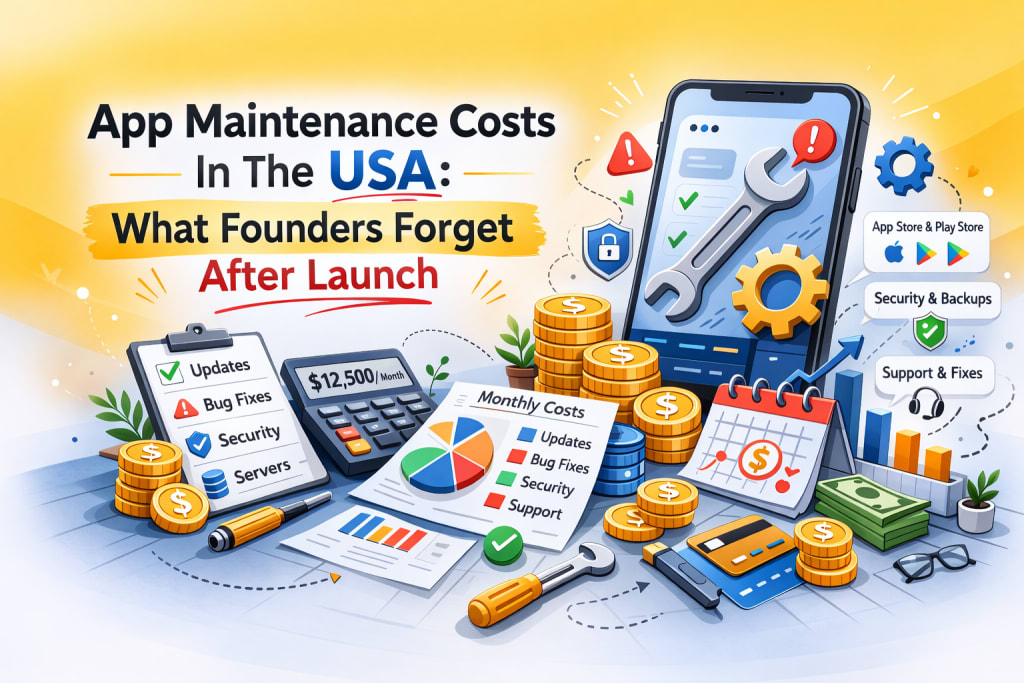
Your app didn’t finish at launch. It started a monthly bill
If you’re planning a US app budget for 2026, this is the part most teams miss.
A founder once told me, We launched. So why are we still paying every month?
I understood the question because it sounds fair. You paid to build the app. It’s live on the App Store and Play Store. Users can download it. Job done, right?
But mobile apps don’t work like a one-time purchase.
Launch is when your app meets real phones, real networks, real OS updates, real payment failures, and real users doing things you didn’t predict. That’s when the “monthly bill” begins.
I’ve written a longer breakdown on my site, but I am keeping this post standalone.
Here’s the short truth:
Most maintenance costs aren’t about fixing random bugs.
They’re about keeping the app compatible, trustworthy, and usable while the world around it keeps changing.
Why maintenance feels invisible (until it isn’t)
Maintenance is quiet work.
When it’s done well, nobody celebrates it. The app just works.
When it’s not done, users don’t email you a detailed report. They leave a one-star review that says it doesn’t work and move on with their day.
That’s why founders often under-budget maintenance. It doesn’t feel like building. It feels like small stuff.
But the small stuff is constant.
The three kinds of maintenance you’re paying for
Most teams think maintenance means bug fixing.
In real life, it’s more like three buckets.
1) Keeping the app compatible
Phones change. Operating systems change. App Store rules change. SDKs get outdated.
Even if your code never changes, your environment does.
That’s why you get surprise problems like: A screen that was fine last month now has layout issues on the newest iPhone.
Push notifications behave differently after an OS update.
A permission prompt moves or changes and users get confused.
A library update becomes required because the old one is no longer safe.
This bucket is the reason we haven’t changed anything doesn’t protect you.
2) Keeping money flows reliable
If your app takes payments or has subscriptions, maintenance is not optional.
Payments fail in weird ways:
A bank blocks a transaction.
A subscription renews but access doesn’t update properly.
A user upgrades, downgrades, cancels, comes back, and your logic gets messy.
Refunds, chargebacks, and retries create edge cases that only show up after launch.
In testing, you usually cover the happy path.
In real life, users take every path.
3) Keeping trust intact
This is the bucket founders don’t like talking about, because it sounds serious.
But trust work is part of maintenance.
Security patches. Dependency updates. Secrets rotation. Abuse patterns. Fraud attempts. Fake signups. Account takeover attempts.
Even if you’re not a fintech app, your users still expect basic safety. And app stores expect it too.
This isn’t about paranoia. It’s about not letting your app become easy to break.
What app maintenance budgets look like in the USA (simple planning ranges)
If you’re budgeting in the US for 2026, here are practical monthly ranges many teams use to plan.
A small MVP with light traffic often lands around $500 to $2,000 per month. That usually covers monitoring, store submissions, top crash fixes, small bug fixes, and basic support.
A growing app with regular releases often lands around $2,000 to $7,000 per month. This is where you start paying for steady release support, OS update work, analytics cleanup, push notification tuning, payment and API upkeep, and real QA.
A complex app with multiple integrations can land anywhere from $7,000 to $25,000+ per month. That’s when you’re paying for faster response, deeper testing, security routines, backend reliability, complex payments, and a wider device matrix.
These aren’t quotes. They’re planning bands so you don’t go into vendor calls blind.
The retainer problem (and how founders get trapped)
A lot of founders ask for a maintenance retainer without defining what maintenance means.
So they end up with a plan that covers tiny bugs… and then everything else becomes extra.
A simple way to avoid this is to think in tiers.
An essential care type retainer is usually for stability. You want the app to keep working and not fall apart. You’re mainly covering crash triage, minor bug fixes, store support, basic monitoring, and light QA.
A growth maintenance type retainer is for teams that update often. You’re not only fixing issues. You’re doing regular improvement work too: release planning, OS updates, analytics fixes, push tuning, payment and API upkeep.
A high responsibility type retainer is for apps with real revenue and low tolerance for downtime. You’re paying for faster response expectations, deeper QA coverage, regular security routines, performance work, and release management.
The point isn’t the label. The point is clarity.
If you don’t define what’s included, you’ll be surprised later.
A simple yearly rule (for people who just need a number)
If you hate budgeting conversations (same), here’s a plain rule many teams use as a quick check:
For small to mid-size apps, yearly maintenance often lands around 15% to 20% of the initial build cost.
So if your build cost was about $25,000, you might plan something like $3,750 to $6,250 per year for maintenance.
If it was $75,000, you might plan around $11,250 to $18,750 per year.
If it was $150,000, you might plan around $22,500 to $37,500 per year.
Again: not a quote, just estimations for you to understand.
If someone promises maintenance is basically free, ask what happens the first time an OS update breaks something important.
The hidden calendar costs nobody budgets for
Even if you have the fix ready, app updates still need to go through store submission.
App review is usually fast, but not always. And not always is what messes up founders.
You plan a fix for Monday. But the store review takes longer than expected. Now the fix goes out on Wednesday. Meanwhile, users are still hitting the bug.
So maintenance isn’t only money. It’s time and release planning.
If your app is tied to marketing campaigns, seasonal launches, or paid ads, store timing matters a lot more than founders expect.
The most common missing items that create surprise costs
Here’s what I see missing (or unclear) in many maintenance proposals:
The post-launch warranty window. Founders assume bugs after release are covered. Vendors assume the opposite unless it’s written down.
Bug severity definitions and response timing. When everything becomes urgent, you end up arguing instead of fixing.
An OS update plan. OS changes are predictable. Surprise is not.
Store submission ownership. Who owns App Store Connect and Play Console work? Who handles rejections and resubmissions?
Analytics and event tracking scope. Tracking is usually rushed at launch. Later, you realize it’s messy and you can’t trust the numbers.
None of these are technical detail. They decide your real cost after launch.
A simple way to budget maintenance without overthinking it
If you want a clean approach, budget maintenance like this:
First, set a keep it running baseline.
This covers crashes, basic bug fixes, monitoring, store updates, and OS compatibility work.
Second, add a release and improve the bucket.
This covers steady improvements: onboarding fixes, payment edge cases, push tuning, performance issues, analytics cleanup.
Third, keep a small surprise fund.
Because real apps always have surprises. A weird device bug. A third-party API change. A store policy update. A sudden spike in support tickets.
This way you’re not shocked when the month isn’t perfectly smooth.
When it makes sense to rebuild (yes, sometimes it does)
Founders ask this a lot: Should we just rebuild the app instead of maintaining it forever?
A practical way to think about it is this:
Compare your yearly maintenance spend to the cost of rebuilding the core product (not every feature, just the core).
If you’re paying close to a rebuild-level budget every year just to keep the app stable, that’s not really maintenance anymore.
That’s ongoing rework.
When that happens, it’s usually a sign of deeper problems like:
- Old architecture that’s hard to change
- Too many quick fixes stacked over time
- Slow releases because every change breaks something else
- Too many moving parts with no clear ownership
Sometimes the cheapest first step isn’t a rebuild. It’s a clear audit of what to keep, what to simplify, and what to redo properly.
The one sentence I wish every founder wrote into their plan
If you remember nothing else from this post, remember this:
A mobile app is a living product, not a finished deliverable.
So when you plan your budget, don’t ask: How much to build it?
Also ask: How much to keep it healthy for the next 12 months?
That question alone saves a lot of regret.
If you want, tell me what kind of app you have (MVP, subscriptions, marketplace, healthcare, etc.) and what platforms you’re on (iOS, Android, cross-platform). I’ll suggest a realistic maintenance budget band and what to put inside the retainer so you don’t get surprise add-ons later.
About the Creator
Kajol
I help founders and engineering teams design and build fintech and crypto products—exchanges, trading platforms, and payment flows.
More about my work: https://www.budventure.technology/blog/does-your-startup-need-ai-2026
No Other Choice (2025)
It is only February, so other films may well surpass “No Other Choice”, but I think this is the best film I’ve seen so far this year. And that surprises me, because, it is a subtitled film and while I am pretentious enough to choose to watch foreign-language films, I was also very tired and that was an extra commitment from me. But more importantly, let me warn you, this film is gruesome and violent. There were times I had to turn away from the screen to avoid the worst of it (including some self-inflicted dentistry).
By Rachel Robbins7 days ago in Geeks
Celebrities You Forgot Starred on 'ER'
The original hit medical drama, ER, sure has had its fair share of actors walk through the doors of County General Hospital. Over the course of 15 seasons, the amount of patients, doctors, nurses, medical students, and secondary characters to appear on the show are endless. Whether you know it or not, ER served as a stepping stone for some actors and actresses that went on to become some of the biggest stars in Hollywood.
By Jenika Enoch3 days ago in Geeks



Comments
There are no comments for this story
Be the first to respond and start the conversation.