
A remote volcano is erupting after 700,000 years of dormancy.
Examining the volcano Taftan

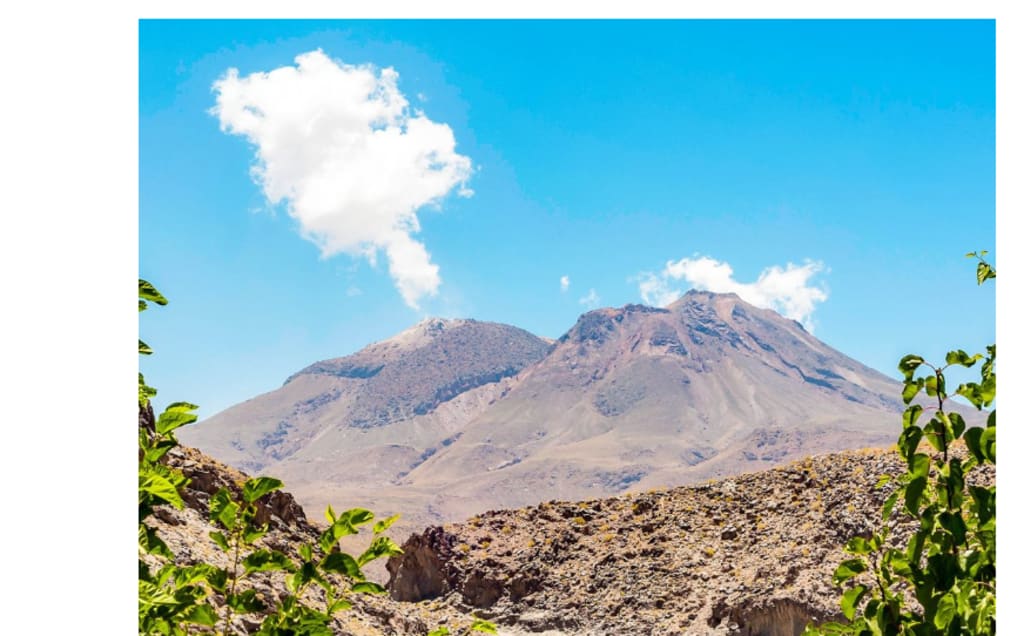
In just ten months, a volcano in southeast Iran has pushed higher by almost 3.5 inches (9 centimetres). Although this may seem like a minor increase, it has significant implications.
A recent study claims that pressure is increasing close to the top and used satellite data to identify the shift. Taftan is the volcano. The new signal indicates that the system is stirring and requires attention, even if it has never exploded in human history.
Examining the volcano Taftan
Using InSAR, a radar technique that detects ground motion from space, scientists were able to follow the ground. They made use of Sentinel-1 satellites, which are capable of seeing through clouds and operate day and night.
The Taftan volcano uplift was concentrated close to the peak and lasted for just over ten months. The fact that the rise has not decreased indicates that the pressure has not yet subsided.
The senior author overseeing the work is Pablo J. González of the Spanish National Research Council (IPNA) of the Institute of Natural Products and Agrobiology.
Taftan lacks on-the-ground tools like continuous GPS receivers and is far away. Therefore, the best way to monitor a mountain that numerous communities still flank but few people visit is with satellite radar.
The location of the pressure
A source that was only 1,600 to 2,070 feet (490 to 630 meters) below the surface was modelled by the study. The location of gases that flow and gather within a hydrothermal system—where hot water and gas circulate beneath a volcano—is suggested by that shallow level.
They ruled out local earthquakes and heavy rain as triggers and evaluated known suspects. Without external interference, the signal increased and decreased, which is consistent with internal mechanisms operating within the structure.
The magma reservoir, a sizable subterranean mass of molten rock, is located deeper within the Taftan volcano. Since it is more than two miles (3.2 kilometres) below the surface, gases above it are probably the source of the current push rather than newly formed magma.
The design resembles a gradual squeezing. As fresh fissures appeared and some gas found ways out, the ground first raised and then stabilised. Labels such as "extinct volcano" might be misleading.
The 12,927-foot (3,940-meter) Taftan volcano is a steep stratovolcano composed of ash and lava layers. It erupts through summit fumaroles, which are gas-emitting volcanic vents, demonstrating that the system is still in motion. One of the issues is the paucity of eruption records for the previous 10,000 years.
In rock and gas, silence on paper does not equate to a dead system.
Long periods of inactivity can be followed by months of change on volcanoes. For this reason, ash plumes are not the only early warning signs that scientists look for. They also consider ground motion, heat, and gas. Measurements are more important than labels. The new deformation is not a label; it is a measurement.
Raises without using magma
Gas accumulation in fissures and tight rocks is one probable cause. The rock slightly lifts as gas pressure increases, and the peak region reacts first.
Another theory is that volatiles, which are gases that escape from magma, were discharged into the deeper, shallower plumbing by a little melt pulse. Pressure is pumped into pores by those gases as they percolate upward.
Both theories make sense given the timing and the shallow source. The findings also indicate that the rate of uplift decreased as gas discovered channels. An eruption is not necessary for any of these. It does require attention because pressure requires a way out, and the way out is important.
Risks associated with Taftan Volcano
Lava flows are not the primary short-term threats. When heated fluids flash to vapour close to the surface, it can cause phreatic blasts, which are steam-driven explosions.
Downwind crops, lungs, and eyes may be briefly irritated by gas explosions. About 31 miles (50 km) distant is the city of Khash, which is close enough to smell sulphur when the wind is right.
In the future, it must be released in some way, either subtly or forcefully. The purpose of this study is not to make people frightened. González explained, "It's a wake-up call for the authorities in the region of Iran to allocate some resources to look at this."
These aren't forecasts; they're just plain warnings. The mountain is whispering, not shouting, thus the message is to get ready now.
What scientists hope to do next
Teams are interested in measuring the gases on the slopes and at the vents. Sulphur dioxide, carbon dioxide, and water vapour levels can be continuously measured to determine whether pressure is increasing or decreasing.
In order to record shake and slow stretch, they also require a simple network of seismometers and GPS units. Timing would be improved and blind spots would be decreased with even a simple arrangement.
Satellites will continue to observe. Small changes can be detected by InSAR, a radar technique that monitors ground movement from space, and field personnel can verify them in a matter of days.
Authorities can create maps of potential hazards, prepare evacuation routes, and provide local residents with basic instructions. Today, having clear procedures on paper reduces confusion when circumstances change.
Setting the scene for the Taftan volcano
Taftan is located in a subduction zone, which is where two tectonic plates move beneath one another. That environment produces gas-rich fluids higher up and magma at depth.
The volcano features long-lived gas vents and two main peaks. Scientists are informed by these characteristics that heat still rises from below.
Similar, gradual changes that never culminate in an eruption are seen in many volcanoes worldwide. Others require immediate action and spike up quickly after a quiet period.
The bottom line is that life is saved by consistent, tedious surveillance. It transforms unexpected events into known issues with known solutions.
Why satellites are important in this context
Radar satellites do not care if it is day or night; they can see through smoke and clouds. In arid, elevated regions where weather is severe and stations malfunction, that is helpful.
C band radar, which Sentinel-1 carries, may repeat passes frequently enough to create a motion movie. When the difference is just a few inches, those repeated viewings are crucial.
Recurrence times get shorter as more satellites launch. This provides scientists with quicker updates when Ground and space work best together. While devices on the mountain provide detail, satellites scan the broad picture.
The future of the Taftan Volcano
Pressure is reducing and gas has discovered new outlets if the ground begins to sink. Pressure is still increasing and the likelihood of steam occurrences increases if uplift persists or increases.
Another warning sign is if petrol readings increase and remain above. Concern might also be raised by abrupt shifts in the small quakes beneath the summit.
Researchers will check to see if the piping opened or remained closed. The following gas pulse's potential size will be determined by the response.
Simple actions are helpful to those in the vicinity. Keep masks on hand for sulphur odours, be aware of wind patterns, and heed official instructions.
About the Creator
Keep reading
More stories from Francis Dami and writers in Horror and other communities.
Marine dark waves: The consequences of a dark bottom
The seafloor loses light nearly overnight, and coastal water can occasionally change from clear to hazy. Scientists can evaluate the timing, duration, and intensity of these underwater blackouts across regions thanks to a novel surveillance system. These blackouts can swiftly damage kelp and seagrass.
By Francis Dami27 days ago in Horror
Killing him slowly
There’s an intruder in my house again. He stumbles through the door, wet carrier bags in hand. He’s bought me offerings. I show my appreciation, letting him caress my beautiful body. He wants to touch me. I rub myself against his legs. He sighs, dropping the bags. He can’t resist touching me. Running his hand slowly down my spine, I arch my back towards his caress, let out a low purr. It’s what we both need.
By N J Delmas25 days ago in Horror
At My Wits’ End
Life is about taking out the trash and calling it trash because you have every reason to. It wasn't meant to be linear, they say. But the times you tried to make it straight led to problems, and you didn’t have the tools to put any of it to use. You don't put your right shoes on the right feet; you put the left shoes on the left feet. The grey hardened slab will trip you up anyway.
By Caitlin Charlton3 days ago in Humans




Comments
There are no comments for this story
Be the first to respond and start the conversation.