
The Bells of Blackmere
They rang every night at exactly midnight

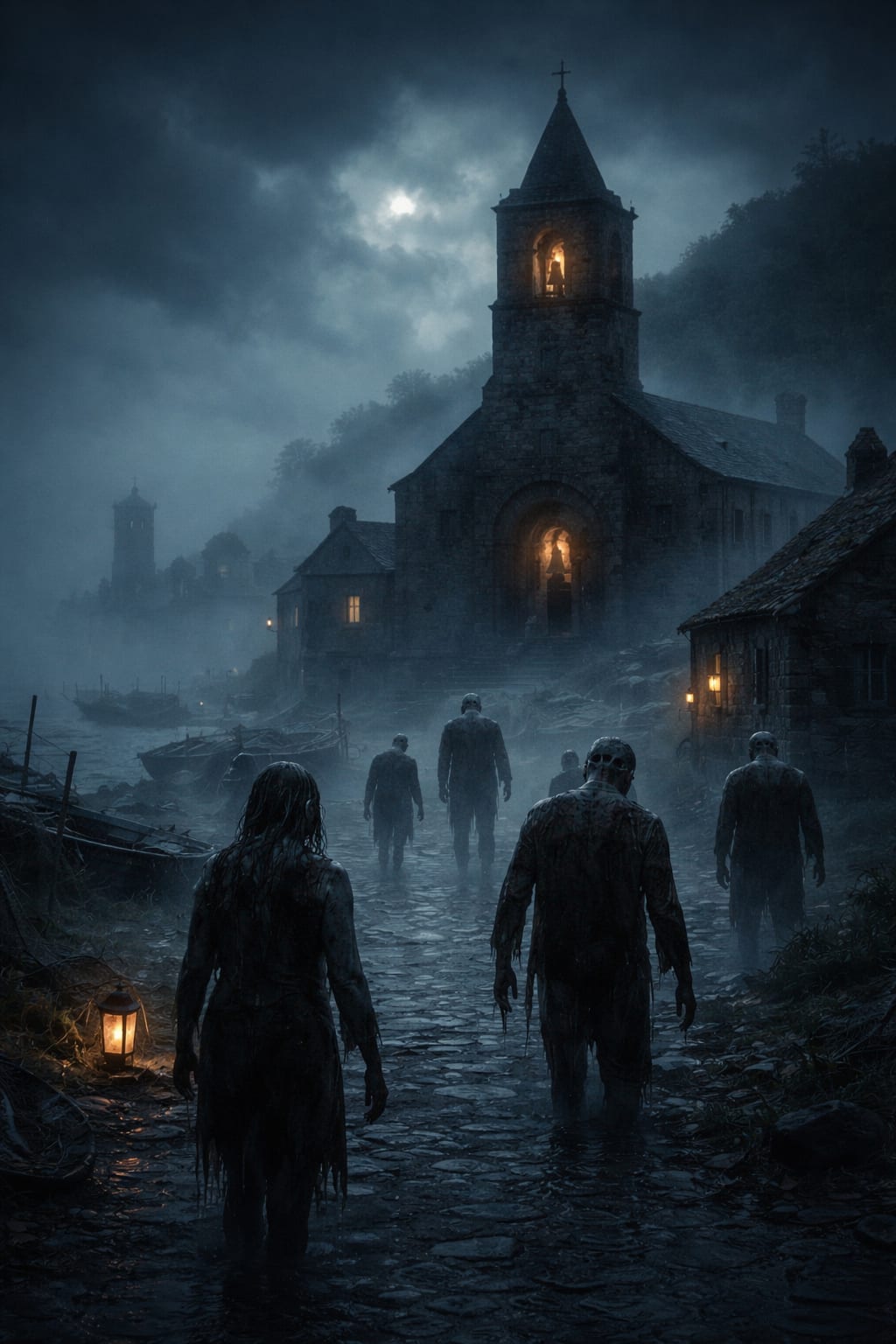
In the northern reaches of a forgotten coastline, beyond the tourist maps and the bright harbors, lay the village of Blackmere. It was the kind of place that clung to the edge of the world—stone cottages pressed against black cliffs, roofs bowed like tired shoulders, and a church tower that rose like a broken finger pointing at the sky.
People in nearby towns spoke of Blackmere in lowered voices. Not because of crime or war, but because of the bells.
.
No priest lived there anymore. No clock mechanism worked. Yet the bells tolled—slow, deep, and heavy—twelve times, without fail.
Elena Voss arrived in Blackmere in early October, when fog rolled in from the sea like a living thing. She was a journalist from Hamburg, searching for stories about dying villages. Blackmere, with its shrinking population and strange reputation, seemed perfect.
When she stepped off the bus, there were only three passengers left: an old woman with milk bottles, a boy with hollow eyes, and a man who refused to look at her.
Her rented room was in a narrow house near the cliffs. The landlady, Mrs. Harrow, had skin like dried paper and hands that never stopped trembling.
“You must not go outside at night,” Mrs. Harrow said as she handed Elena the key.
“Because of the bells?” Elena asked.
The woman’s eyes darted to the window.
“Because of what comes after them.”
Elena laughed politely. She had heard such warnings before—villages loved their legends. Still, something about Mrs. Harrow’s fear felt too real to be theatrical.
That evening, Elena explored the village. Most houses were abandoned, doors warped by salt and wind. Nets hung from walls like rotting spiderwebs. The church stood at the center, its doors chained shut, its windows blind with dust.
An old fisherman sat on a bench facing the sea.
“Do you know why the bells ring?” Elena asked.
He spat into the water.
“Because the dead don’t know they’re dead.”
She assumed he meant metaphorically.
She would soon learn otherwise.
At 11:58 p.m., Elena lay awake, recorder on her bedside table. The air felt wrong—thick, heavy, as though the fog had crept into her lungs. Then, without warning, the bells began.
BOOM… BOOM… BOOM…
Each sound rolled through the village like thunder beneath the earth.
At the sixth bell, she noticed movement outside her window.
Figures were emerging from the fog.
They walked slowly, stiffly, their shapes warped by mist. Some limped. Some dragged their feet. All of them moved toward the church.
Elena’s breath caught in her throat.
They were villagers.
But they were not alive.
Their skin was gray, stretched tight over bone. Eyes glowed faintly, like embers beneath ash. One woman’s neck bent at an impossible angle. Another man’s jaw hung loose, as if forgotten by gravity.
Elena stumbled back from the window.
The twelfth bell rang.
And silence fell.
The figures vanished into the church.
She did not sleep.
The next morning, Blackmere looked normal. Mrs. Harrow served tea. A man repaired a fishing net. Children played near the shore.
“Did… anything unusual happen last night?” Elena asked.
No one answered.
The fisherman from the bench passed by and muttered,
“They go back when the bells stop.”
“Who goes back?”
He looked at her.
“Those who drowned.”
Elena’s research revealed a shipwreck in 1912. A ferry carrying villagers to the mainland had been swallowed by a sudden storm. Dozens died in the freezing water. Their bodies were never recovered.
The church bells had begun ringing that same year.
A final entry in the village archive chilled her blood:
They return at midnight. They walk as they walked in life. They do not speak. They wait.
Wait for what?
That night, Elena hid inside the church, slipping through a broken side door before sunset. The air inside was cold and smelled of mold and salt. She crouched behind the altar as the bells began again.
The dead came.
They filed in silently, filling the pews. Water dripped from their clothes onto the stone floor. Their faces were empty—except for one.
A child stood at the front, eyes fixed on the altar.
On Elena.
It raised a hand and pointed.
The others turned.
They moved toward her.
Their mouths opened at once.
And they screamed.
It was the sound of drowning—of lungs filled with water, of terror frozen in time. Elena ran. She burst through the church door and into the fog, the screams chasing her like a storm.
The bells did not stop.
They rang again.
And again.
And again.
When dawn came, Blackmere was empty.
Every house stood open. Nets lay abandoned. Boats drifted loose from their ropes.
Elena was found on the road by a passing driver, barefoot and shaking.
She never published her story.
But every year, in early October, the bells of Blackmere ring one extra time.
For the one who escaped
About the Creator
Iazaz hussain
Start writing...
Keep reading
More stories from Iazaz hussain and writers in Horror and other communities.
The Silence at Blackmere House
Blackmere House stood at the edge of a forgotten coastal cliff, where the wind howled through broken railings and the sea beat against sharp rocks like a restless heart. It was the kind of place people in the UK whispered about, a house with a history so dark that even local tour guides avoided telling the full story.
By Iazaz hussain3 months ago in Horror
Killing him slowly
There’s an intruder in my house again. He stumbles through the door, wet carrier bags in hand. He’s bought me offerings. I show my appreciation, letting him caress my beautiful body. He wants to touch me. I rub myself against his legs. He sighs, dropping the bags. He can’t resist touching me. Running his hand slowly down my spine, I arch my back towards his caress, let out a low purr. It’s what we both need.
By N J Delmas24 days ago in Horror
The Last Train Home
Daniel had never liked taking the late train, but that night he had no choice. Work had kept him longer than expected, and the last train departing from the nearly deserted station was his only way home. The platform was unusually quiet, the overhead lights flickering as if struggling to stay awake. A cold wind swept through the empty space, carrying scraps of newspaper across the cracked tiles. Daniel checked his phone for the time, relieved to see the train was arriving on schedule. When the distant rumble echoed through the night, he felt a strange sense of comfort. At least the ride would be short.
By Sudais Zakwan4 days ago in Horror
The Tango Connection
I suppose I've become a writer so I wouldn't bore everyone to death telling them my stories. Reading them is reading. Not the same. There's rhythm. And timing and, most importantly, drama and suspense. Unless you have tremendous magnetism and an undeniable stage presence, there's no way you can engage an audience the way you can by writing your story. That's my opinion.
By Rene Volpi 8 days ago in Beat



Comments
There are no comments for this story
Be the first to respond and start the conversation.