
The House That Waits
A once-charming Victorian becomes a living nightmare, as Jason discovers the terrifying truth hidden within its walls.

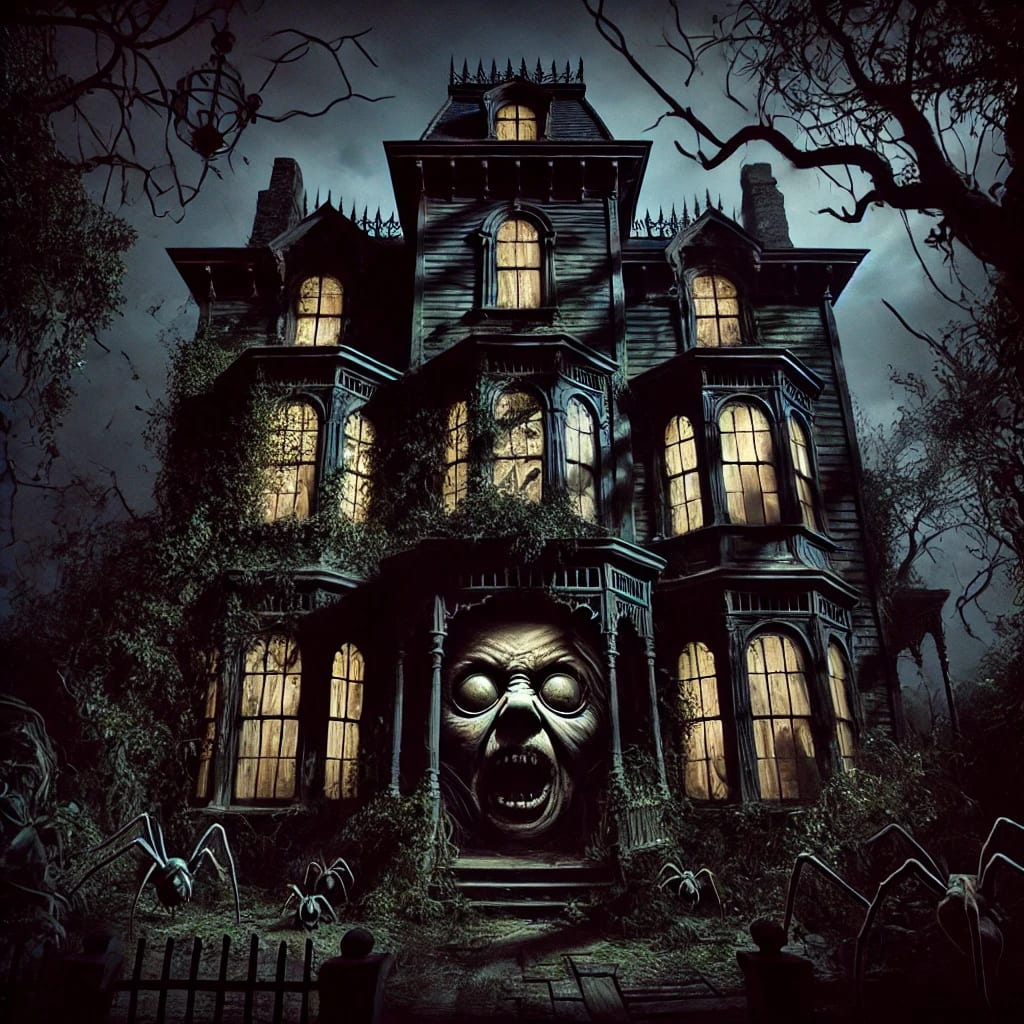
The house had always been too quiet, too perfect in its decay. Jason found it on a whim—an old Victorian on the outskirts of town, barely visible through the overgrowth of ivy and twisted trees. The price was laughable, almost as if they were begging him to buy it.
At first, he thought it was charming. The creaking floors, the musty smell, the peeling wallpaper. It was like a house from another era, forgotten by time but somehow untouched. He’d always wanted a place like this. He moved in within days, setting up a life in the dim-lit rooms that felt like a dream—until the spiders came.
It started slow. A single spider in the corner of the kitchen, no bigger than a dime. Jason squashed it without thinking. The next day, two more appeared in the same spot. He killed them too, annoyed but indifferent. No big deal.
Then it escalated. The spiders were no longer confined to the kitchen. They were in every room, every corner—small at first, but growing larger, crawling from the walls and ceiling like they had always been there, waiting for him. Jason had no choice but to kill them. Every time he crushed one, two more appeared in its place, larger, more grotesque.
It became a daily ritual—he’d wake to find more, always in the same places, always in greater numbers. They seemed to move in patterns, appearing and disappearing with a purpose. Jason was starting to feel like he was losing his mind. The walls felt different, too. The house seemed alive—breathing, shifting, pulsing under his touch. The cracks in the plaster weren’t just cracks; they were veins, leaking something dark and slick.
One night, the sound woke him. It wasn’t the usual skittering or clicking of tiny legs—it was a soft, wet slithering sound, something far too large to be just a few spiders. He sat up in bed, his heart racing, and looked around the room.
The walls were moving. Not creaking or shifting like an old house, but alive. They breathed.
Jason’s throat constricted as he saw it: a grotesque bulge in the wall. A face, pressing against the wallpaper, its features distorted, stretched like something caught between worlds. Its eyes were wide, too wide, and bulging, staring straight at him as if it knew him, as if it was waiting.
"Jason," the voice rasped, thin and broken. It wasn’t a sound from the air—it was coming from inside the walls, the plaster, the beams.
“You can’t leave. You’re already here.”
A cold wave of terror slammed into him. His legs trembled as he backed away, his pulse roaring in his ears. He tried to run, but his feet felt heavy, as if the floor was pulling him down. And then he saw them—dozens of spiders, their bodies gleaming black, emerging from the cracks, crawling toward him like they knew what was coming next. He couldn’t escape them. No matter how fast he moved, more appeared. They seemed to rise from the floor, the walls, the ceiling, until they were everywhere.
His breath caught in his throat as the house seemed to groan under the weight of it all, the floor buckling beneath him. The walls weren’t just moving anymore—they were shifting, warping, bending as though the house itself was alive, stretching to make room for the spiders, for him.
Jason stumbled backwards, but his vision blurred. His hands were shaking, his body freezing, as the sound of skittering legs grew louder. Too loud. It was inside him now, crawling through his veins, crawling into his lungs. His mouth went dry, and for the first time, he felt a terrible, primal instinct—the urge to run. But the door was gone. The windows, sealed shut. The walls had become one—a writhing, living thing that he couldn’t escape.
The face pressed closer, its mouth stretching open in an agonized scream, as the spiders poured out from it, spilling onto the floor, into the air, into his body. Jason screamed, but the sound was swallowed by the walls, the house that had always been hungry, the house that wanted him.
His skin burned as the spiders burrowed into him, under his flesh, their tiny legs gnawing at his muscles, at his bones, at his soul. And then, just as the last breath left his body, he felt it—his body dissolving, being pulled into the walls, becoming part of the house, part of the endless maze of plaster and wood, his skin tearing open as the spiders consumed him from the inside out.
Jason’s last thought was that it wasn’t the spiders he had to fear—it was the house. The house that had been waiting for him, had been waiting for someone just like him.
And now, it would never let him go.
The walls were silent again. Empty, save for the faces—hundreds of them, all screaming silently from the plaster, their eyes wide, their mouths stretched open in eternal agony.
And in the darkness, the house breathed.
About the Creator
Reader insights
Outstanding
Excellent work. Looking forward to reading more!
Top insights
Compelling and original writing
Creative use of language & vocab
Easy to read and follow
Well-structured & engaging content
Excellent storytelling
Original narrative & well developed characters
Expert insights and opinions
Arguments were carefully researched and presented
Eye opening
Niche topic & fresh perspectives
On-point and relevant
Writing reflected the title & theme
Keep reading
More stories from Jason “Jay” Benskin and writers in Horror and other communities.
Killing him slowly
There’s an intruder in my house again. He stumbles through the door, wet carrier bags in hand. He’s bought me offerings. I show my appreciation, letting him caress my beautiful body. He wants to touch me. I rub myself against his legs. He sighs, dropping the bags. He can’t resist touching me. Running his hand slowly down my spine, I arch my back towards his caress, let out a low purr. It’s what we both need.
By N J Delmas14 days ago in Horror
The Mirror That Learned My Face
The mirror was already in the room when I moved into the apartment. It stood against the far wall, tall and narrow, with a dark wooden frame scratched by time. I didn’t bring it with me, and the landlord said nothing about it. I assumed the previous tenant had forgotten it, and I was too tired to care.
By Sudais Zakwan2 days ago in Horror




Comments (2)
Oh no those darn spiders. It’s amazing how the word ‘crawl’ makes your skin crawl. I don’t feel it will ever lose its power. The fact that these spiders keep multiplying and becoming more grotesque is scary. Oh my, I wasn’t expecting the cracks to be that way. What the thing said to Jason was unexpected and creepy. Somebody needs to burn that house so that it will die, sadly Jason would die with it but gosh, this house is scary.
Arachnophobia here I come. Your image was startling and do not take this the wrong way your story was disgusting for I do not like spiders except for Daddy long legs. Great work.