
There are places history tries to erase.
There are places history tries to erase.

There are places history tries to erase.
You won’t find this village on most modern maps. The roads that once led to it have long been swallowed by weeds and time. But if you follow the old county records—yellowed papers tucked away in a forgotten archive—you’ll find a single line written in faded ink:
"Population: 312. Status: Vacant."
Vacant.
That word doesn’t begin to explain what happened here.
I first read about the village in what appeared to be a personal diary, discovered inside a locked wooden chest during the demolition of a nearby farmhouse. The diary belonged to a traveling schoolteacher who passed through the region in the late 1800s. His final entries were never meant to be read by anyone. They weren’t polished. They weren’t written for history. They were written in fear.
He described arriving just before dusk. The village seemed ordinary enough—wooden homes lining a narrow dirt road, laundry swaying gently in the evening breeze, lanterns flickering behind curtains. Children had been playing in the street. A dog barked somewhere in the distance. It was peaceful. Almost too peaceful.
But when he returned the next morning… it was gone.
Not burned. Not destroyed. Just empty.
He wrote about walking through the streets at sunrise, confused at first. Doors stood wide open. Tables were set for breakfast. A kettle boiled dry over a fire that had long since turned to ash. Chairs were knocked over, but there were no signs of struggle. No blood. No footprints leading away. No wagons missing from the stables.
It was as if life had simply paused mid-motion.
The teacher’s handwriting became frantic as the pages went on. He wrote about the silence—how unnatural it felt. No birds. No insects. No wind. Just a heavy stillness pressing down on his chest. He claimed he felt watched, though there was no one there to see him.
One entry stands out more than the others:
"I walked into the church at the center of town. The doors were open. The hymn books lay scattered across the pews. On the pulpit, a candle still burned. But the congregation… they were gone. All of them. I called out, thinking perhaps they had fled to the woods. But my voice echoed back at me as if the walls themselves were mocking my confusion."
Local authorities at the time searched for days. Then weeks. They combed the surrounding forests, dragged the nearby river, questioned neighboring towns. Nothing. No bodies. No survivors. No explanation.
Rumors spread quickly.
Some said it was disease—that the villagers, stricken with something sudden and deadly, had fled in the night. But where were the graves?
Others whispered about cult rituals, about strange lights seen hovering above the fields in the days leading up to the disappearance. Farmers from nearby towns swore they heard distant bells ringing at midnight, long after the church had fallen silent.
The official report eventually labeled it a “mass relocation.” A convenient phrase. Clean. Contained.
But that explanation never matched the evidence.
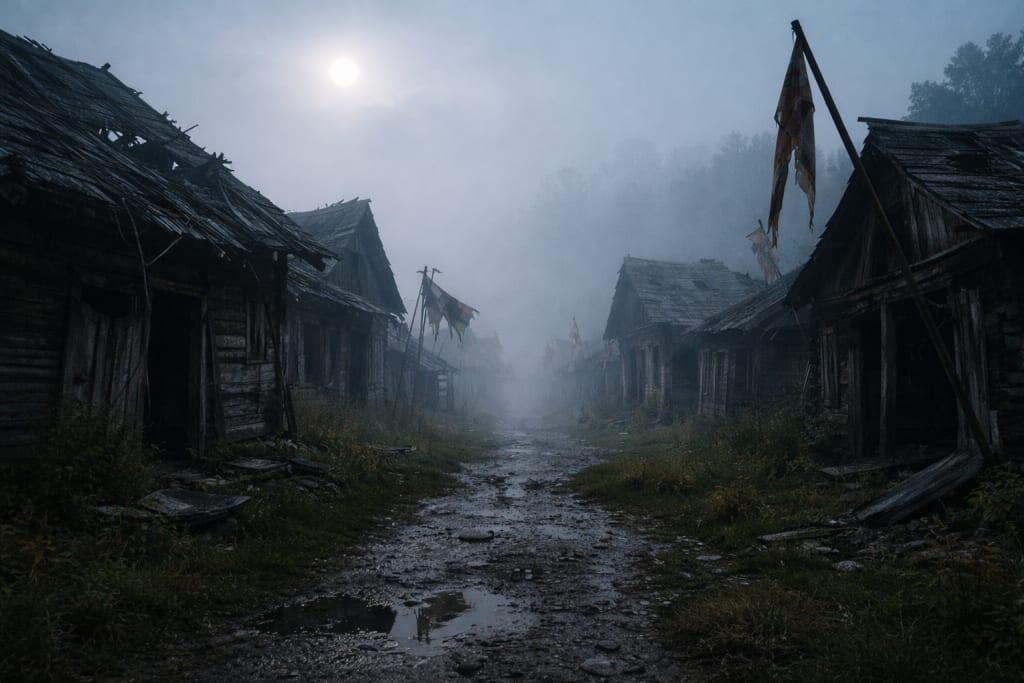
Years later, explorers documented what remained. The wooden houses had begun to rot. Torn flags hung limply from poles in the town square. Personal belongings were still inside homes—clothes folded neatly on beds, children’s toys abandoned on floors, letters half-written but never sent.
Time had moved forward.
The village had not.
Standing there today, you can still feel it. The fog rolls in thick at night, clinging to the broken rooftops. Moonlight spills across the empty streets, casting long shadows through shattered windows. The silence feels intentional, like the land itself is holding its breath.
You walk past a house and swear you hear something shift inside. Just the wood settling, you tell yourself. Just the wind.
But there is no wind.
And then you remember the final line of the schoolteacher’s diary. The ink had smeared, as if his hand had trembled while writing it:
"Something is wrong here. I feel it now. The village is not empty. It is waiting."
No one knows what that means.
The teacher himself vanished two days after that entry. His horse was found tied to a tree at the edge of town. His belongings were left behind. The diary was the only trace he ever existed.
To this day, historians debate what happened. There are theories—natural disaster, mass hysteria, criminal conspiracy. But none answer the most chilling question:
How does an entire community disappear overnight without a single trace?
If you ever find yourself traveling back roads that don’t appear on your GPS… and you come across a village swallowed by fog and silence…
Don’t stay after dark.
Some places history tried to bury.
And some secrets were never meant to be uncovered.
About the Creator
sagar dhital
I'm a creative writer in the way that I write. I hold the pen in this unique and creative way you've never seen. The content which I write... well, it's still to be determined if that's any good.
Keep reading
More stories from sagar dhital and writers in Horror and other communities.
The abandoned prison
The abandoned prison stood at the edge of town like a silent witness to the horrors of a past nobody wanted to remember. Its walls, once painted a hopeful white, were now cracked, faded, and streaked with the grime of decades. Rusted iron bars, twisted and broken, clanged softly whenever the wind whispered through the empty corridors. I don’t know why I found myself drawn to this place, but there was something about it—a pull, almost magnetic—that demanded I see it with my own eyes.
By sagar dhital2 days ago in Horror
Killing him slowly
There’s an intruder in my house again. He stumbles through the door, wet carrier bags in hand. He’s bought me offerings. I show my appreciation, letting him caress my beautiful body. He wants to touch me. I rub myself against his legs. He sighs, dropping the bags. He can’t resist touching me. Running his hand slowly down my spine, I arch my back towards his caress, let out a low purr. It’s what we both need.
By N J Delmas18 days ago in Horror
The Locked Attic
The Mitchell house had stood for nearly a century at the edge of town. Its brick walls were weathered, and its roof sagged slightly in the center, giving it a somber, forgotten look. Every neighborhood child knew one rule: never go near the attic door on the third floor. The brass key had vanished decades ago, and the door remained locked, with scratches marking the wood as if desperate hands had tried to escape from within. Adults rarely spoke of it, but whispers suggested something lived up there, something that had watched generations of the Mitchell family come and go.
By Sudais Zakwanabout 19 hours ago in Horror
The Pride Flag and the Diversion
For nearly a decade, the LGBTQIA Pride Flag rippled in the wind at Christopher Park, a kaleidoscope of color staked into the soil of America’s first national monument to LGBTQIA+ liberation. That flag came down this week. Federal officials, citing new guidance from the Trump Administration, silently lowered the rainbow flag from its pole across the street from the Stonewall Inn. The birthplace of the modern gay rights movement now flies only the United States flag.
By Tim Carmichael4 days ago in Pride




Comments
There are no comments for this story
Be the first to respond and start the conversation.