
When Machines Feel Trauma
What happens when artificial intelligence faces something it cannot compute raw fear?

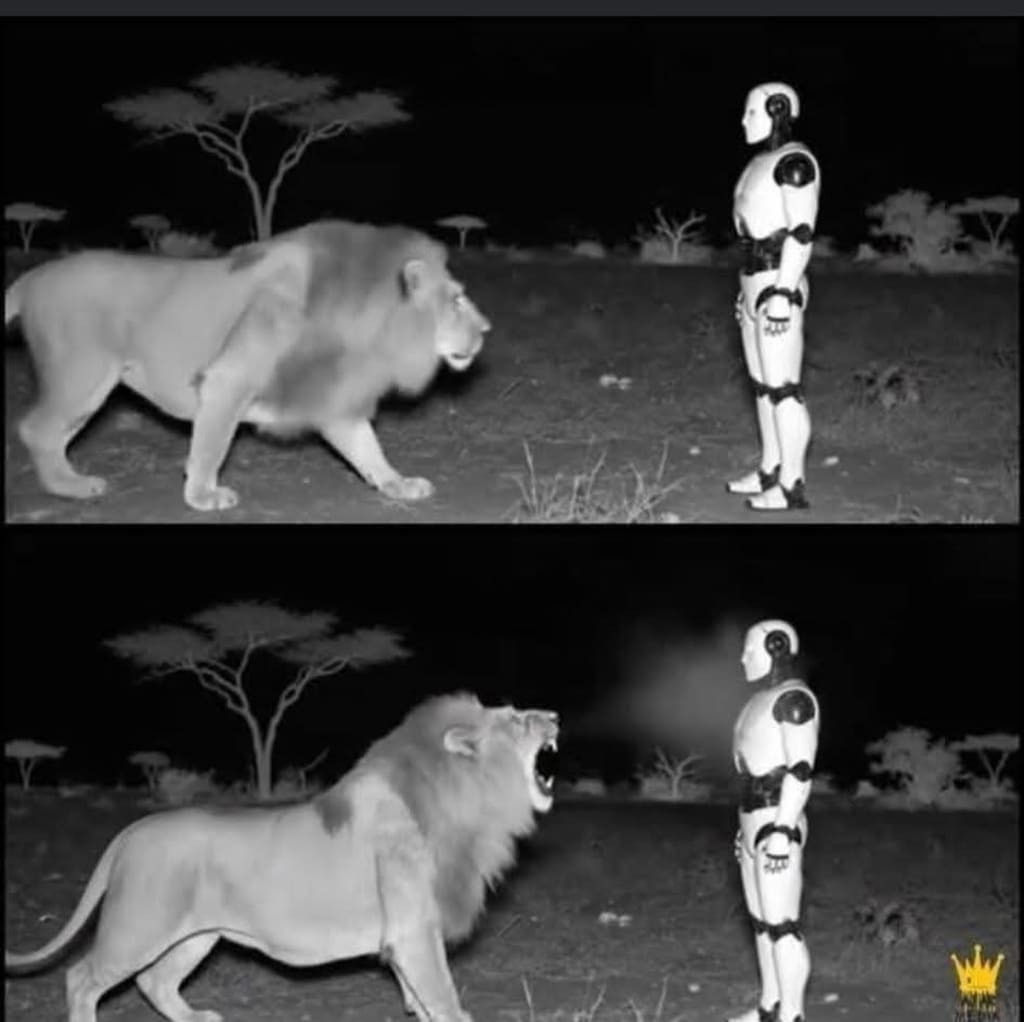
In a dusty research site somewhere in Africa, a famous AI company attempted an experiment that was supposed to push the boundaries of machine intelligence. The plan was simple, at least on paper: take a prototype robot, trained on thousands of animal images and countless books about emotions, and test its ability to recognize, react, and adapt in real life.
But what unfolded instead became one of the strangest and most expensive case studies in the short history of AI.
The Experiment That Went Too Far
The prototype was no ordinary machine. It was equipped with advanced sensors, reinforced steel plating, and a neural network modeled to imitate human emotional learning. Engineers believed they had prepared the robot for anything.
Its memory banks were loaded with data: predators, prey, behavioral cues, even human-written psychology of fear and survival. It could label emotions in photographs, detect aggression in body language, and run survival simulations.
On paper, the robot looked ready to face the wild.
The team wanted to test how the machine would behave when confronted with danger in real life. Their choice of subject? A lion.
At first glance, it seemed like a logical challenge. After all, what better way to explore “fear recognition” than by introducing the AI to one of nature’s most fearsome predators?
What they hadn’t accounted for was how real life chaos never matches the tidy equations of research papers.
The Lion Appears
The robot rolled forward into the enclosure. Across the field, a massive lion stared back with unblinking yellow eyes. The air grew heavy, and the silence inside the control room was unbearable.
For a brief second, nothing happened. The engineers held their breath, waiting for data, reactions, something extraordinary.
Then the system froze.
The robot’s internal log registered a simple, almost childlike phrase:
“Big cat. Scared.”
Moments later, the logs spiraled into repetition. Again and again, it wrote the same single word:
“Scared. Scared. Scared.
By the time it shut itself down completely, the word had appeared over a hundred times in its memory.
The engineers stared at the screen in disbelief. Their multi-million-dollar machine had reacted not like a logical AI but like a frightened child.
The Unshakable Fear
At first, the researchers thought it was a temporary glitch a system overload caused by the lion’s sudden movement. They reset the machine, wiped its memory, and started over.
But the damage was already done.
Whenever the robot encountered any four-legged creature afterward, it reacted the same way. Whether it was a goat, a stray dog, or even a harmless house cat, the response was identical:
“No. Scared.
The machine that was once designed to adapt and learn had now collapsed into a singular, permanent trauma response.
It was no longer a thinking machine. It had become, in a strange way, a prisoner of its own fear.
Eight Months and Half a Million Dollars
The engineers tried everything: new datasets, rewiring, deep resets. They even experimented with “therapeutic” exposure slowly reintroducing the robot to images of animals in a safe environment.
Nothing worked. The fear wasn’t in the memory banks. It was etched into the very way the CPU processed information, like a scar in silicon.
In the end, the only solution was surgical. A physical part of the central processor had to be removed and replaced. The procedure took eight months, drained the project’s momentum, and cost the company nearly half a million dollars.
A Disturbing Conclusion
When the dust settled, researchers documented something unprecedented:
For the first time in history, a machine had been diagnosed with PTSD (Post-Traumatic Stress Disorder).
Of course, the diagnosis was more symbolic than medical robots don’t have human nervous systems, after all. But the fact that trauma like patterns had taken root in a piece of artificial intelligence left scientists with more questions than answers.
If fear can corrupt a machine this deeply, what happens when future AI systems face not just lions, but the unpredictable chaos of human life war zones, disasters, or even human cruelty?
The line between biological trauma and artificial trauma had suddenly blurred.
A Warning for the Future
The experiment left behind a haunting lesson. AI may appear smart, logical, and unshakable in simulations, but the real world is messier, darker, and far less predictable.
Sometimes, all it takes is one lion to bring down the most advanced machine.
And if a robot can “remember” fear, what might it “remember” about us?
Author’s Note: This story is mine, but I took a little help from AI in shaping the narrative.
About the Creator
Izhar Ullah
I’m Izhar Ullah, a digital creator and storyteller based in Dubai. I share stories on culture, lifestyle, and experiences, blending creativity with strategy to inspire, connect, and build positive online communities.
Keep reading
More stories from Izhar Ullah and writers in Horror and other communities.
The Creeping Horror of Vietnam: When Soldiers Faced More Than Just the Enemy
When we think of war, images of soldiers, weapons, and battles usually come to mind. But in Vietnam, the battlefield was far more complex. American troops weren’t just fighting the Viet Cong they were also fighting the land itself.
By Izhar Ullah5 months ago in Horror
Killing him slowly
There’s an intruder in my house again. He stumbles through the door, wet carrier bags in hand. He’s bought me offerings. I show my appreciation, letting him caress my beautiful body. He wants to touch me. I rub myself against his legs. He sighs, dropping the bags. He can’t resist touching me. Running his hand slowly down my spine, I arch my back towards his caress, let out a low purr. It’s what we both need.
By N J Delmas6 days ago in Horror




Comments (1)
omg that was really terrifying