
5 Key And Honest Lessons For Becoming A Top-Rated Freelancer On Upwork
Honest and straight-to-the-point advice for writers and other freelancers to increase their chances of success on the platform.


It may seem like a small deal to become a freelancer with 'Top-Rated' status on Upwork to some. Yet, bear in mind this represents 10% of talent on the site, which, in my opinion, is an achievement.
It has become more challenging to succeed on the platform as time passes. Here are some current Upwork problems: saturation of 'cheap' clients and freelancers, spam from bots, boosting, etc.
Despite the challenges, I achieved the 'Top-Rated' badge last month with over $20 000 in lifetime earnings.
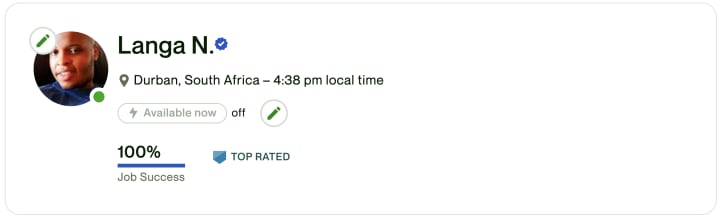
Screenshot of my Top-Rated statusSo I believe I can offer helpful and honest pointers on becoming a successful freelancer on the site. I have yet to try other freelancing platforms, but few can argue that Upwork remains the best.
My goal is to help freelancers see the platform in a different light and try things they haven't yet to tilt the odds in their favour. So here we go!
Some background on my Upwork journey
I discovered Upwork in 2018, but I officially started working over there only a year later. Before then, I survived for a few years doing primarily transcribing work.
From October 2018 to October 2019, I stayed in a different city in South Africa, Joburg. A lot happened that forced me to move back to my hometown, Durban. But it was a blessing in disguise as it allowed me to try something new.
One of my goals was, of course, to establish myself on Upwork. I had a few years of experience trading forex and crypto. So, the simplest path was to become a blog writer for those topics on the site, which is what I still do today.
Now let's look at the simple yet key tips to increase your chance of success as a freelancer on Upwork.
1. Having a portfolio is a must
This is the essential element to your journey on Upwork. Many newbies join the site and believe they can land a client without proving they can do whatever they offer.
Few will rarely take you seriously unless you have a portfolio. When I started, I created a super-basic WordPress blog talking about certain forex and crypto-related topics.
That was enough to get my foot in the door and land my first client after a few weeks of submitting proposals.
I know it is a little harder to prove your work in some niches. But, still, you have to find a way around it. You don't need to create a separate portfolio site, as Upwork has a feature to display your stuff professionally.
This is where you can direct your prospects to view examples of similar work in line with what they need. The point is that a portfolio demonstrates your experience.
One crucial concept I grasped early on about freelancing is that formal qualifications or certifications rarely matter. Clients only care about you having done the exact thing they need to be done.
I won't spend time on the profile (there are plenty of online resources on making that look pretty). It becomes easier to fill that in once you have a body of past work. That's why the portfolio is your foundation.
2. Creating compelling cover letters
Next up is having solid cover letters to convince potential clients to work with you. Again, I won't go too deep on this topic as it's been covered to death online. However, you need to understand that the first two lines are your make or break.
The reason is that that's what clients see when viewing your proposal. So, those lines are the 'hook' for them to open and read the rest of the letter.
While cover letters are vital, spending too much time creating the perfect one may be counter-productive. You shouldn't spend more than 10 minutes from seeing a post to submitting a proposal.
Yet, It's a catch-22 situation as, ideally, each proposal should be unique and not seem generic. Yet, on the other hand, that won't guarantee a greater hire rate.
The key to striking a balance is having a template or two that you can quickly tailor based on the needs of each job poster. That's what I use. The first two lines are almost always the same: they simply emphasise my experience with the type of work being offered and how happy my clients have been.
Then, the main body will have a few lines talking about the projects I've completed and links to previous work in this regard. Next, I'll round off with what the client will benefit from working with me. And then, finally, a call-to-action where I ask the client when we can schedule a call.
Keep it short and sweet with a compelling first two lines, a structured body and a CTA.
3. The early bird catches the worm
Sending proposals is time-consuming, no doubt. But it's pointless if you are applying to jobs posted many hours or days ago. So, timing is another make or break on Upwork – strike while the iron is hot.
You can have the best portfolio, profile and cover letter. Yet, you still need to increase the chances of clients viewing all of this stuff in the first place. The primary way of achieving this is by applying to posts as soon as possible once live.
Fortunately, there is a solution allowing you to respond when clients have posted their jobs immediately. The service is called Leapfrog Leads, which sends job alerts to your email once the jobs are up using filters you've created on Upwork.
The downside is that it costs quite a bit ($30 monthly) for the average person. But for those who can afford it, it's worth considering and will give you a leg up against other freelancers.
(Side note: I was today years old when I learnt from this Medium article of a site called IFTTT where you can use RSS feeds, including those from Upwork. It seems free or much cheaper. You'll have to verify as I've never used it, but I thought it'd be useful to mention.)
Here's why it's crucial to apply early, even though many Upworkers continue to debate this. In my experience, serious clients hire within a few hours or a day at the max. The sooner you apply, the higher the chances of your proposal being at the top of their results.
After a day, most clients are generally not in a 'hiring mood.' So it's pointless to apply then as they have less interest, which would be a waste of 'connects.' Of course, it's not always possible to apply immediately due to physical and time constraints.
Still, the sooner you do, the greater your viewing rate, the higher the views, the higher the interviews and the higher the chances of getting hired.
4. Job search filtering
When you first start, applying to as many listings as possible makes sense. But as you get better, receive 5-star ratings and increase earnings, you become more selective. But this is an attitude to adopt from the get-go.
Quality is far better than quantity. Finding decent work with few or no job search filters is tough. Upwork allows you to filter to the finer details: job type, hourly range, experience level, location, connects needed, etc.
Of course, it's difficult to have a blanket approach over which filters to pick. The goal is to spend your connects wisely and not use them willy-nilly.
You'll have to decide on your particular filters, but here are things to note:
- Regardless of your experience on the platform, avoid clients without payment verification. These are often new to Upwork and have a reputation for low hire rates and putting up tons of 'spam' posts.
- If you're new, consider applying only to 1, 2 or 4-connect jobs to build up your profile. Then, over time, you can filter to only 6 or 8-connect stuff.
There are other things you'll weed out as you go along, such as avoiding clients with hire rates less than 50%. The point is that you should reach the listing carefully and watch for any red flags.
As freelancers, we have a right to be selective about who to work with (and vice versa for clients).
5. The 80/20 rule
Pareto's principle in freelancing and Upwork describes how 80% of your income comes from 20% of your clients. On the one hand, freelancing is about casting your net widely by speaking to many prospects at once.
Yet, many freelancers can agree that most of their yearly income comes from 2–3 people. For myself, only two jobs or clients (out of 22) contribute to over 80% of my lifetime Upwork earnings. So, one client can definitely change your life.
The point is you should always aim to build long-term relationships with clients. You do this by assessing their project and seeing how you could add value. It is not always clear if a one-time job will turn into many jobs down the line.
You may need to do much convincing in the initial phase for a client to give you a chance. Yet, if you see some long-term potential, bear with it, even if it means dealing with criticism about your work.
Of course, there are some clients that you cannot please no matter what. The point is to make a good first impression, potentially leading to more work over time.
Final word
Upwork has continued to receive a lot of flak in the last few years, which is warranted. Few freelancers, including myself, can rely on it for consistent income due to the many negative changes over the years.
Yet, once you know how to get ahead, it can be one stream among other income streams. My goal was to share my lessons that will hopefully be useful to others. I wish you all the best!!!
(If you're looking for laughs, success insights, staying updated on the latest changes and more about Upwork, I recommend this subreddit.)
About the Creator
Langa Ntuli
- fascinated by the financial markets & TradingView charts. Freelance writer @upwork (www.upwork.com/freelancers/langan)
Medium account: medium.com/@lihle_ntuli
Also a humble music nerd, football fan, knowledge hoarder, peace/love extremist.
Keep reading
More stories from Langa Ntuli and writers in Journal and other communities.
Meet The Man Who Flash-Crashed The Stock Market From His Bedroom
It's funny how one person's seemingly small actions from his bedroom can result in an event with international news coverage. This was the case with the infamous 2010 Flash Crash that sent shockwaves to the stock market, even for only about 36 minutes.
By Langa Ntuli3 years ago in Trader




Comments
There are no comments for this story
Be the first to respond and start the conversation.