
Attacks at 12 Locations in Pakistan’s Balochistan: What Does the Expansion of Militants’ Organized Operations to Quetta Mean?
Politics Louder Than Gunfire
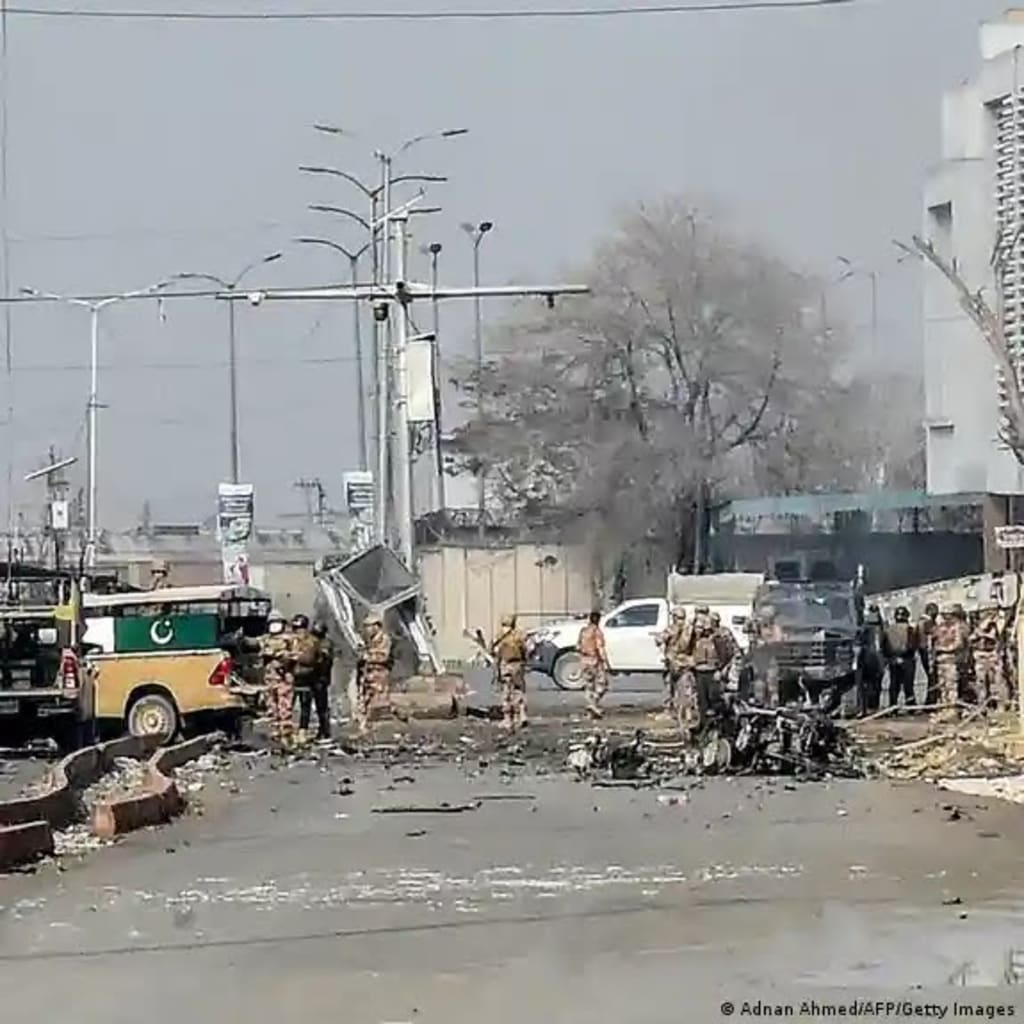
Attacks at 12 Locations in Pakistan’s Balochistan: What Does the Expansion of Militants’ Organized Operations to Quetta Mean?
The Government of Pakistan has confirmed that at least 37 militants and 10 security personnel have been killed so far in attacks carried out in 12 cities of Balochistan, including Quetta. However, security sources claim that 67 militants were killed in retaliatory operations on Saturday.
According to security sources, 41 militants were killed yesterday during various operations in Panjgur and Shaban, after which the number of militants killed over two days has reached 108.
A local police official stated that in Kharaan, an attack on the residence of Mir Shahid Gul Malazai, Chairman of the Malazai National Alliance, resulted in the deaths of seven people including Shahid Gul. Police said that his house and vehicle were also set on fire.
Security sources say that in the attack in Gwadar, 11 members of a family from Khuzdar were killed, including three women and three children.
The government claims that terrorist attacks in various cities, including the provincial capital Quetta, were thwarted. Besides Quetta, terrorists carried out attacks in Mastung, Pasni, Gwadar, Kharaan, Noshki, and Mach, though official details of these incidents have not been provided.
Reports were also received of an attack on the Maritime Security Agency office in Pasni by a female suicide bomber, but authorities have not provided details of the losses there.
The banned separatist group Balochistan Liberation Army (BLA) claimed responsibility for these attacks in a statement, calling them the second phase of “Operation Herof.”
Similar organized attacks were witnessed in August 2024. The BLA had also claimed responsibility for those attacks and named the operation “Herof.”
Attacks Inside Quetta Are a Message That We Can Come Anywhere
It is not the first time that armed groups have entered multiple cities of Balochistan simultaneously, targeting police, government and security buildings, and carrying out suicide attacks.
However, in the recent attacks, it was seen for the first time that such operations also took place inside Quetta, the provincial capital. A powerful explosion was heard in one area of Quetta early in the morning, after which the city’s Red Zone was sealed and emergency declared in hospitals.
Quetta has been considered relatively secure, and security check posts and a protective cordon have been established around the city. Numerous checkpoints also exist inside the city.
Do the recent attacks inside Quetta indicate a security or intelligence failure?
Muhammad Shoaib, associated with the Department of International Relations at Quaid-e-Azam University, Islamabad, says that Pakistani cities have expanded so much that such a “failure” could occur anywhere—even in Islamabad.
In his view, the fact that the attackers were killed quickly shows that security institutions were better prepared.
“The speed with which videos and images emerged suggests that security forces managed to control the fallout. It seems they learned lessons from previous attacks and were somewhat prepared for such situations.”
However, Shoaib says it is indeed the first time that such attacks reached the provincial capital, which is a major development.
“Their arrival in Quetta is a big statement. It is a message from them that we can come wherever we want. People outside Quetta did not expect this, as the city’s security is considered relatively strong.”
Shoaib says that observing the locations targeted in various cities shows that mostly major government and security offices were attacked in each district.
He believes that the expansion of attacks to Quetta indicates that support for the attackers has penetrated the general population.
“The fact that this movement has continued for so long shows that the issue is far more complex.”
According to him, the biggest security challenge in Balochistan is political:
“You have to win hearts and minds. Fighting should be the last option, not the first.”
Such Organized Attacks in Quetta Impossible Without Local Support
Dost Muhammad Baloch (Breach), an analyst based in Balochistan, said that like the August 2024 attacks, the recent ones were also large-scale and organized, and for the first time appeared to reach Quetta.
He agrees that:
“Carrying out such organized attacks in Quetta is impossible without local support. Large-scale operations cannot happen without local sympathies.”
He also agrees that the state’s major challenge is winning the hearts and minds of local people.
“If large military operations continue, people’s grievances will increase. In guerrilla warfare, the real prize is the support of ordinary people.”
He believes the state is trying to win public support, but it is a time-consuming process and must reach the grassroots level.
He cited provincial government initiatives such as:
Balochistan Special Development Program
Balochistan Education Endowment Fund
Balochistan Youth Policy 2024
Benazir Scholarship
Establishment of technical and vocational institutions
He added that another problem is that Balochistan has only one metropolitan city—Quetta.
“If more urban centers are developed, focus will not remain solely on Quetta, and efforts to solve people’s problems will be visible outside Quetta as well.”
He also believes the attacks reveal another dimension—the presence of valuable minerals and gemstones. According to him, both major global powers, the United States and China, have their eyes on these resources.
Some recent videos suggest that the BLA wants to send a message that access to Balochistan’s minerals will not be possible without their consent.
Educated Recruits More Dangerous Than Old Fighters
Muhammad Shoaib of Quaid-e-Azam University says the state also faces the challenge that separatist movements are using social media to promote nationalism.
Educated middle-class youth are influenced and join these movements. Shoaib believes these educated militants are more dangerous than old fighters because they are ideologically driven.
“Unlike old fighters who simply picked up guns, these educated militants are smarter in using weapons and technology.”
He says the state appears to be trying to resolve Baloch grievances, but it must first understand the nature of those grievances and identify what kind of people are joining the movement.
“Local problems need local solutions. The center tries to assess Balochistan from afar, which is very difficult.”
He adds that freedom of expression helps reveal people’s grievances, and the state must provide more local platforms for such expression.
About the Creator
Keep reading
More stories from writers in Journal and other communities.
After the Storm
After the storm of winter snow there sat a small bear by the name Ted, of course. He loves the snow and likes to roll around in it making all sorts of trails and whatever he has a mind to do. He wondered where all the people are, but in a way, he is hoping that they are all snug in the homes maybe drinking hot chocolate-one of his favorite drinks with mini-marshmallows and eating something homemade for he likes this winter wonderland all to himself to romp and play and maybe even catch some fish down by the river.
By Mark Graham4 days ago in Fiction




Comments
There are no comments for this story
Be the first to respond and start the conversation.