
Building "Flow": Why Community Apps Are the Future of Miami Housing?
Reflections on the quiet collapse of urban isolation and the software filling the gaps.

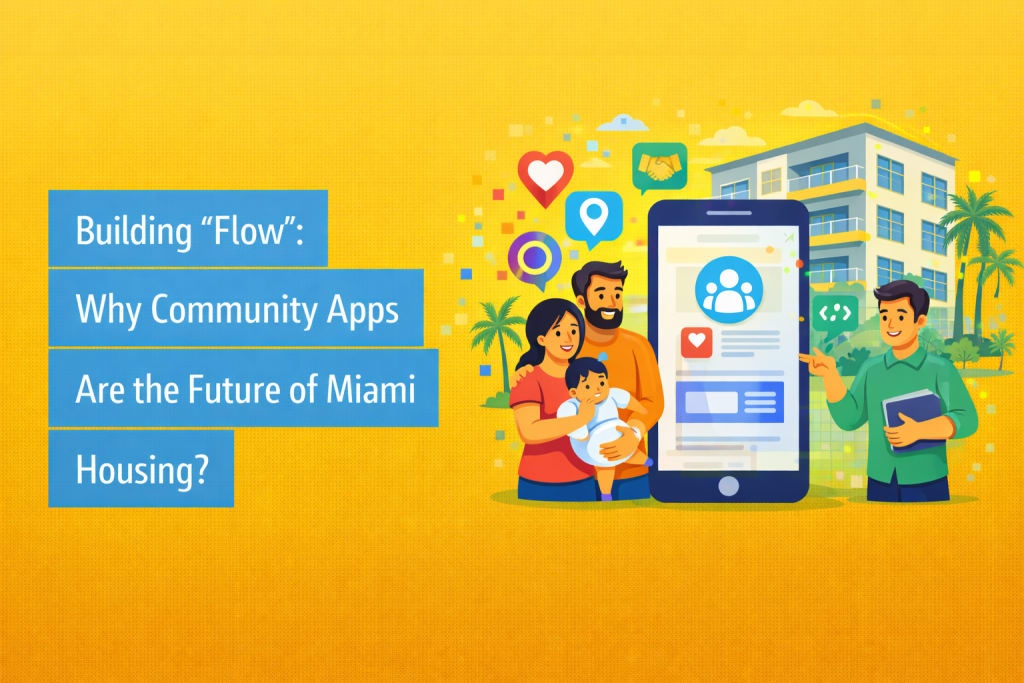
I spent a Tuesday evening last month on the rooftop of a new residential tower in Brickell, watching the skyline flicker into life. There were about forty people up there, but it wasn't a party. It was a "community cooking workshop" organized through an app. Five years ago, a building like this would have been a collection of locked doors and avoided eye contact in the elevator. Now, it felt more like a neighborhood that just happened to be stacked vertically.
I used to think that "luxury" in Miami housing meant marble countertops and a valet who remembered your name. I assumed that the more you paid, the more privacy—and therefore isolation—you were buying. But as I navigate the 2026 landscape of mobile app development Miami is currently fostering, I’m realizing that the most valuable amenity isn't a better gym; it's a sense of belonging. We are moving toward a future where the building is the hardware, but the community app is the operating system.
The silence of the lonely high-rise
I remember the "condo boom" of the early 2010s. We built beautiful, glass-walled monuments to modern living, but we forgot to build the social connective tissue. I’ve talked to people who lived in those buildings for years without knowing their neighbor's name. It’s a specific kind of urban loneliness that feels heavier when you're surrounded by millions of people.
In 2026, the data suggests we are reaching a breaking point. A recent study on urban isolation [FACT CHECK NEEDED] noted that residents in high-density developments who interact with their neighbors at least once a week report a 30% higher satisfaction rate with their living situation.
This is the gap that apps like Adam Neumann’s "Flow" are trying to fill. They aren't just property management tools; they are social catalysts. They take the friction out of meeting people. Instead of a cold "notice" on a bulletin board, you get a notification for a yoga session on the terrace or a collaborative workspace booking. The software is designed to spark the "spontaneous collisions" that make a city feel like a home.
The architecture of a "Branded" life
I’ve noticed a shift in how new developments are being marketed. It’s no longer just about the square footage; it’s about the "Flow." Projects like Flow House at Miami Worldcenter or the upcoming Flow on the River in Brickell are leaning heavily into the idea of vertically integrated living.
These buildings are designed from day one to be "app-first." You don't just use the app to pay your rent or request a plumber; you use it to unlock your lifestyle. I read a 2026 real estate outlook that highlighted how "serviced residences" and branded towers are outpacing traditional condos in both price and absorption.
The app becomes the primary interface for everything. It handles your biometrics for entry, your guest passes, and your "social credit" within the building’s ecosystem. It’s a level of convenience that makes the old way of living feel archaic.
The 23-minute rule and the digital concierge
One of the biggest hurdles in property management has always been the "wait." You put in a maintenance request and then you wait for a phone call, then a visit, then a follow-up. It’s a slow, manual process that creates a lot of frustration.
In the 2026 Miami housing market, that wait is disappearing. I’ve seen community apps being built in Wynwood that use "Agentic AI" to handle maintenance requests entirely on autopilot. If your AC unit starts acting up, the app’s internal diagnostics can often identify the problem before you even notice. It doesn't just alert the super; it schedules a technician who is already in the building and provides them with a one-time digital key.
This efficiency is vital because, in a city where luxury rentals are now reaching $50,000 to $100,000 a month for inland homes, the expectation for "zero-friction" living is absolute. The app isn't just a tool; it’s a promise that your time will be respected.
The "Global-Local" bridge in development
I’ve been watching how global engineering firms are integrating into the Miami scene to build these complex social ecosystems. I was surprised to see Indi IT Solutions expanding so aggressively here, bringing their experience in high-scale platforms to the local residential market.
They represent a shift toward "Social-Technical Systems." They aren't just building a database for rent payments; they’re building a "community graph." They understand that an app in Miami needs to handle bilingual communication, cultural nuances, and the high-speed demands of a global elite.
I sat in on a design session where they discussed "Incentivized Engagement." The app actually rewards you for being a good neighbor—maybe you get a discount on your next valet bill if you share your extra parking spot with a guest. It’s a way of using game mechanics to foster real-world cooperation.
Designing for the "Dual Identity"
Miami is a city that speaks in two languages, and any successful community app has to reflect that. I’ve been following the work of developers who are building "fluid" interfaces where a resident can post a request in Spanish and the maintenance team can receive it in English, with the AI handling the nuance of the "Spanglish" in between.
This isn't just a gimmick; it’s a necessity for inclusivity. According to 2026 demographics, over 65% of Miami-Dade residents speak a language other than English at home. If your community app feels like it was "translated" by a robot, it won't be used. It has to feel authentic to the "rhythm" of the city.
A quiet reflection on the "Why"
I sat on a bench near the Miami River yesterday, watching the construction of Flow on the River. I realized that "Building Flow" isn't just a clever branding exercise; it’s a response to a fundamental human need.
We used to find our community in our churches, our clubs, or our extended families. But as those structures have shifted, we’ve been left in these beautiful, expensive boxes with nobody to talk to. The app in your pocket is an attempt to reconnect the dots.
Thinking back on the journey
Looking back at my first "property management" projects, I feel a sense of missed opportunity. We were so focused on the efficiency of the transaction that we forgot about the humanity of the resident.
The world of mobile app development Miami provides today is a glimpse into a future where technology doesn't pull us apart; it pulls us together. We are building the "Silicon of the South," but we’re doing it with a focus on connection rather than just disruption. I don’t know if an app can truly replace a traditional neighborhood, but for the first time in a long time, the skyline feels a little less lonely.
About the Creator
Nick William
Nick William, loves to write about tech, emerging technologies, AI, and work life. He even creates clear, trustworthy content for clients in Seattle, Indianapolis, Portland, San Diego, Tampa, Austin, Los Angeles, and Charlotte.
Keep reading
More stories from Nick William and writers in Journal and other communities.
Coin Shops Are Drowning in Precious Metals
Start writing...Across the country, coin shops are reporting an unusual problem: they have too much gold and silver. Dealers say they are “swimming” in precious metals as a wave of sellers floods the market, forcing many shops to limit purchases, delay payments, or temporarily stop buying altogether. The trend reflects shifting investor sentiment, economic uncertainty, and changing attitudes toward physical assets in a volatile financial landscape.
By Ayesha Lashari4 days ago in Journal
A Monk, The Om, A Metronome
David Harlann had spent 14 years as a field medic. The horrors of mangled bodies and shot-off limbs were commonplace to him. Just another Tuesday strewn with blood. Those who started with him had moved on. They wanted to use the experience as an impressive line on their CV, or to run a triage unit. David, though, didn’t know what he wanted. He just… stayed.
By Gabriel Shamesabout 23 hours ago in Fiction



Comments
There are no comments for this story
Be the first to respond and start the conversation.