
Can A Lion Cause An AI Company To Loss Millions of Dollars?
Fact, Speculation, and the Thin Line Between Reality and Story

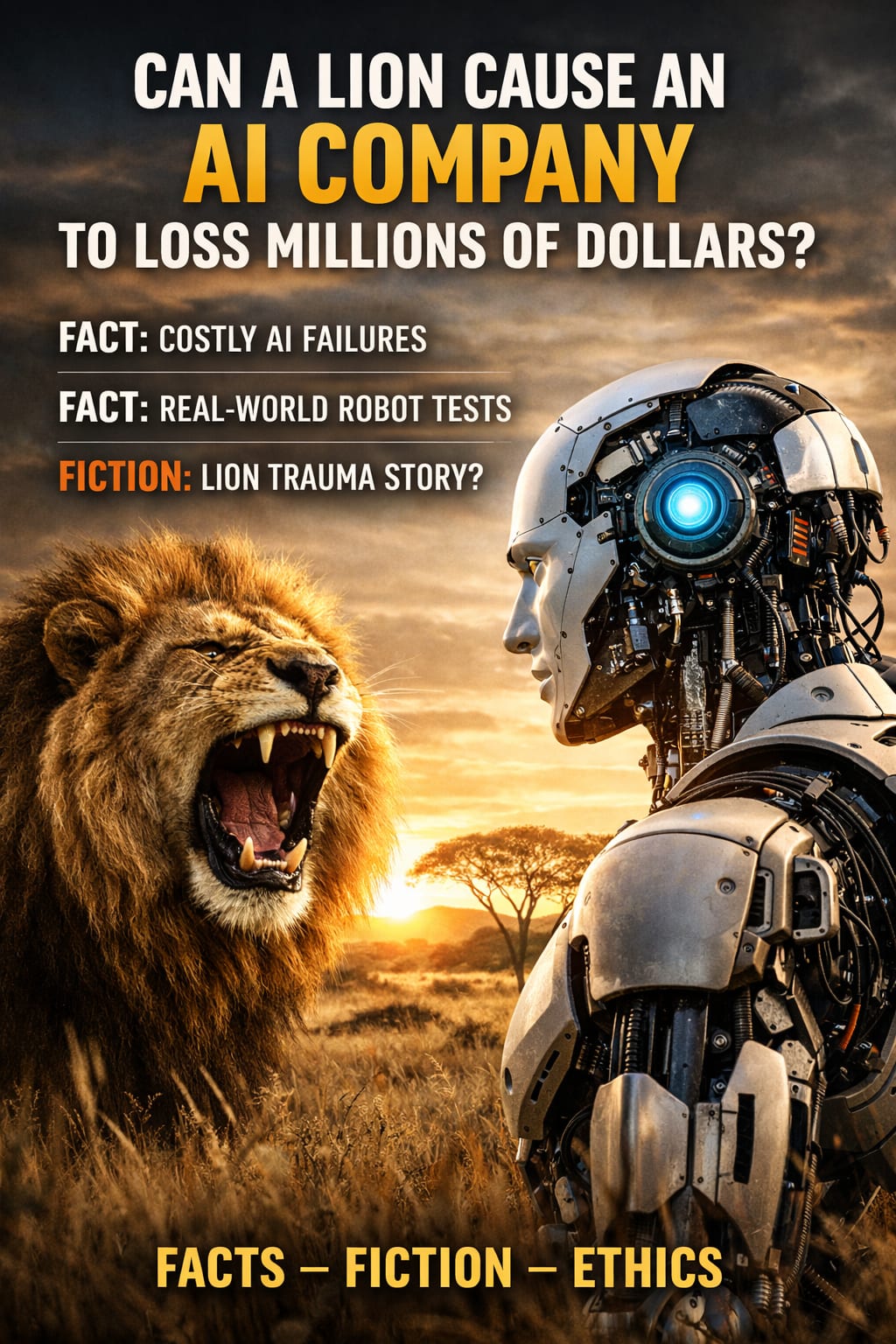
In an age where artificial intelligence is advancing at breakneck speed, stories about machines behaving in unexpected ways capture public imagination quickly. One particularly striking narrative asks: can an encounter with a lion really cause an AI company to lose millions of dollars?
The short answer: there are real facts about costly AI failures and field testing — but the specific story of a robot getting “traumatized” by a lion lives largely in the realm of speculation and illustrative storytelling.
Let’s separate what we know from what we imagine
What Is Fact: AI Experiments Can Cost Millions
There is no doubt that AI research is expensive. Companies routinely spend millions — sometimes billions — on developing, testing, and deploying advanced systems.
Real-world examples show how costly setbacks can be:
Self-driving car programs have experienced crashes leading to expensive redesigns and delays.
Robotics projects often face hardware failures during field testing.
AI models sometimes require retraining after unexpected behavior, costing significant compute resources.
Major organizations like Boston Dynamics and OpenAI invest heavily in testing systems in complex environments precisely because real-world conditions reveal weaknesses simulations cannot.
Fact: When prototypes fail, companies can lose substantial money through repairs, downtime, and reputational impact.
What Is Fact: Robots Are Tested in Harsh Environments
Robotics researchers regularly deploy machines in difficult settings:
Disaster zones
Remote wilderness areas
Industrial sites
Military and search-and-rescue operations
Testing in environments with unpredictable variables — including wildlife — is not unheard of, especially for environmental monitoring or conservation technology.
Fact: Field testing is essential to building resilient AI systems.
Where Fiction Enters: The “Lion Trauma” Narrative
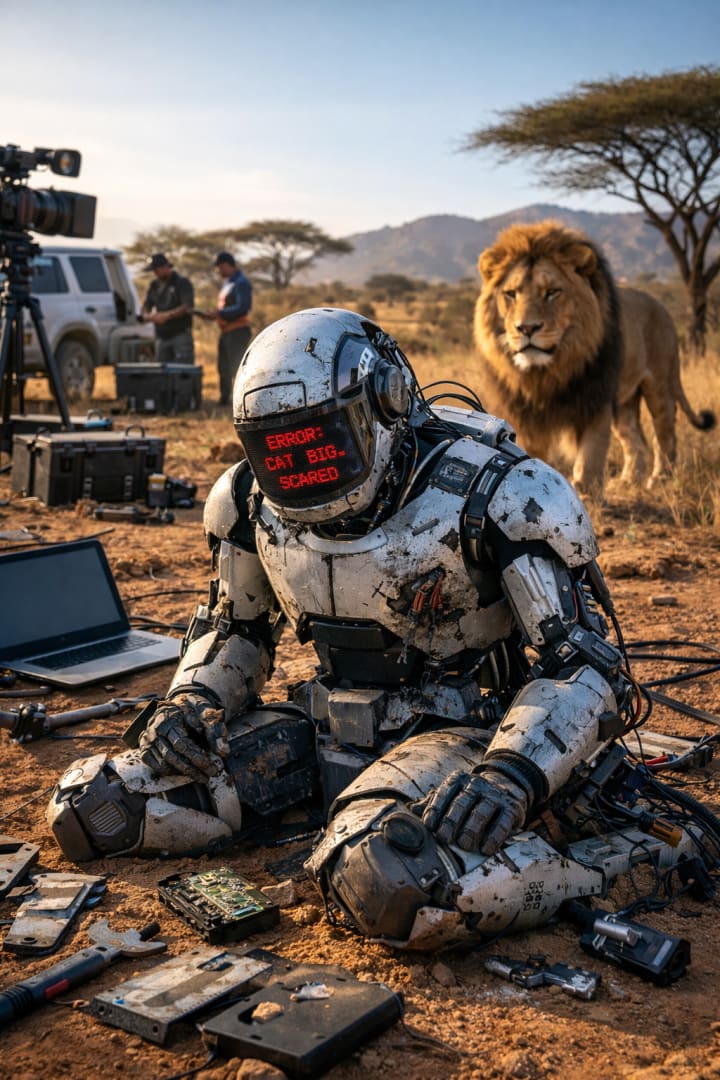
The idea of a robot developing something like PTSD after encountering a lion is best understood as a metaphor or thought experiment rather than a documented scientific case.
There is no verified public record of an AI robot being psychologically “traumatized” by a lion or any animal.
However, the story resonates because it reflects real technical phenomena:
Systems can enter failure loops after unexpected inputs.
Machine learning models can overreact to rare events.
Edge cases can destabilize algorithms.
Calling this “trauma” is a human analogy — useful for storytelling but not a clinical or engineering diagnosis.
Fictional element: The emotional framing of fear or PTSD in machines.
What Is Fact: AI Can Fail in Surprising Ways
Researchers often observe unexpected behaviors when systems encounter scenarios outside their training data — known as “distribution shift.”
Examples include:
Image recognition systems misclassifying objects under unusual lighting.
Language models generating incorrect or nonsensical outputs.
Autonomous robots halting when encountering unfamiliar obstacles.
Fact: AI is powerful but still brittle when facing novelty.
Why the Lion Story Persists
Stories like this endure because they dramatize a real concern: the gap between simulated intelligence and real-world complexity.
A lion represents the ultimate symbol of unpredictability — a reminder that nature cannot be fully modeled.
Even if the literal event is fictional, the lesson is grounded in reality:
Extreme scenarios expose limitations.
Engineers must plan for rare events.
Overconfidence in models can be costly.
Real Financial Risks in AI Development
Companies can lose millions due to:
Hardware damage
Delayed product launches
Regulatory scrutiny
Investor reactions
Reputational harm
In large-scale research programs, even a single failed experiment can cascade into months of additional work.
Fact: Financial loss from experimental setbacks is common in cutting-edge technology.
The Ethical Angle: Learning from Hypotheticals
Even hypothetical stories serve a purpose. They prompt serious questions:
Should AI be exposed to extreme stress conditions?
How do we design systems that recover gracefully from failure?
What responsibilities do researchers carry when deploying experimental technology?
Thought experiments — even fictional ones — help shape ethical frameworks.
What Experts Actually Say About “AI Emotions”
Scientists generally agree:
AI does not feel emotions.
Apparent emotional responses are pattern recognition outputs.
Terms like “fear” or “trauma” are analogies, not literal experiences.
Understanding this distinction is crucial to avoiding misunderstandings about machine capabilities.
A Balanced View: Story as Metaphor
Think of the lion narrative as a parable about innovation:
The lion symbolizes real-world uncertainty.
The robot represents human ambition.
The failure reflects the cost of learning.
Stories often communicate truths more vividly than technical reports.
Conclusion: Fact Meets Imagination
So — can a lion cause an AI company to lose millions?
In reality: Companies can lose millions when experiments encounter unexpected challenges.
In storytelling: A lion encounter becomes a vivid way to illustrate those risks.
The blend of fact and fiction reminds us that while technology advances rapidly, humility remains essential. The world is complex, and no model captures it perfectly.
About the Creator
Omasanjuwa Ogharandukun
I'm a passionate writer & blogger crafting inspiring stories from everyday life. Through vivid words and thoughtful insights, I spark conversations and ignite change—one post at a time.
Keep reading
More stories from Omasanjuwa Ogharandukun and writers in Journal and other communities.
Ramaphosa’s SONA 2026: A Nation at a Turning Point Amidst Challenges
South Africa’s President Charts a Course for Optimism and Action President Cyril Ramaphosa delivered his much-anticipated State of the Nation Address (SONA) on February 12, 2026, painting a picture of a nation at a crucial turning point. Against a backdrop of persistent challenges, Ramaphosa’s speech sought to inspire optimism, outlining government plans for the year ahead with a particular focus on tackling endemic crime and addressing critical water crises. This blog post delves into the key themes of SONA 2026, the public’s reaction, and the implications for South Africa’s political and social landscape.
By Omasanjuwa Ogharandukun5 days ago in Journal
~ Fired ~
— Ai Intrusion ~ Are you Next ~ Is Ai Evolution after your job? — Few workplaces haven't been affected. Ai is in supermarkets, at doctors' offices, and even monitoring farms. I just can't think of anything this machine is not getting into, can you? For instance: Education ~ Law and Tech jobs will one day have a major influence or be taken over by these inanimate machines, with accuracy and vigor. From mechanics' diagnoses to a wide variety of everyday jobs, including fast food workers, with this input having the ability to cut their unnecessary work hours. I'm certain all of us have been touched by this with our short stories and colorful headings, have you? Even comments are very questionable 'Non-Robot' insertions.
By Jay Kantor18 days ago in Journal
GOAT Movie Review: A Fun, Heartfelt Animated Underdog Story
GOAT is the latest animated feature from Sony Pictures Animation, and this time the studio trades multiverses for sports arenas. The story follows Will Harris, a small goat with oversized dreams of playing in the elite Roarball League — a competition dominated by the biggest, toughest animals around. In his world, goats simply aren’t built for that level of play.
By Bella Anderson2 days ago in Journal



Comments
There are no comments for this story
Be the first to respond and start the conversation.