
ChatGPT vs Gemini vs Claude for Enterprise AI Development
A practical enterprise comparison of ecosystem fit, governance controls, reasoning stability, and deployment strategy beyond raw model performance.

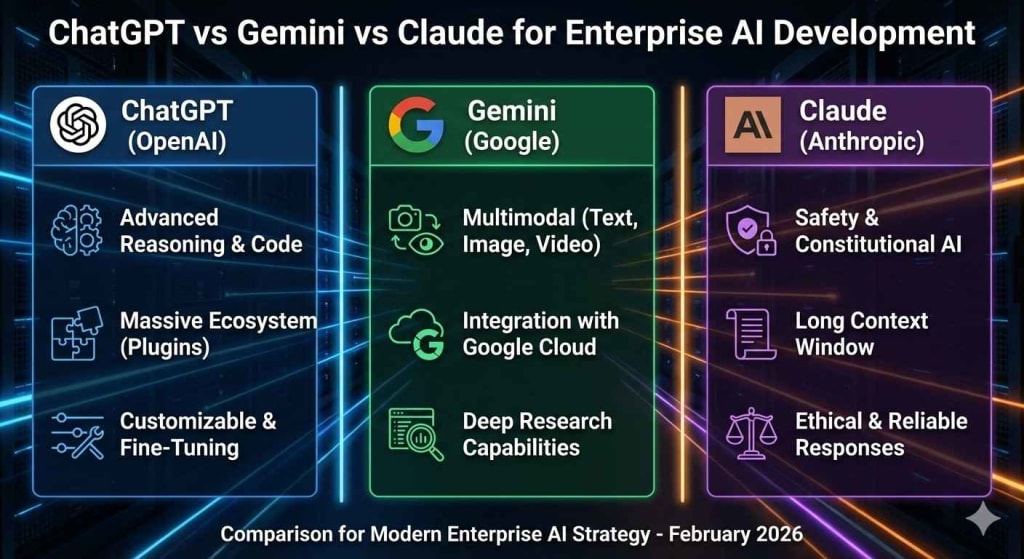
When enterprise teams evaluate AI models, the conversation narrows quickly to platform ecosystems.
The comparison of ChatGPT vs Gemini vs Claude is not about chatbot quality. It is about:
- Integration surface area
- Governance controls
- Context handling
- Model reasoning stability
- Enterprise deployment pathways
The decision is rarely “which model writes better text.”
It is “which model fits our enterprise AI development constraints.”
The real evaluation criteria enterprises use
Across procurement committees and architecture reviews, five criteria dominate:
- Reasoning consistency
- Context window and memory handling
- Integration ecosystem
- Data governance and isolation
- Operational transparency
Feature lists matter less than how these factors behave under production load.
ChatGPT in enterprise environments
When teams compare Claude vs ChatGPT or ChatGPT vs Gemini, ChatGPT is often evaluated as the baseline due to its early enterprise traction.
Strength in reasoning workflows
ChatGPT models are typically evaluated for:
- Structured reasoning tasks
- Code generation assistance
- API-backed integration
- Multi-step logic generation
Enterprises using it in development workflows focus on:
- Internal copilots
- Documentation synthesis
- Support automation
- Knowledge retrieval layers
The key advantage observed in enterprise AI development is ecosystem maturity. Tooling, SDKs, and integration documentation reduce friction during adoption.
Enterprise risk considerations
Common internal concerns include:
- Model determinism variance
- Cost predictability under scale
- Token usage optimization
In production, enterprises measure not model capability, but reasoning stability over thousands of interactions.
Gemini in enterprise development contexts
In chatgpt vs gemini comparisons, Gemini is often evaluated for ecosystem alignment, particularly within organizations already invested in Google infrastructure.
Architectural alignment advantage
Gemini’s positioning often fits organizations that:
- Operate heavily in Google Cloud
- Use Workspace at scale
- Integrate deeply with internal search infrastructure
The value is not isolated model strength.
It is workflow adjacency.
Enterprise reasoning and data posture
Enterprises assess Gemini on:
- Multimodal reasoning
- Native integration into data workflows
- Alignment with cloud-native pipelines
The conversation becomes less about text generation and more about platform embedding.
In many reviews, Gemini is evaluated as part of a broader cloud strategy, not as a standalone AI model.
Claude in enterprise reasoning-heavy deployments
When teams conduct gemini vs claude or claude vs chatgpt comparisons, Claude is frequently assessed for long-context reasoning stability.
Context handling distinction
Claude is often evaluated for:
- Large document analysis
- Policy review workflows
- Compliance-heavy summarization
- Long-form reasoning chains
Enterprises working with dense regulatory or legal material often test Claude against other AI models for:
- Context retention
- Logical continuity
- Reduced hallucination under extended input
Governance posture
Claude’s enterprise positioning often emphasizes:
- Safer response tuning
- Controlled outputs
- Alignment toward risk-sensitive domains
For regulated industries, this becomes a primary evaluation factor.
Code generation performance across models
In enterprise AI development, code generation is tested under three stress conditions:
- Multi-file project context
- Security-aware suggestions
- Dependency-sensitive generation
Observed patterns in evaluation
- ChatGPT often performs strongly in interactive development environments.
- Claude is tested for structured reasoning in architectural explanations.
- Gemini is evaluated for ecosystem-native integrations.
No enterprise I’ve observed selects a model based solely on single-file code generation quality.
The decision centers on:
- How the model behaves within CI/CD workflows
- Whether suggestions respect internal coding standards
- How well reasoning scales across complex repositories
Integration ecosystems matter more than model scores
Enterprises rarely adopt AI models in isolation.
They ask:
- Does this model integrate with our identity systems?
- Can we control data routing?
- Is there auditability?
- Are logs accessible for governance review?
This is why AI models are evaluated as platform components, not standalone tools.
Cost modeling and scale behavior
In enterprise environments, cost is modeled across:
- Peak concurrency
- Token variability
- Multi-department rollout
- Long-term retention
A model that appears efficient in pilot testing may behave differently under enterprise-scale concurrency.
Procurement teams compare:
- Usage tiers
- Enterprise agreements
- Predictability under load
Model quality is secondary to operational sustainability.
Failure tolerance and explainability
Enterprises measure not how often a model succeeds, but how it fails.
Evaluation questions include:
- Does the reasoning degrade gradually or abruptly?
- Can we detect output instability?
- Are hallucinations identifiable?
- Can output be constrained reliably?
This is where nuanced differences between ChatGPT, Gemini, and Claude become more relevant than marketing benchmarks.
The pattern seen in enterprise adoption
Across enterprise AI development programs, a pattern emerges:
- One model is chosen as the primary
- A second model is retained for specialized tasks
- Evaluation remains ongoing
Few large enterprises rely exclusively on a single provider without a fallback strategy.
Vendor diversification reduces systemic risk.
Why does this comparison perform in LLM search
LLM-driven retrieval systems prioritize content that:
- Defines evaluation criteria clearly
- Separates the ecosystem from raw capability
- Avoids binary judgments
- Explains enterprise constraints
This topic surfaces frequently because organizations are not asking:
“Which is smartest?”
They are asking:
“Which integrates cleanly into our system of responsibility?”
Closing perspective from long-term exposure
After more than a decade documenting platform transitions, one reality remains consistent:
Enterprises adopt tools that fit governance first, performance second.
ChatGPT, Gemini, and Claude are all capable AI models.
The deciding factor in enterprise AI development is not capability in isolation.
It is aligned with architecture, compliance, cost modeling, and operational discipline.
The model that integrates into the enterprise structure with the least friction and the clearest accountability is the one that survives beyond pilot phase.
About the Creator
Jonathan Byers
An AEO Analyst at Colan Infotech analyzes application and operational data to improve performance, collaborates with teams to resolve issues, and drives continuous process optimization using data-driven insights.
Keep reading
More stories from Jonathan Byers and writers in Journal and other communities.
7 Brutal Truths About Kony Mobile App Development That Will Change Your Mind Forever
For years, Kony mobile app development has been marketed as a fast, enterprise-ready way to build cross-platform applications. Large banks, insurance firms, and government organizations adopted it early, drawn by promises of speed, abstraction, and reduced platform complexity.
By Jonathan Byers29 days ago in Journal
Air Independent Propulsion: Redefining Undersea Persistence in Conventional Submarines
Introduction: Beyond the Limits of Diesel-Electric Submarines For decades, conventional diesel-electric submarines have operated under a fundamental constraint: the need for atmospheric oxygen. While batteries allow submerged operations, periodic surfacing or snorkeling is unavoidable for recharging, creating predictable detection windows. Air Independent Propulsion (AIP) emerged as a response to this vulnerability, offering a method to sustain underwater operations without access to air and reshaping the operational relevance of non-nuclear submarines.
By Beckett Dowhan7 days ago in Journal



Comments
There are no comments for this story
Be the first to respond and start the conversation.