

Sometimes, in a rare, quiet moment, I wonder if maybe it could have all been different, if we hadn’t run out of wood for the stove and if the storm hadn’t hit on a Thursday.
Bill worked late on Thursday’s at the municipal airport unloading baggage. Those were the evenings I was able to relax, no cooking, no talking, no listening. I would lay on the old living room couch, my dinner in my hand — sharp cheese and salami slices — and stare into the fireplace, the wiggling flames reducing to embers until I caught a cool breeze and put another log in the stove. Some of these quiet nights I would write little notes to myself, an act of privacy I suppose, where I could explore all the mysteries of my thoughts. It was the only time I could write without Bill making a scene, yelling about how my thoughts are nonsense and snatching the black-bound book from my hands. He would hide my journal from me, but I would find it eventually and put it back in my bedside stand. Other nights, when my journal was missing and I couldn’t write, I would happily lay there thinking of nothing and just watch the glow.
—
“Start the fire,” Bill said grabbing his coat from the rack, his dense boots thudding loudly down the hallway toward the door, “they say the storm is coming a day early.”
One of his co-workers was honking wildly out front, the phone was ringing, and Bill was out the door before I noticed we were out of wood. He usually stocked the pile but he was working extra hours this month to afford this or that, or so he said.
“Hello?”
“Ms. Bryer?”
“Yes”
“This is Diane Givens with the Woodford County Credit Union”
“Yes.”
“Is your husband home? Maybe I should speak with him.”
“What is this about?
“The home, ma’am. The payments were never received.” There was a brief pause. “We're going to have to foreclose on the home.”
“Okay…” I was thinking.
The woman’s voice became hurried, “Really, miss, if you’re husband is home..um..William Bryer, yes, William is the primary on the account.”
“Bill isn’t home.”
I hung up.
I couldn’t say I was surprised or felt anything really. We were always just getting by, ebb and flow, it was just a part of it. There were moments of perceived affluence, a financed motorcycle or a trip to Cincinnati and a night in a fancy hotel. Then the motorcycle was repossessed when Bill stopped paying the payments and we were left with nothing more then a heap of unpaid speeding tickets. He lost his license over it and, with it, any chance at good work. I said I wanted to work, but he refused. It was his job to make the money for his family, he would repeat definitively and I wouldn’t argue. I was his only family, and if I could control anything it would be to keep our family small. It’s why I got an abortion the previous spring. Bill, of course, had no idea. I told him my sister was sick and I had to visit her for a week in Chicago to help look after her kids. He gave me four hundred dollars and drove me to the train station.
You would like that a memory of a person stay complete, but my memory of Bill lacks dimension. Sure, Bill could be kind in moments, like when he gave me money to go care for my sister, but mostly Bill was inconsistent, an uncontrollable man who wanted what he wanted, when he wanted it. It was the first thing I learned about him and the way I remember him most.
I’ll give you an example. When we first met I was on a date with another boy. The Smokehouse Diner on Sixth street was packed that Saturday night. I remember it so clearly. I had curled my hair; it was long and a deep and silky auburn back then. I had even dared to try a new color of lipstick, Violet Vixen. We had just ordered when my date, I forget his name after all these years, got up to use the restroom. Within moments Bill had singled me out, sliding confidently across the table from me as if he was the one sitting there all along. He had some story about how he knew when he walked in that his wife was going to be here tonight and that it most certainly had to be me. His broad shoulders added to his confidence and his tousled, mouse-brown hair danced playfully as he talked. Everything about the experience was confounding but I’d be lying if I said I wasn’t flattered. When my date returned, Bill introduced himself cordially and then, not so cordially, told him to beat it. I didn’t intervene.
Sometimes it feels as if all things, upon reflection, are unavoidable; that any outcome was clear all along and any alternative ending was simply impossible. What if I had asked Bill to leave that night and continued my date as planned? What if the forecaster’s were actually right for once and the storm hit us on the weekend when Bill would be home to build the fire? What if we hadn’t run out of wood?
I had only chopped wood a few times before. It was a playful thing for Bill to hand me the axe and watch me swing. It was clearly something I could do, but without practice felt awkward and a little dangerous. Without fully processing the phone call from Ms. Givens, beyond feeling it was a common annoyance, I put on my wool jacket and headed toward the shed where Bill kept the axe among other miscellanea. The shed was about twenty yards from the house. That stillness before the impending storm surrounded everything on the hillside that morning, everything was quiet: no birds, no rustling squirrels, it was as if the trees were asking for my quietness as well. I jostled the handle of the shed, it was locked with a small lock through a latch.
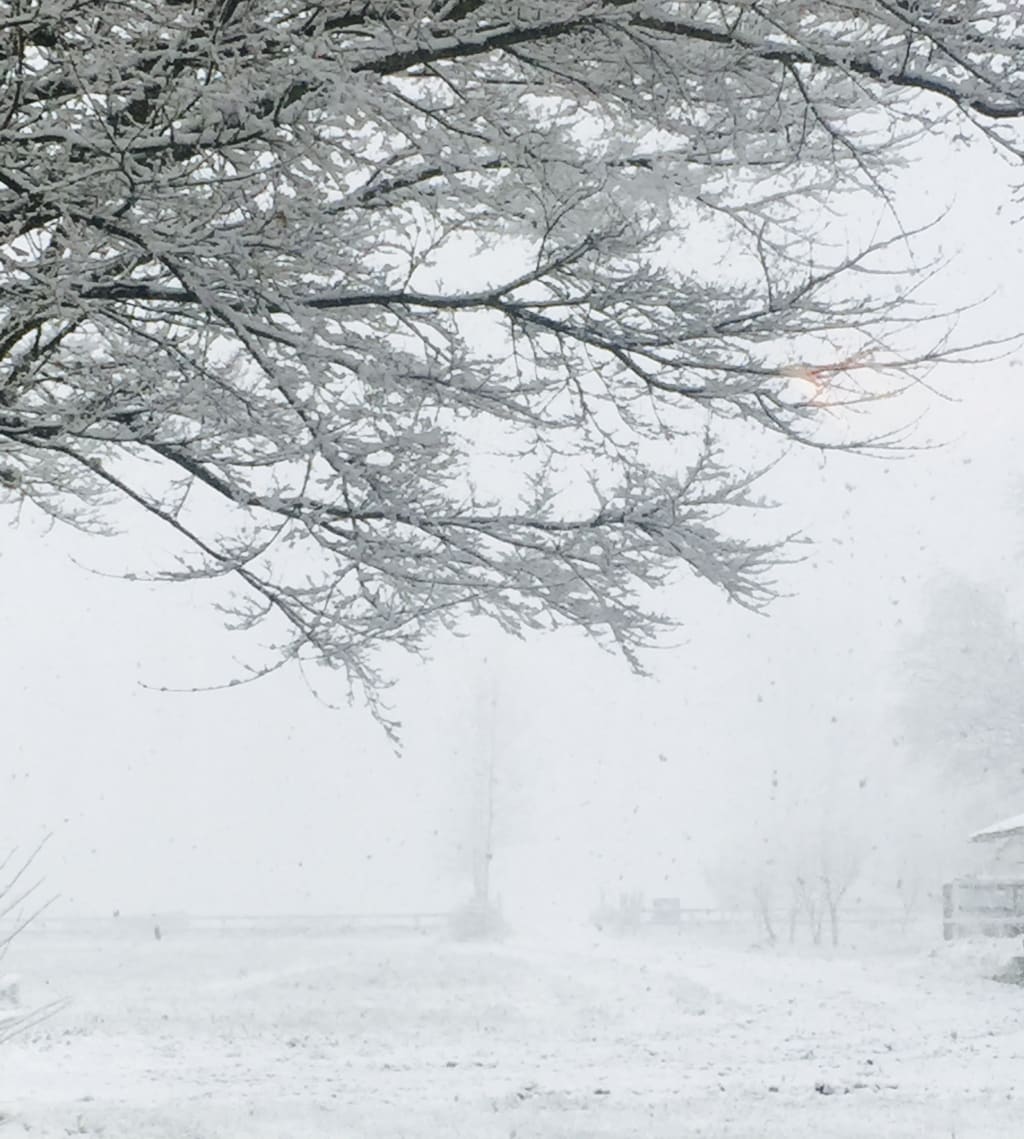
There are only a few good places to keep a key, especially a small one. I checked the basket by the phone, nothing. I hastily searched the junk drawer yet no keys matched the description. Frustrated, I stopped to think. I could see from the kitchen window the first bits of snow were beginning to fall outside; so sweet and magical landing thoughtfully on the ground.
That’s when I remembered. Two days before, Bill came stumbling drunk into the house from the shed, he had been out there working on something for hours, music blaring into the night. He stumbled past me in the kitchen, grabbed my ass, and headed straight into the mud room to undress. His dirty clothes were still in a pile on the floor. I held up his hoodie to check the pockets, nothing. His coat was laying across the lid of the washer, nothing. I reached for his jeans, feeling the pockets from the outside. There was something in them, not the small heaviness of a key but like a thick, folded fabric or tissue. I reached inside and pulled it out.
This is the part that makes no sense in retrospect. What I found in his pants was money, a lot of money. When I re-counted it on the train I held the bills stealthily between my legs, scared someone would see, but too curious and disbelieving to wait. It was twenty thousand in neatly banded one hundred dollar bills, an amazingly large sum in such a small package. The questions were never answered: Where did this come from? How was Bill so careless as to leave it in his dirty jean pockets? How could he have missed the mortgage payments? How? The questions will always be there.
I don’t remember how long I stood over his pile of clothes in the mud room holding the bills in my hands, looking at them like foreign objects. I had never touched something so valuable before. When I finally looked up, the snow was falling heavier and I could see my breath. The house was cold.
Certainly, I could bore you with what happened next, but you already know: I left that day.
I want to say I had this grand reaction, a great weighing of the options, nostalgia for our past or imaginings of a future, but I don’t think that was the case. Since then, I’ve become viscerally aware of the experience of making choices; the hi-def, confounding nature of the present in those moments, how the possibilities seem endless, the opportunities boundless, and the risk of mistake, terminal.
I felt none of that then. Beyond the colorful bills in my hand, everything seemed dull. The color of the walls, the floor, my pants and t-shirt, everything has a grey-wash over it when I try to visit that place in my mind.
We lived a little out of town and a little over three miles from the train station on Front Street. We lived so close Bill and I could hear the train whistle three times each day, like clockwork, as it would arrive and depart the station. I knew the schedule well and there would be a train arriving in a little over an hour. I packed a few pieces of clothing in a black bag, rolling all the money into my favorite dress, save for a single hundred which I placed in my pocket for train fare and maybe some food. I cleared what few things I had from my bedside stand: a watch, a letter from my sister in Chicago, two pencils, and my journal. I ripped out the pages I had written-on from the journal and stuffed them into the bag. I still had on my boots from my previous march to the shed and, with little hesitation, I began walking toward the station.
I shouldn’t give all this wondering much more time than I already have. However, there is a part of this memory that eludes me and I can’t seem to escape the mystery. It’s not something I cared to think of then, but I can’t help wonder about it now.
I wonder if Bill felt anything as he came home from work that night. Did the house smell different without a fire going, or without me in it? Was there an audible vacancy, or did he just lumber in unaware, shaking snow from his boots, sit in his chair and close his eyes? Was it right away or did he wait to pick up my journal; that worn, little black book, the binding rubbed thin from the inside of my jean pockets, pages half torn and missing. The ribbon frayed yet holding the last page on which I wrote:
Goodbye. Sorry about the fire.
Did he notice it right away, laid unusually and purposefully on the kitchen counter to be found? Or did he not go inside, but instead chose to follow my footsteps in the snow down the tree-lined path toward the road. It would have been easy at first to follow; just a single line of deep prints. But once he reached the main road they would have inevitably mixed with others and their direction would have been lost.
About the Creator
Jessica Clements
Gardener, friend of dogs and goats. A writer, too!
Keep reading
More stories from writers in Journal and other communities.
Solo Mio Review: A Valentine’s Day Getaway That’s Sweet, Scenic, and Slightly Forgettable
Today, we’re talking about Solo Mio, the latest romantic comedy-drama from Angel Studios. It tells the story of a man who gets left at the altar and then has to go on his already-booked Italian honeymoon… completely alone.
By Bella Anderson2 days ago in Journal




Comments
There are no comments for this story
Be the first to respond and start the conversation.