
How Users Make Decisions in an Age of Information Overload
In a world overflowing with signals, the role of digital products is no longer to inform

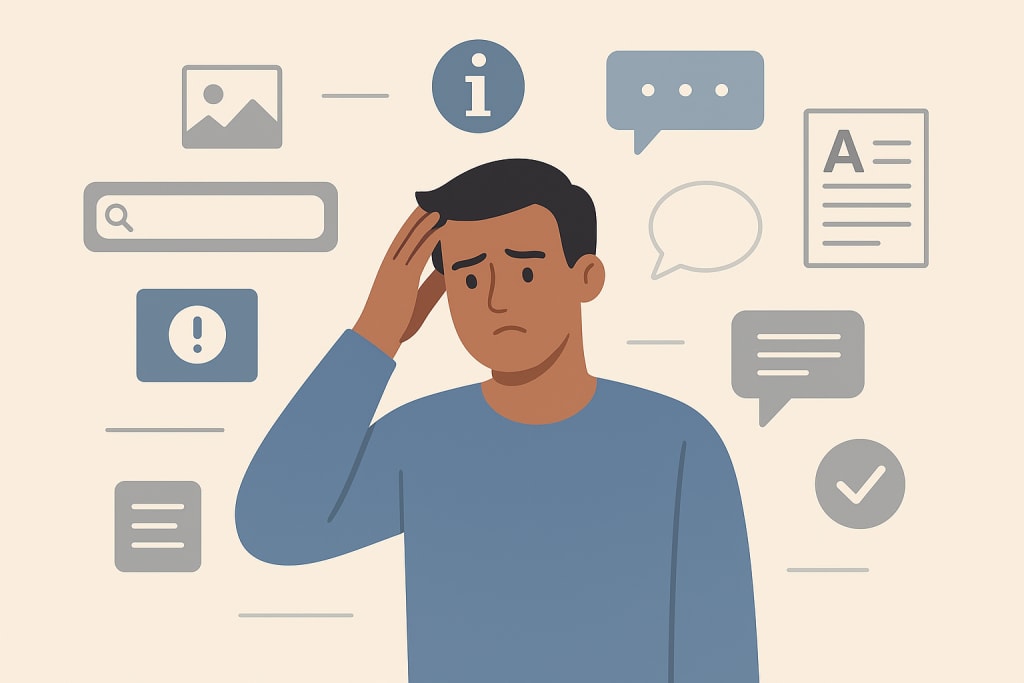
We live in a time when information is no longer scarce — it is overwhelming. Every day, the average user is exposed to more data than a person in the 15th century consumed in an entire lifetime. Notifications compete for attention, search engines deliver millions of results, and digital interfaces often offer more options than the human brain can comfortably process.
As a team at MiniMuzeum, we work closely with these patterns every day. Our research, product decisions, and constant observation of user behavior give us a front-row seat to how people actually navigate this flood of information. And the more we study it, the clearer it becomes: decision-making in the modern world is no longer just a practical action — it is a cognitive challenge.
Understanding how users move through this overload is essential not only for our own work, but for anyone building digital products today.
The Cognitive Burden of Too Many Choices
A common misconception in digital design is that more options equal more value. In reality, the human mind defaults to energy-saving strategies. When presented with an excess of choices, users often experience a paradox of decision paralysis: the more they can choose from, the harder the choice becomes.
This phenomenon has been studied for decades, and researchers consistently reach the same conclusion: people prefer simplicity even if it means sacrificing completeness.
When faced with an overwhelming amount of information, users typically:
- skim instead of read
- choose the first acceptable option rather than the optimal one
- rely on familiar cues instead of exploring alternatives
- avoid making a decision altogether if the cognitive load is too high
In other words, information overload does not create empowered users — it creates anxious ones.
The Shift Toward Trust-Based Decision Models
When digital environments become too complex, users stop evaluating information and start evaluating sources. They look for something — or someone — to trust.
This is why trusted brands, recognizable visual language, consistent communication, and transparent presentation matter more today than ever. Once a user decides a source is reliable, their brain delegates large portions of decision-making to that trust. This reduces cognitive load and speeds up their journey dramatically.
In an age of information noise, trust is not a luxury. It is a survival tool for users and a responsibility for product creators.
The Role of Mental Shortcuts
Users rely heavily on heuristics — automatic thinking patterns that help them navigate complexity quickly. These include:
- Anchoring: the first piece of information acts as a reference point.
- Social proof: validation from others reduces perceived risk.
- Recognition: familiar names and styles generate cognitive ease.
- Simplicity bias: users choose the easiest option to understand.
These shortcuts are not signs of “irrationality.” They are evidence of the human brain optimizing itself in an environment it was never designed for. Digital ecosystems have evolved faster than human cognition, and heuristics are the bridge between the two.
Why Clarity Becomes a Form of Value
As information overload increases, clarity becomes a competitive advantage.
Clear structure, predictable patterns, and transparent logic allow users to move through complexity without friction. The most successful products today do not merely provide information — they organize it in a way that reduces anxiety and increases user confidence. This requires:
- concise wording
- clean visual hierarchy
- consistent patterns
- strong signal-to-noise ratio
- reduction of redundant steps
- intuitive grouping of related content
In other words, clarity is not an aesthetic preference. It is a functional requirement in an overloaded world.
Why Users Now Seek “Decision Support,” Not Information
People rarely want information for its own sake. They want certainty. They want orientation. They want help making a decision.
The rise of comparison platforms, review-focused services, curated collections, and expert-driven digital tools shows a clear pattern: users gravitate toward services that reduce complexity rather than increase it. They look for confidence, not volume.
When a product becomes a guide rather than a repository, users reward it with loyalty.
- The Emotional Layer of Modern Decision Making
Information overload is not merely a cognitive burden — it is an emotional one. Users experiencing too much data often report:
- frustration
- fatigue
- fear of making the wrong choice
- avoidance of interaction
- distrust toward ambiguous information
This emotional layer dramatically shapes user behavior. It influences not only what people choose but whether they choose at all.
Products that acknowledge this and intentionally design for emotional safety — calm interfaces, clear language, logical flows — create a strong competitive edge.
The Future of User Decision-Making
As AI, digital ecosystems, and recommendation engines evolve, the next phase of decision-making will be defined not by information quantity, but by curation quality. Users will increasingly expect digital systems to:
- filter noise automatically
- personalize content intuitively
- provide context, not just data
- predict needs before they are expressed
- deliver explanations, not only results
The winners of the future will be those who understand not how much information users can consume, but how little they should have to consume to make a confident choice.
In a world overflowing with signals, the role of digital products is no longer to inform — it is to clarify, guide, and support human decisions in the simplest, most trustworthy way possible.
About the Creator
MiniMuzeum
V Minimuzeum pracujeme na platformě, která má změnit způsob, jakým se sleduje a chápe svět iGamingu.
Keep reading
More stories from MiniMuzeum and writers in Journal and other communities.
MiniMuzeum.com: How We Analyzed User Pain Points and How It Changed Our Product
In our previous article, we explored how users make decisions in an age of information overload — a reality where clarity becomes a form of value, and trust becomes a cognitive shortcut. Understanding this context has shaped nearly every product choice we make at Minimuzeum.
By MiniMuzeum2 months ago in Journal



Comments
There are no comments for this story
Be the first to respond and start the conversation.