
I Published 4 Kindle Books That Flopped. Here’s How “Keyword Archaeology” Unlocked My First Bestseller.
“Publish a book and watch the money roll in!” My reality was a graveyard of lost time and hope.

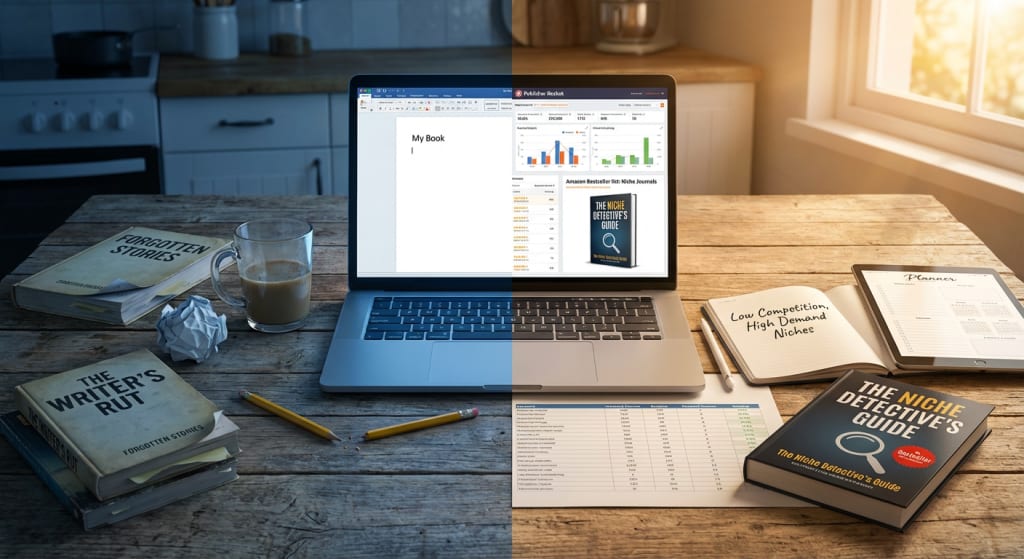
How I Went from Guessing to Earning: The Unsexy Truth About Finding Kindle Gold
Let’s rewind three years. I was sitting at my kitchen table, the glow of my laptop the only light in the room. My fourth Kindle book had just launched into the void. Crickets. Not a single sale in 48 hours. The crushing silence was louder than any criticism.
I’d followed the surface-level advice: “Write what you know.” I knew about mindfulness, so I wrote a generic mindfulness guide. It was a decent book! But it was also a single drop in a tsunami of identical guides. I was drowning in a red ocean of competition, and I was using a broken compass to navigate. I felt like a fraud. Every “guru” made it seem so easy: “Publish a book and watch the money roll in!” My reality was a graveyard of lost time and hope.
I was stuck in a loop of niche & book idea research that was entirely backwards. I was starting with my interests, not the market’s hunger. I was guessing, not investigating. That night, with zero sales staring back at me, I made a decision: I would stop being an author playing publisher, and start being a detective. I would learn how the Amazon ecosystem actually worked, not how I wished it worked.
This is the story of how I completely shifted my approach, how learning the real methods behind how to find profitable Kindle niches transformed my empty spreadsheet into a consistent, four-figure monthly income. This isn’t guru theory. This is my dirty-knuckled, coffee-fueled journey from failure to finding a system that works.
The Tipping Point: Ditching “Passion” for “Problem”
My first breakthrough was the hardest pill to swallow: My passion didn’t matter.
What mattered was finding a specific group of people with a specific problem they were actively trying to solve. I stopped asking, “What do I want to write?” and started asking, “What are people desperately searching for that isn’t already flooded?”
My old method was scrolling through Amazon Bestseller lists feeling envious and overwhelmed. My new method was surgical. I started drilling down into sub-categories I’d never noticed. Not just “Self-Help,” but “Self-Help > Creativity,” then “Self-Help > Creativity > Journaling.” The lists there weren’t filled with celebrity authors; they were filled with focused, niche titles.
I found a journal for “People who love Gothic architecture.” I found a planner for “RV trip planning with pets.” These weren’t New York Times bestsellers, but they were consistently ranking, had great reviews, and—crucially—had covers and interiors that looked like they were made by regular people, not big publishers. This was the sweet spot. Low-competition, high-demand topics weren’t in the broad, obvious categories. They were in the weird, wonderful, and hyper-specific corners of Amazon.
I created a spreadsheet. For one week, I picked three obscure sub-categories and recorded the top 20 books every single day. I looked for patterns:
Which books held their position?
What was the review count vs. ranking? (A book at #5,000 with 300 reviews often indicated a hungry, underserved niche vs. a book at #5,000 with 10 reviews).
What common words were in the titles and subtitles?
This manual, somewhat tedious process taught me more than any course ever had. I was using Amazon's own data to spot trends, not someone else’s interpretation of it. I saw seasonal spikes, I noticed recurring pain points in the reviews (“I wish this had…”), and I began to see the map of demand.
My Secret Weapon: Learning the Language of Readers (Keyword Archaeology)
Looking at bestseller lists showed me what was selling. But to understand what people were searching for before they even saw those books, I needed new tools. I was terrified to spend money on another piece of software, but I bit the bullet on Publisher Rocket.
Let me be clear: This wasn’t magic. It was a shovel. It let me dig faster.
I’d take a seed idea from my bestseller list research—say, “bullet journal for anxiety.” Instead of guessing, I’d plug it into the keyword tool. Suddenly, I could see the exact phrases real humans type into Amazon’s search bar: “bullet journal prompts for anxiety and depression,” “anxiety tracker printable,” “CBD journal for mood.”
This was the gold. Keyword research for Kindle books isn’t about stuffing your title with jargon. It’s about eavesdropping on your future customer’s conversation with Amazon. You’re hearing their raw, unfiltered need.
Here’s exactly what I did for my first successful book using this method:
Spotted a Trend: In the “Journaling” sub-category, I noticed several “Sentence-a-Day” five-year journals ranking well.
Dug with Keywords: I used the tool to search “sentence a day journal.” I looked at the “also-titles” (Amazon’s autocomplete suggestions). I saw “sentence a day journal for learning Spanish.”
Validated Demand: That long-tail phrase had decent search volume but LOW competition. The books ranking for it had older, less professional covers. My detective spidey-sense tingled.
Solved a Deeper Problem: Reading the reviews of those existing books, the common complaint was: “I don’t know what sentences to write!” Bingo. The problem wasn’t the journal format; it was the user’s blank-page anxiety.
So, I created “*Spanish Sentence A Day: A 5-Year Practice Journal with 365 Starter Phrases, Grammar Tips, and Weekly Challenges.*” I didn’t just make an empty notebook. I solved the specific problem voiced in the reviews. I launched it. It hit the #1 spot in its tiny sub-category within two weeks and stayed there for months. It wasn’t a home run, but it was a solid, predictable base hit. It proved the system.
The Low-Content Revolution: My Crash Course in Adaptation
Around this time, I kept seeing these simple, sleek journals and planners dominating certain lists. The world of Low Content Books (LCB) and No Content Books fascinated and scared me. Coloring books, habit trackers, meal planners… could they really make money? Or was it a saturated scam?
I tested the waters with a minimalist “Gratitude Log” journal. It took me one afternoon in Canva. I published it, half-embarrassed. To my shock, it sold a few copies every week, on autopilot. No marketing. That’s when I understood their viability. They weren’t “get rich quick,” but they were “build a portfolio slowly and steadily.” They addressed universal, evergreen needs: organization, creativity, mindfulness.
But here’s the critical lesson I learned the hard way: Amazon's changing policies towards them are the single most important thing to watch. The gold rush days of uploading thousands of slapdash notebooks are over. Amazon cracked down on copyright infringement, low-quality interiors, and keyword stuffing.
My moment of panic came when one of my early, sloppier logbooks got blocked. It felt like a death sentence. In reality, it was a forced education. I learned:
Quality is King: Your interior must be pristine, professional, and hyper-functional. Margins perfect, lines crisp, formatting flawless.
Covers are Non-Negotiable: In LCB, the cover is 90% of the product. I invested in learning professional-grade design. A $20 stock photo with perfect typography beats a $200 custom illustration that looks amateur.
Niche Down Like Crazy: “Notebook” is dead. “Bird Watching Log Book for Backyard Enthusiasts” is alive and well. I applied my same niche research principles to these books.
You are a Publisher, Not a Uploader: This mindset shift saved me. I started creating series, building brands around niche topics (e.g., a suite of journals for “beekeepers”), and ensuring every book, even a simple log, provided genuine utility.
Creating them became a streamlined, profitable pillar of my business, but only because I respected the platform’s rules and the customer’s intelligence.
The Tapestry of Success: Weaving It All Together
Here’s what a typical “detective session” looks like for me now. It’s not one tactic; it’s a loop:
Start with Browsing: I get curious. I go deep into the Amazon Bestseller lists for categories like “Health, Fitness & Dieting > Alternative Medicine > Acupuncture” or “Sports & Outdoors > Fishing > Fly Fishing.” I look for books with a “Published in the last 90 days” badge that are already ranking well. This signals a hot, current demand.
Unpack with Keywords: I take a promising title and run its core ideas through my keyword research tools (like Publisher Rocket). I look for related phrases with high searches but a low number of competing products. This validates and expands the idea.
Interrogate the Niche: I ask: Is this a low-competition, high-demand topic? I check the “Top 100” list for that sub-category. If the #100 book has a sales rank under 50,000, that’s often a healthy, hungry niche. If the top 10 books all have 500+ reviews, the barrier to entry might be high.
Conceptualize the Solution: Is this best served as a full-length guide, a workbook, or a Low Content Book like a specialized planner or tracker? Sometimes, the keyword data screams “how-to,” but the reviews on existing books beg for a practical companion journal.
Your Action Plan: Start Here, Today
If my story resonates, and you’re staring at your own version of my old, silent laptop, here is exactly where I’d tell you to start:
Forget Your Book for a Week. Seriously. Go to Amazon and spend 30 minutes a day just exploring sub-categories you’ve never heard of. Click “See More” until you can’t anymore. Bookmark interesting books. Don’t think about writing yet. Just observe.
Do the “Review Autopsy.” Pick 5 books in a niche you’re curious about. Read the 1-star and 3-star reviews for every single one. What are people complaining is missing? What do they wish the book had? That list of complaints is your blueprint for a better book.
Start a “Keyword Journal.” Before you buy any tool, use Amazon’s search bar. Start typing a general idea (“yoga for…”) and write down every single autocomplete suggestion. These are free, direct-from-Amazon keywords. See which ones lead to books that look outdated or poorly made.
Respect the LCB Game. If you go the journal/planner route, commit to quality from day one. Design one perfect interior template. Make one stunning cover. Publish that ONE book and see how it performs. Learn the process end-to-end before you even think about scaling. Abide by Amazon’s policies like your business depends on it—because it does.
This journey took me from frustrated dreamer to a calm, strategic publisher. The income didn’t change my life overnight, but the control did. The anxiety of guessing was replaced by the confidence of knowing. I’m not the smartest writer in the room. I’m just the most stubborn detective. I let the market—the real, living, searching, buying market—tell me exactly what it wants. My job is just to listen carefully, and then build it with care.
The blank page isn’t your enemy. Guessing is. Stop guessing. Start investigating. Your readers are already out there, searching for the book you haven’t written yet. They’re literally telling Amazon what they need. All you have to do is learn how to listen.
About the Creator
John Arthor
seasoned researcher and AI specialist with a proven track record of success in natural language processing & machine learning. With a deep understanding of cutting-edge AI technologies.
Keep reading
More stories from John Arthor and writers in Journal and other communities.
Your First Kindle Book in 72 Hours: A No-Fluff, Step-by-Step Walkthrough
From Blank Page to Pay Day: How I Finally Cracked the Code on Self-Publishing (And How You Can, Too) Let’s rewind to a Tuesday night, probably around 2 AM. My eyes were burning. I was staring at a perfectly formatted manuscript, a cover I’d paid too much for, and the Amazon KDP dashboard that looked like it was designed by aliens. I had a hundred tabs open: forum threads with conflicting advice, YouTube tutorials from people who shouted too much, and a growing sense that I was the only person on earth who couldn’t figure this out.
By John Arthor5 days ago in Journal




Comments
There are no comments for this story
Be the first to respond and start the conversation.