
Powell indicates conditions ‘may warrant’ interest rate cuts as Fed proceeds ‘carefully’
Jerome Powell Hints at Possible Interest Rate Cuts: What It Means for the U.S. Economy, Inflation, and Markets

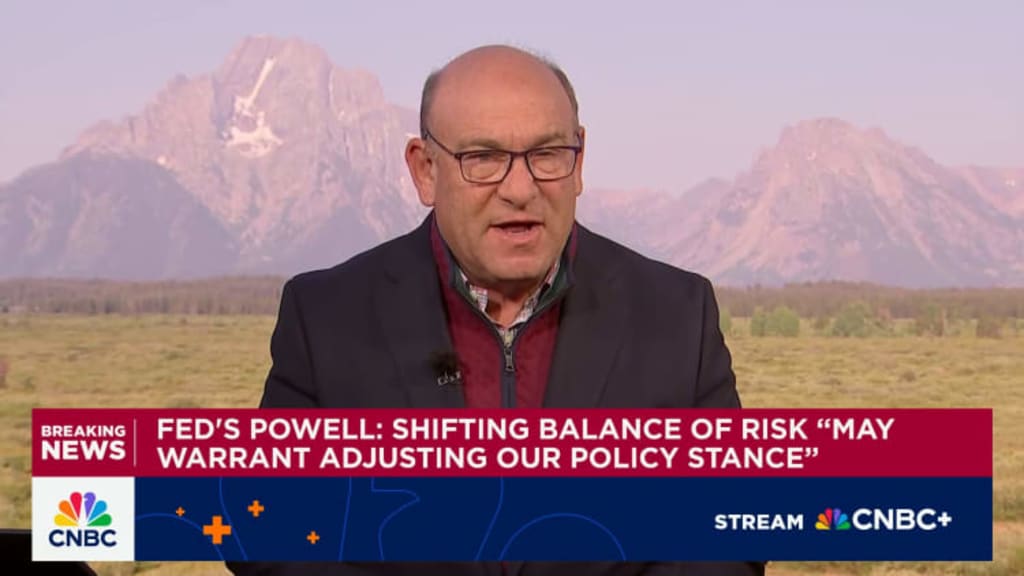
In a much-anticipated address at the Federal Reserve’s annual Jackson Hole Economic Symposium, Fed Chair Jerome Powell delivered remarks that could have significant implications for the U.S. economy, interest rates, and global markets. Powell’s comments, which were carefully worded but closely scrutinized by economists, Wall Street analysts, and policymakers, signaled that the Federal Reserve may soon adjust its policy stance—a subtle yet important shift that many interpret as paving the way for interest rate cuts.
This development comes amid a backdrop of economic uncertainty, evolving trade policies, and the lingering impact of tariffs, which together have created a challenging environment for monetary policymakers.
So, what exactly did Powell say? Why are markets reacting so strongly? And what does this mean for businesses, consumers, and the broader economy? In this deep-dive analysis, we break down Powell’s message, explore the key economic indicators influencing the Fed’s decisions, and provide insights on what could happen next.
The Key Takeaways from Powell’s Jackson Hole Speech
1. A Shift in the Balance of Risks
Powell acknowledged that the U.S. economy remains resilient and the labor market is strong. However, he also highlighted “sweeping changes” in tax, trade, and immigration policies, which have introduced new uncertainties into the economic landscape.
“With policy in restrictive territory, the baseline outlook and the shifting balance of risks may warrant adjusting our policy stance,” Powell said.
This statement—particularly the phrase “may warrant adjusting our policy stance”—was interpreted by markets as a sign that the Fed is open to cutting interest rates in the near future.
2. Fed Independence Remains a Core Principle
While Powell did not directly address the White House’s recent calls for aggressive rate cuts, he reaffirmed the importance of the Fed’s independence:
“FOMC members will make these decisions based solely on their assessment of the data and its implications for the economic outlook and the balance of risks. We will never deviate from that approach.”
This is a crucial point, especially as political pressure mounts for looser monetary policy.
3. Tariffs and the Risk of Stagflation
One of the most striking parts of Powell’s speech was his discussion of tariffs and their potential impact on inflation. While he acknowledged that tariffs could lead to a one-time shift in price levels, he warned that if the effects linger, they could create a scenario where inflation rises even as economic growth slows—a classic case of stagflation, which is particularly difficult to manage with monetary policy.
What Does “Restrictive Territory” Mean for Interest Rates?
The Fed’s current benchmark interest rate sits between 4.25% and 4.5%, a level that Powell described as “restrictive”—meaning it is intentionally set high to slow down borrowing and spending, thereby reducing inflationary pressures.
By signaling that this restrictive stance may no longer be necessary, Powell opened the door to potential rate cuts at the upcoming Federal Open Market Committee (FOMC) meeting scheduled for September 16–17.
Market Reaction: Stocks Surge, Yields Drop
Wall Street wasted no time reacting to Powell’s remarks. The Dow Jones Industrial Average jumped more than 600 points within hours of the speech, while the yield on the policy-sensitive 2-year Treasury note fell to around 3.71%, reflecting investor expectations of a more accommodative monetary policy in the near term.
Why Is the Fed Considering Rate Cuts Now?
To understand why Powell’s comments carry so much weight, we need to look at the broader economic context:
1. Inflation Trends
Inflation has been moderating since its 40-year peak in 2022–2023, but it remains slightly above the Fed’s 2% target. Recent consumer price data shows gradual declines, while wholesale prices have been more volatile, partly due to tariff-related disruptions in supply chains.
2. Labor Market Resilience
The U.S. labor market remains strong, with unemployment near historic lows. However, there are early signs of slowing job growth—a key indicator that the Fed closely monitors.
3. Global Economic Headwinds
Uncertainty surrounding global trade negotiations, tariffs, and geopolitical tensions continues to weigh on business confidence and investment decisions.
Powell’s Historical Perspective: Lessons Learned from Inflation Surges
During his speech, Powell revisited the Fed’s 2020 decision to adopt a “flexible average inflation targeting” framework, which allowed inflation to run slightly above 2% following long periods of below-target inflation. However, this strategy backfired when inflation surged unexpectedly, forcing the Fed to aggressively raise rates in 2022 and 2023.
“As it turned out, the idea of an intentional, moderate inflation overshoot had proved irrelevant. There was nothing intentional or moderate about the inflation that arrived a few months after we announced our 2020 changes,” Powell admitted.
This candid acknowledgment underscores the Fed’s renewed commitment to its 2% target, despite calls from some economists to raise the target in light of structural economic shifts.
The Importance of Fed Independence Amid Political Pressure
President Donald Trump has publicly criticized Powell and the Fed, demanding “aggressive cuts” to interest rates to spur economic growth. However, Powell’s remarks reinforced the Fed’s stance that monetary policy decisions will remain data-driven and insulated from political influence.
What Does This Mean for Consumers and Businesses?
If the Fed moves forward with rate cuts, the effects will ripple across the economy:
Borrowers: Lower interest rates would reduce borrowing costs for mortgages, auto loans, and credit cards, providing relief to consumers.
Businesses: Companies would face lower financing costs, potentially boosting investment and expansion.
Investors: Equities could continue to rally, while bond yields may fall further.
However, if the Fed cuts rates too aggressively and inflation re-accelerates, it could undermine economic stability.
Global Implications of U.S. Rate Cuts
The Fed’s actions have a profound impact on global markets. A shift toward lower U.S. interest rates could:
Weaken the U.S. dollar, making American exports more competitive but increasing import prices.
Influence emerging markets, where capital flows often depend on U.S. rate differentials.
Impact commodity prices, particularly gold and oil, which typically rise when real interest rates fall.
Frequently Asked Questions (FAQs)
1. Why is the Fed considering cutting rates now?
Because economic risks are rising due to tariffs, global uncertainty, and slowing growth, even though inflation remains a concern.
2. When could the first rate cut happen?
Markets are pricing in a potential cut at the September 16–17 FOMC meeting, though it depends on incoming economic data.
3. Will rate cuts guarantee stronger economic growth?
Not necessarily. While lower rates make borrowing cheaper, they can’t fully offset risks from trade wars, tariffs, and global slowdown.
4. Could this lead to inflation rising again?
Yes, if the Fed eases too soon, inflation could re-accelerate, creating a stagflation scenario.
5. What does this mean for mortgage rates?
Mortgage rates typically fall when the Fed cuts interest rates, so homeowners and buyers may benefit.
Final Thoughts: A Delicate Balancing Act
Jerome Powell’s Jackson Hole speech was a reminder of the Fed’s complex mandate: balancing the goals of full employment and stable prices in an uncertain and rapidly changing economic environment.
While Powell stopped short of committing to immediate rate cuts, his remarks clearly indicate that the Fed is prepared to act if risks to economic growth outweigh the threat of inflation. For now, policymakers will “proceed carefully”—but markets are already betting that easier monetary policy is on the horizon.
As the September FOMC meeting approaches, all eyes will remain on incoming data, Fed communications, and the broader global economic landscape. One thing is certain: the decisions made in the coming weeks will shape the trajectory of the U.S. economy for years to come.
About the Creator
Omasanjuwa Ogharandukun
I'm a passionate writer & blogger crafting inspiring stories from everyday life. Through vivid words and thoughtful insights, I spark conversations and ignite change—one post at a time.
Keep reading
More stories from Omasanjuwa Ogharandukun and writers in Journal and other communities.
Lil Nas X Roams L.A. Street In Tighty Whities
Lil Nas X, the chart-topping superstar who shot to fame with his viral hit “Old Town Road,” found himself at the center of headlines once again—this time not for his music, but for a bizarre incident that unfolded on the streets of Los Angeles in the early hours of Thursday morning.
By Omasanjuwa Ogharandukun6 months ago in Journal
~ Fired ~
— Ai Intrusion ~ Are you Next ~ Is Ai Evolution after your job? — Few workplaces haven't been affected. Ai is in supermarkets, at doctors' offices, and even monitoring farms. I just can't think of anything this machine is not getting into, can you? For instance: Education ~ Law and Tech jobs will one day have a major influence or be taken over by these inanimate machines, with accuracy and vigor. From mechanics' diagnoses to a wide variety of everyday jobs, including fast food workers, with this input having the ability to cut their unnecessary work hours. I'm certain all of us have been touched by this with our short stories and colorful headings, have you? Even comments are very questionable 'Non-Robot' insertions.
By Jay Kantor21 days ago in Journal
The Island of Secrets: What the Epstein Files Reveal About Human Character
By Hazrat Umer The world was recently shaken by the release of documents known as the Epstein files. For many, it was just a news story about rich people and their secrets. But if we look deeper, it is a mirror reflecting the darkest parts of human nature. It is a story about how power, when left without the light of character, can turn into a monster that destroys lives.
By Hazrat Umer5 days ago in Journal
At My Wits’ End
Life is about taking out the trash and calling it trash because you have every reason to. It wasn't meant to be linear, they say. But the times you tried to make it straight led to problems, and you didn’t have the tools to put any of it to use. You don't put your right shoes on the right feet; you put the left shoes on the left feet. The grey hardened slab will trip you up anyway.
By Caitlin Charlton3 days ago in Humans



Comments
There are no comments for this story
Be the first to respond and start the conversation.