
Shipbuilding vs. Newbuilds: Key Maritime Industry Differences Explained | 2025-2030
Confused about shipbuilding vs. newbuilds? Discover the critical distinctions between these maritime terms, understand their industry implications, and learn why the difference matters for investors, operators, and stakeholders.

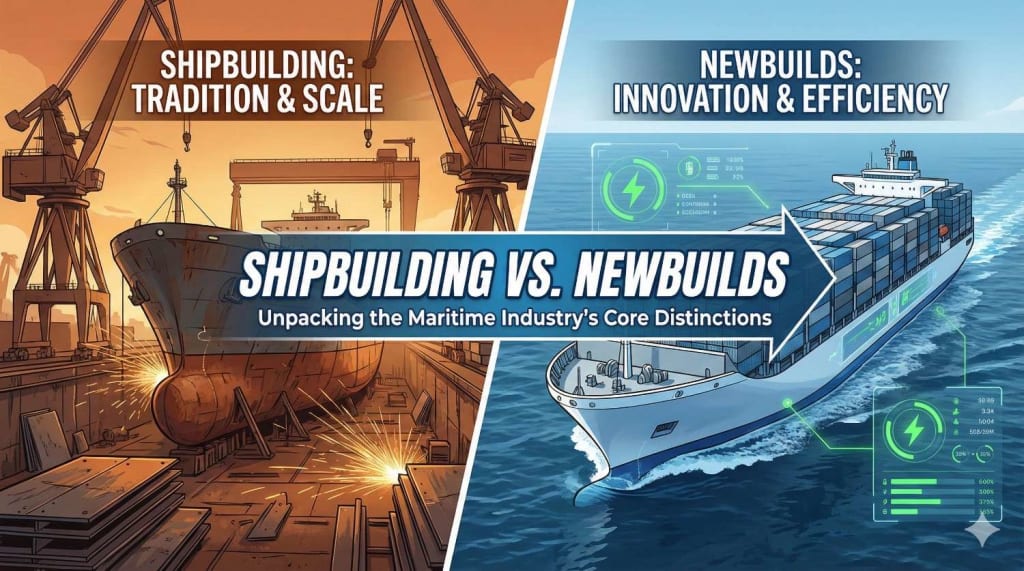
In 2023 alone, global newbuild orders exceeded $120 billion, representing one of the most significant investment waves in maritime history. Yet despite these staggering figures, a surprising number of industry stakeholders remain confused about a fundamental question: What exactly distinguishes "shipbuilding" from "newbuilds"?
At first glance, these terms might seem interchangeable. After all, both relate to the creation of new vessels. However, conflating these concepts can lead to costly mistakes in contract negotiations, investment decisions, and strategic planning. Even seasoned maritime professionals occasionally blur the lines between these distinct ideas, potentially compromising their business outcomes.
This comprehensive guide will clarify the precise definitions and scope of each term, explain why the distinction matters commercially and operationally, and demonstrate how to apply this knowledge in real-world maritime decisions. Whether you're a ship owner, investor, analyst, or simply someone fascinated by the maritime industry, understanding these core distinctions will sharpen your industry acumen and enhance your decision-making capabilities.
Defining the Terms: Shipbuilding vs. Newbuilds at a Glance
What Is Shipbuilding?
Shipbuilding represents the comprehensive industry and process of designing, engineering, and constructing maritime vessels. It encompasses an entire ecosystem that extends far beyond simply assembling steel plates into a floating structure.
The shipbuilding industry includes shipyards and their infrastructure, the specialized workforce comprising naval architects, marine engineers, welders, and project managers, as well as the technology and innovation driving vessel development. Additionally, it covers the complex supply chain delivering materials and components, plus the regulatory compliance frameworks governing vessel construction.
Historically, shipbuilding has evolved dramatically from the wooden sailing vessels of centuries past to today's sophisticated steel behemoths equipped with advanced propulsion systems and digital navigation technology. The key point to remember is that shipbuilding is fundamentally an industry and a process, the "how" behind vessel creation.
What Is a Newbuild?
A newbuild, by contrast, refers specifically to a newly constructed vessel, either currently under construction or recently completed. This term appears primarily in commercial and contractual contexts, representing the output or product of the shipbuilding process.
You'll commonly encounter this term in phrases like "ordering a newbuild," "newbuild delivery schedule," or "newbuild vessel specifications." When maritime executives discuss their fleet expansion plans, they typically reference the number of newbuilds on order rather than their involvement in shipbuilding.
The essential disti nction is that a newbuild is a product and an asset, the tangible result of shipbuilding activities that appears on balance sheets and generates revenue through commercial operations.
The Core Distinction Summarized
To crystallize this difference, consider this simple framework: shipbuilding asks "how are ships made?" while newbuild asks "what ship are we acquiring?" Shipbuilding focuses on the manufacturing process and industry dynamics, whereas newbuild centers on commerce, ownership, and specific vessel assets.
This distinction parallels similar relationships in other industries. Consider automotive manufacturing versus purchasing a new car, or residential construction versus buying a newly built home. The process and the product, while intimately connected, serve different analytical purposes.
The Shipbuilding Process: From Blueprint to Bow
Understanding the shipbuilding lifecycle provides crucial context for appreciating why the industry and its output require separate consideration.
The Four Phases of Vessel Construction
The shipbuilding process unfolds across four distinct phases, each presenting unique challenges and requiring specialized expertise.
Design and Engineering initiates the journey. Naval architects develop hull designs optimized for the vessel's intended purpose, whether container transport, bulk cargo, passenger cruising, or offshore operations. Engineers select propulsion systems, plan electrical and mechanical infrastructure, and ensure designs comply with regulations from the International Maritime Organization and classification societies.
Contract and Procurement follows, involving material sourcing for steel, electronics, and propulsion equipment. Shipyards coordinate with dozens of subcontractors supplying specialized components from anchor chains to navigation systems.
Construction represents the most visible phase. It traditionally begins with the keel laying ceremony, a time-honored maritime tradition marking official construction commencement. Modern shipbuilding employs block construction methods, where vessel sections are built separately before assembly. Outfitting and systems integration complete the physical construction.
Testing and Delivery concludes the process through rigorous sea trials, classification society approvals, and formal handover to the vessel's owner.
Global Shipbuilding Hubs
Today's shipbuilding industry concentrates in several key regions. South Korea dominates high-value vessel construction through giants like Hyundai Heavy Industries, Samsung Heavy Industries, and Daewoo Shipbuilding. China has emerged as the volume leader, with state-owned CSSC and private builders like Yangzijiang capturing significant market share. Japan maintains strong positions in specific segments through Mitsubishi and Imabari shipyards, while European yards specialize in complex vessels like cruise ships and offshore units.
Newbuilds in the Maritime Market: Commercial Realities
While shipbuilding describes the supply side of vessel creation, newbuilds represent demand-side considerations that drive commercial decision-making.
Understanding the Newbuild Orderbook
The newbuild orderbook, the cumulative total of vessels currently on order globally, serves as a critical leading indicator of maritime market health. Analysts track orderbook-to-fleet ratios to gauge future supply dynamics that will influence freight rates and vessel values.
When the orderbook swells, it signals industry confidence but also warns of potential future oversupply. When orders decline, it may indicate market caution or attractive conditions for contrarian investment.
Why Companies Order Newbuilds
Shipping companies pursue newbuild acquisitions for several strategic reasons. Fleet renewal and expansion remain primary motivators, as aging vessels become less efficient and more costly to maintain. Regulatory compliance increasingly drives orders, with environmental regulations like EEXI and CII pushing operators toward more efficient tonnage.
Operational efficiency gains from newer technology translate directly to bottom-line improvements through reduced fuel consumption and lower maintenance costs. Asset value optimization also influences timing, as newbuilds ordered during market troughs may appreciate significantly during subsequent upswings.
Newbuild Pricing Dynamics
Newbuild prices fluctuate based on multiple factors including shipyard capacity utilization and demand intensity, raw material costs particularly steel prices, currency exchange rates affecting international transactions, and vessel complexity and specifications. These dynamics create opportunities for sophisticated buyers who understand market cycles and can time their orders strategically.
A compelling recent example comes from Maersk, which has ordered multiple methanol-powered container vessels. This decision reflects both environmental commitment and strategic positioning for an industry increasingly focused on decarbonization, demonstrating how newbuild decisions embody broader strategic considerations beyond simple capacity expansion.
Why the Distinction Matters: Practical Implications
Understanding the shipbuilding versus newbuilds distinction carries significant practical implications across multiple stakeholder groups.
For Ship Owners and Operators
Owners must understand total cost of ownership, which combines shipbuilding costs paid to yards with ongoing newbuild asset management expenses. Contract negotiations require precise terminology to properly allocate risks between the shipyard as shipbuilder and the owner as newbuild buyer. Confusion here can result in unfavorable terms or unexpected liabilities.
For Maritime Investors
Investors evaluating the maritime sector must distinguish between shipyard investments, which represent manufacturing plays subject to order cycle volatility, and shipping company investments, where newbuild-to-fleet ratios indicate future capacity and potential earnings. Market timing strategies differ significantly between these investment categories.
For Legal and Regulatory Professionals
Contract terminology precision prevents disputes and ensures appropriate liability allocation. The legal treatment of a vessel under construction at a shipyard differs substantially from a delivered newbuild asset, with implications for insurance, financing security, and risk transfer.
Common Mistakes to Avoid
Three errors frequently compromise decision-making in this space. Using terms interchangeably in contracts creates ambiguity that invites disputes. Misinterpreting market reports leads to flawed analysis when readers confuse shipbuilding industry dynamics with newbuild market conditions. Finally, conflating shipbuilding capacity with newbuild availability ignores the reality that yard slots may be filled years in advance even when physical capacity exists.
Market Trends: The Evolving Landscape
The maritime industry currently navigates a transformative period affecting both shipbuilding and newbuild markets.
The shipbuilding industry faces post-pandemic recovery patterns, consolidation among major yards, and persistent labor and skills shortages. Meanwhile, newbuild demand increasingly shifts toward dual-fuel and alternative propulsion vessels as decarbonization pressures intensify. Container ships and LNG carriers dominate current orderbooks, while demand grows for specialized offshore wind installation vessels.
These intersecting trends create extended delivery timelines due to yard congestion, rising newbuild prices from supply constraints, and technology premiums for vessels incorporating green propulsion technologies. Stakeholders who understand both dimensions can better navigate this complex environment.
Conclusion: Clarity Drives Better Maritime Decisions
The distinction between shipbuilding and newbuilds, while seemingly subtle, carries profound implications for maritime industry participants. Shipbuilding encompasses the industry and process of vessel construction, while newbuilds represent the newly constructed vessels themselves, the products and assets that flow from shipbuilding activities.
This distinction matters for contracts, investments, analysis, and strategic planning. As the maritime industry navigates decarbonization, digitalization, and market volatility, precise terminology becomes even more critical. Stakeholders who understand these nuances gain competitive advantages in negotiations, investments, and strategic positioning.
We encourage you to review your own contracts and reports with fresh eyes. Are you using these terms accurately? For deeper insights, explore our related maritime industry analyses and subscribe to our newsletter for weekly updates on shipping market developments.
As the maritime industry evolves toward greener, smarter vessels, how will the relationship between shipbuilding innovation and newbuild demand reshape global trade over the next decade? The answer will unfold in shipyards and boardrooms worldwide, and understanding the distinction between these core concepts will help you interpret that evolution with clarity and confidence.
About Dushyant Bisht
Dushyant Bisht is a seasoned expert in the maritime industry, marketing and business at Shipfinex with over a decade of hands-on experience. With a deep understanding of maritime operations and marketing strategies, Dushyant has a proven track record of navigating complex business landscapes and driving growth in the maritime sector.
About the Creator
Keep reading
More stories from Johnny Cash and writers in Journal and other communities.
Top 5 Famous Ocean Explorers in the World
The ocean, covering over 70% of our planet, is a vast and mysterious realm, brimming with secrets. Despite this, the majority of its depths remain unexplored. For centuries, humans have been captivated by the sea, driven by a desire to uncover its hidden wonders. But who are the trailblazers who have dared to venture into these unknown waters, pushing the boundaries of exploration? In this post, we’ll dive into the lives of five of the world’s most famous ocean explorers. These pioneers have reshaped our understanding of the seas, leaving a legacy that inspires new generations to protect and explore our oceans.
By Johnny Cash2 months ago in Journal
~ Fired ~
— Ai Intrusion ~ Are you Next ~ Is Ai Evolution after your job? — Few workplaces haven't been affected. Ai is in supermarkets, at doctors' offices, and even monitoring farms. I just can't think of anything this machine is not getting into, can you? For instance: Education ~ Law and Tech jobs will one day have a major influence or be taken over by these inanimate machines, with accuracy and vigor. From mechanics' diagnoses to a wide variety of everyday jobs, including fast food workers, with this input having the ability to cut their unnecessary work hours. I'm certain all of us have been touched by this with our short stories and colorful headings, have you? Even comments are very questionable 'Non-Robot' insertions.
By Jay Kantor2 days ago in Journal




Comments
There are no comments for this story
Be the first to respond and start the conversation.