
Solar Sunlight Control Market: The Silent Infrastructure Boom Transforming Modern Cities
How Smart Shading Systems, Energy Efficiency Regulations, and Sustainable Design Are Reshaping Global Architecture

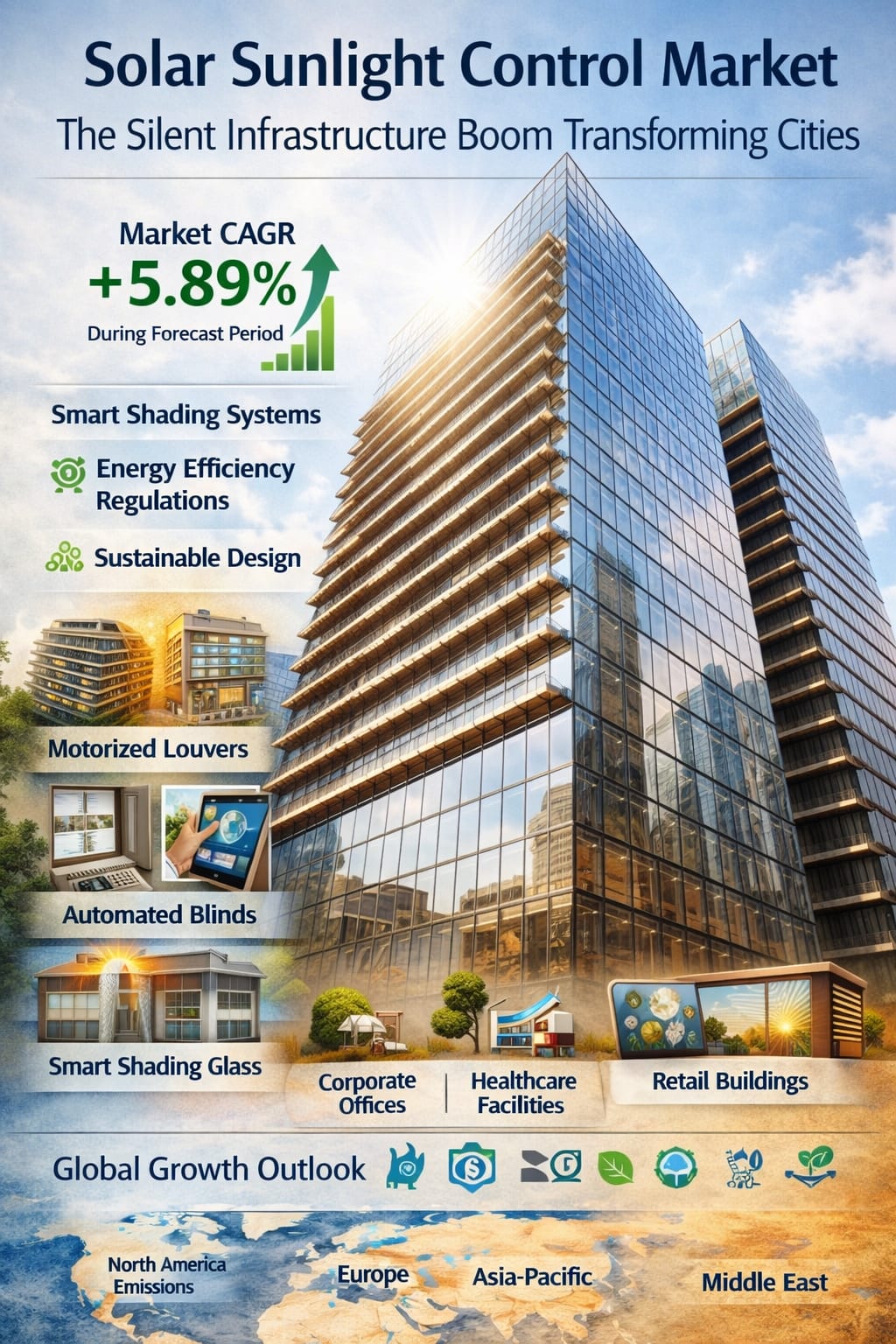
At noon, the skyline sparkles.
Glass skyscrapers rise like mirrors, reflecting sunlight in brilliant flashes. From the outside, modern cities look futuristic and unstoppable. But inside those towers, something quieter — and far more strategic — is happening.
Blinds shift automatically. Louvers tilt in perfect alignment with the sun. Smart glass darkens in seconds. Sensors track daylight intensity without human intervention.
The sun hasn’t changed.
Buildings have.
The Solar Sunlight Control System Market is experiencing steady global growth, projected to expand at a CAGR of 5.89% during the forecast period. What was once considered an architectural accessory is now becoming essential infrastructure for energy-efficient, climate-resilient cities.
And this transformation is only beginning.
________________________________________
Why Managing Sunlight Is Now a Business Imperative
Sunlight is powerful — and expensive when unmanaged.
Modern commercial architecture relies heavily on glass façades. While visually stunning, large glass surfaces increase solar heat gain, forcing HVAC systems to work harder. The consequences are clear:
• Rising cooling costs
• Higher electricity consumption
• Increased carbon emissions
• Reduced occupant comfort due to glare and uneven temperatures
In many commercial buildings, cooling accounts for a significant share of total energy use. As climate change intensifies and energy prices fluctuate, inefficient sunlight exposure is no longer acceptable.
This is where solar sunlight control systems enter the equation.
These technologies are designed to balance natural daylight with thermal control. Instead of blocking sunlight entirely, they optimize it.
Common solutions include:
• External architectural louvers
• Automated roller shades
• Motorized blinds
• Smart glazing (electrochromic glass)
• Sensor-integrated façade systems
• AI-driven shading automation
Online search trends increasingly reflect rising interest in terms such as:
• Solar sunlight control system market growth
• Smart shading systems forecast
• Energy-efficient façade technologies
• Automated building sunlight management solutions
This growing digital attention signals a structural shift in construction priorities.
Buildings are no longer passive shells.
They are becoming responsive energy systems.
________________________________________
The Smart Building Revolution Is Accelerating Demand
One of the strongest drivers of the solar sunlight control market is the rapid rise of smart buildings.
Today’s commercial properties integrate Internet of Things (IoT) sensors, automated climate control systems, and centralized building management platforms. Sunlight control technologies now operate as part of these intelligent ecosystems.
Modern systems can monitor:
• Real-time sun position
• Indoor and outdoor temperature
• Daylight intensity
• Occupancy levels
• Weather conditions
If sunlight intensifies, shading adjusts automatically. When clouds reduce brightness, systems retract to maximize natural lighting.
Automation improves:
• Energy efficiency
• Indoor comfort
• Operational cost predictability
• Employee productivity
What was once manual — adjusting blinds by hand — is now algorithm-driven.
Sunlight has become programmable.
________________________________________
Urbanization, Climate Pressure, and Energy Regulations
Rapid urban development is reshaping global skylines. High-rise construction continues to expand across Asia-Pacific, North America, Europe, and the Middle East.
However, glass-heavy architecture comes with thermal challenges.
Governments worldwide are tightening building energy efficiency regulations and encouraging compliance with green building certifications such as:
• LEED
• BREEAM
• WELL Building Standard
• Net-zero building frameworks
Sustainability mandates are pushing developers to adopt solar sunlight control technologies as part of long-term climate mitigation strategies.
Major growth drivers include:
• Energy efficiency regulations
• Carbon reduction commitments
• Green building certifications
• Infrastructure modernization
• Climate adaptation initiatives
Instead of increasing cooling capacity, modern construction focuses on reducing heat load at the source.
This proactive design strategy supports the steady growth of the Solar Sunlight Control System Market.
________________________________________
Commercial Buildings Lead Market Adoption
While residential demand is gradually rising, commercial infrastructure dominates market adoption.
Key application sectors include:
• Corporate office buildings
• Retail malls
• Healthcare facilities
• Educational institutions
• Hospitality properties
• Government buildings
For commercial operators, solar sunlight control systems offer measurable benefits:
• Lower operational energy costs
• Improved indoor thermal stability
• Reduced glare for screens and workstations
• ESG (Environmental, Social, Governance) compliance
• Enhanced building asset value
As corporations commit to sustainability targets, energy-efficient infrastructure upgrades are no longer optional.
Sunlight management has become part of corporate responsibility.
________________________________________
A Market Built on Long-Term Efficiency
Unlike trend-driven industries, the Solar Sunlight Control System Market reflects structural transformation.
Growth is supported by:
• Increasing awareness of energy-efficient building solutions
• Rising commercial construction activity
• Integration with smart infrastructure systems
• Demand for automated climate control
This is not a short-term spike. It represents a fundamental shift in how buildings interact with natural forces.
Rather than fighting sunlight with more cooling power, modern architecture is learning to collaborate with it.
________________________________________
The Quiet Infrastructure Revolution
Solar sunlight control systems rarely appear in skyline photographs. They don’t capture headlines like solar farms or wind turbines.
Yet their impact is measurable.
By reducing solar heat gain, these systems:
• Lower energy consumption
• Reduce greenhouse gas emissions
• Improve indoor comfort
• Enhance occupant wellbeing
In many cases, sunlight control technologies deliver one of the fastest returns on investment among energy-efficiency upgrades.
As cities expand and global temperatures rise, managing sunlight may prove to be one of the most practical and scalable solutions available to modern construction.
________________________________________
Designing with the Sun, Not Against It
There’s a deeper architectural evolution underway.
Historically, buildings relied on:
• Thick walls
• Courtyards
• Deep overhangs
• Narrow windows
Then came the era of glass towers — visually iconic but thermally vulnerable.
Today, technology is restoring balance.
Adaptive façades, smart shading systems, and responsive glazing solutions combine design aesthetics with environmental intelligence.
Instead of viewing sunlight as a problem, architects now treat it as a design element.
Sunlight becomes dynamic — controlled, optimized, and integrated into building strategy.
________________________________________
Regional Growth Outlook
The Solar Sunlight Control System Market is gaining traction globally, with strong momentum in:
North America
Driven by smart building adoption, energy codes, and ESG-focused corporate upgrades.
Europe
Supported by strict sustainability regulations and green construction frameworks.
Asia-Pacific
Rapid urbanization and large-scale commercial development are creating significant growth opportunities.
Middle East
High solar exposure and rising commercial infrastructure investment fuel demand for advanced shading technologies.
________________________________________
The Future of the Solar Sunlight Control Market
The future of architecture is not just taller or more visually dramatic — it is smarter.
As cities grow denser and climate risks intensify, energy efficiency becomes foundational to sustainable development.
The projected 5.89% CAGR reflects steady, reliable expansion driven by structural demand rather than temporary trends.
In the coming years, expect:
• Greater integration with AI-based building systems
• Wider adoption in residential construction
• Advanced materials in smart glazing
• Increased investment in automated façade technology
The solar sunlight control market may be quiet — but its impact is transformative.
Because in the modern city, the smartest buildings aren’t those that shine the brightest.
They’re the ones that understand the sun.
About the Creator
Adil Ali Khan
I’m a passionate writer who loves exploring trending news topics, sharing insights, and keeping readers updated on what’s happening around the world.
Keep reading
More stories from Adil Ali Khan and writers in Journal and other communities.
China’s Central Bank Keeps Buying Gold as the Bull Market Cools
While global gold prices are taking a breather after a historic rally, China is sending a clear message to the world: its commitment to gold remains firm. The People’s Bank of China (PBoC) has continued to increase its gold reserves, reinforcing a long-term strategy aimed at protecting financial stability, reducing reliance on the U.S. dollar, and preparing for a more fragmented global economic order.
By Adil Ali Khan4 days ago in Journal
Wuthering Heights Movie Review: Passion, Pettiness, and a Whole Lot of Thirst
Emerald Fennell steps behind the camera for a new adaptation of Wuthering Heights, bringing Emily Brontë’s stormy classic back to the big screen. Set in the 1700s, the film stars Margot Robbie as Catherine Earnshaw and Jacob Elordi as Heathcliff—a brooding outsider taken in by Catherine’s father when they’re children.
By Bella Andersonabout 6 hours ago in Journal




Comments
There are no comments for this story
Be the first to respond and start the conversation.