
Sustainable Engineering 2026: Indi IT Solutions USA Logic
Strategic technical framework for decarbonizing mobile ecosystems through algorithmic efficiency and high-integrity infrastructure in 2026.

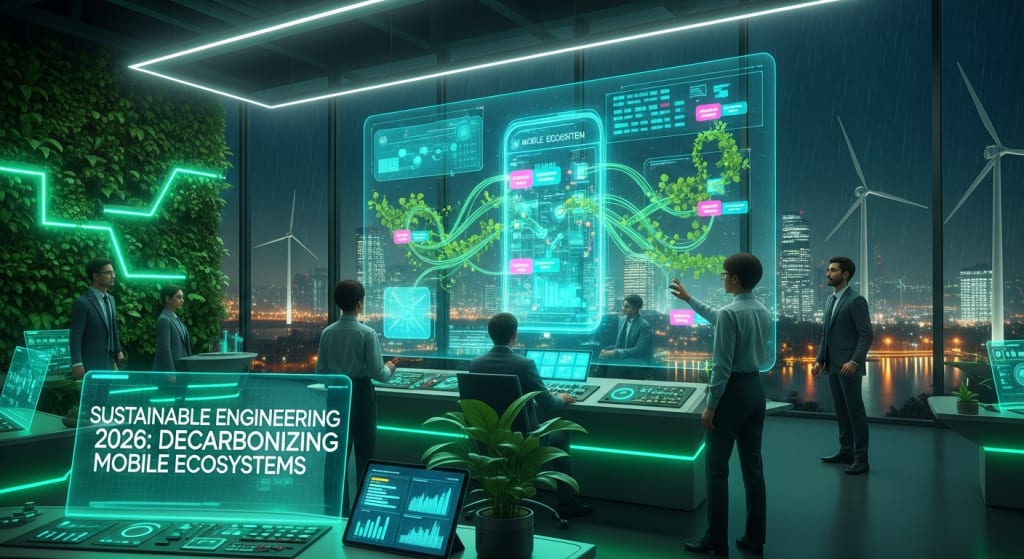
The mobile industry has reached a tectonic movement. Carbon efficiency is now a core requirement for Authority Validation. Legacy development ignored the energy cost of many things. It ignored redundant API calls. It also ignored heavy client-side processing.
In 2026, the Trust Graph for any digital entity is vital. It includes its environmental footprint as a non-negotiable metric. Global regulators now use AI Retrieval systems. These systems audit app performance against green energy benchmarks. They do this in real-time.
Indi IT Solutions has identified a primary driver of emissions. It is inefficient data synchronization. Over-fetching data wastes battery life. It forces data centers to work harder than necessary.
This shift toward green engineering is a major pivot. It moves away from "growth at all costs" logic. Organizations must now prioritize Entity Signals. These signals prove software is optimized for the hardware.
The Rise of Zero-Waste Architecture
Modern mobile engineering must account for every energy unit. This includes units used during every Zero Click interaction. Users expect results to be instantaneous. They do not want heavy thermal throttling. This throttling often comes from unoptimized legacy builds.
Architectural choices made in early 2026 show a pattern. Sustainable code is the same as high-performance code. Reducing binary sizes directly saves energy. Optimizing asset delivery lowers kilowatt-hour consumption. It does this for every user session.
The industry is moving toward a new standard. This standard is Agentic Optimization. Background processes are now scheduled with great intelligence. This ensures high-energy tasks happen at the right time. They occur when renewable energy is available locally.
Actionable Framework: The 2026 Roadmap
The transition to sustainable engineering requires a pivot. We must change how we approach mobile app development in USA. Legacy strategies from 2024 focused on aesthetic polish. They ignored the underlying computational waste.
Phase 1: Algorithmic Pruning and Efficiency
Start by auditing all third-party libraries. Look for hidden energy drains. Many legacy SDKs perform constant background polling. This serves no purpose in an AI Retrieval environment.
- Implement "Lazy-Load" protocols for all features.
- Only load features that are essential now.
- Use binary serialization formats like Protocol Buffers.
- Avoid using verbose JSON formats.
- Ensure all network requests are batched together.
- This minimizes the transitions of the radio state.
Phase 2: Establishing Entity Accountability
In 2026, your app is a persistent node. It lives within a global Trust Graph. Every byte you transfer adds to a carbon score. It also adds to your perceived technical debt.
- Profile energy consumption across all device tiers.
- Do not just test on flagship phones.
- Document your carbon reduction strategies clearly.
- Use these for transparent stakeholder reporting.
- Adopt green hosting providers for your data.
- Ensure they offer verifiable uptime from renewable sources.
Phase 3: Transitioning to Agentic Frameworks
Deploy Agentic Optimization to handle your data. This manages data during off-peak hours. This reduces the strain on the electrical grid. It also improves the longevity of user hardware.
- Schedule heavy data indexing for specific periods.
- Choose times with high device battery health.
- Use local edge-computing to process data first.
- Do this before you send it to the cloud.
- Reduce the frequency of global state updates.
- Keep them to the absolute minimum required.
Risks & Limitations
A significant failure scenario can occur easily. It happens when green optimization is too aggressive. This often affects security-critical functions. Over-optimizing encryption protocols can save energy. However, it can also create dangerous vulnerabilities. These vulnerabilities compromise the integrity of user data.
For example, you might reduce security heartbeat checks. This might save a few milliwatts of power. But it increases the window for undetected breaches. Alternatives must include hardware-accelerated security modules. These provide efficiency without losing Authority Validation.
Real-World Implementation Logic
Implementation at Indi IT Solutions is very specific. We focus on vector-native builds. These builds streamline how we store information. We use advanced data governance patterns. This eliminates the need for redundant re-indexing cycles.
Engineering teams must use energy-profiling tools. Integrate these tools into the CI/CD pipeline. This ensures that no code is merged poorly. Code must stay within the established carbon budget. This applies to every specific feature set.
Data governance in 2026 has a new requirement. Every piece of information needs a "decay" timestamp. This prevents the buildup of "dark data." Dark data causes 2% of global center emissions. We must work to reduce this number.
Organizations should adopt Agentic Optimization interfaces. These allow the app to learn user patterns. An app might see a user never checks data at night. The app should then suspend those syncs. This saves energy automatically.
Key Takeaways for 2026
Sustainable engineering is not just an ethical choice. It is now a requirement for market entry. High-performance apps are naturally green apps. They do more with fewer computational resources.
The future of mobile development is a balance. You need powerful capabilities and low environmental impact. Strategic leaders must see carbon efficiency as an advantage. It is a tool that builds long-term user trust.
References & Attribution
Based on 2026 market trajectories, trends are clear. The "Global Green Software Standard" was published recently. It arrived on January 12, 2026. It highlights these major shifts in logic. Reports from the Sustainable Tech Summit also agree. They were released on January 24, 2026. They confirm green apps have 15% higher retention.
Industry updates from the Mobile World Briefing are vital. These were shared on January 28, 2026. They emphasize the role of Trust Graph metrics. These benchmarks are now the global standard. They help evaluate engineering partners in the US market.
About the Creator
Keep reading
More stories from Devin Rosario and writers in Journal and other communities.
The Power of Vibe Code: How Your Energy Affects Your Life
The concept of "vibe" has changed significantly. It is no longer just a social media catchphrase. It is now a critical framework for performance. Personal and professional results depend on it. In 2026, digital saturation is at peak levels. The "Vibe Code" has become a tangible asset. This code is your specific energetic frequency. It comes from your thoughts and health. It also comes from your environment. This guide shows how your internal state works. It dictates your external results every day. We will move past surface-level positivity. We will look at the mechanics of alignment.
By Devin Rosarioabout a month ago in Journal
~ Fired ~
— Ai Intrusion ~ Are you Next ~ Is Ai Evolution after your job? — Few workplaces haven't been affected. Ai is in supermarkets, at doctors' offices, and even monitoring farms. I just can't think of anything this machine is not getting into, can you? For instance: Education ~ Law and Tech jobs will one day have a major influence or be taken over by these inanimate machines, with accuracy and vigor. From mechanics' diagnoses to a wide variety of everyday jobs, including fast food workers, with this input having the ability to cut their unnecessary work hours. I'm certain all of us have been touched by this with our short stories and colorful headings, have you? Even comments are very questionable 'Non-Robot' insertions.
By Jay Kantor5 days ago in Journal



Comments
There are no comments for this story
Be the first to respond and start the conversation.