
The Hidden Cost of 'Pretty' Websites: Why Design Is Killing Your Revenue in 2026
An analysis of why the era of bloated templates is over, and why "Digital Architecture" is the only way to survive Google’s new performance standards.

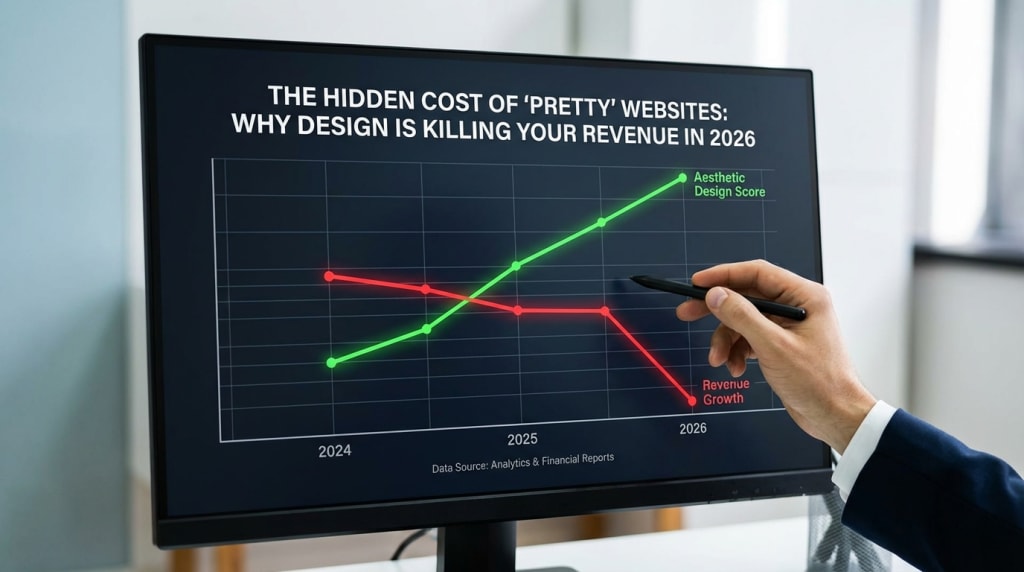
There is a common tragedy playing out in corporate offices across the business world right now.
A company decides it needs a new digital presence. They hire a creative agency. They spend weeks debating color palettes, hero images, and font pairings. Finally, launch day arrives. The website looks stunning. It has high-resolution videos playing in the background, sleek animations that slide in as you scroll, and a design that pops.
Everyone celebrates. The site looks like a million dollars.
But three months later, the data comes in. The bounce rate is 80%. Organic traffic is flat. Conversion rates have actually dropped.
The business owner is baffled. "How can this be?" they ask. "The website is beautiful."
The answer lies in a harsh reality of the 2026 digital economy: Google doesn't look at your website. It reads your code. And for many businesses, their beautiful new website is, technically speaking, a disaster.
The Problem with "Template Bloat"
To understand why this happens, we have to look at how most modern websites are built.
In an effort to save time and money, many agencies rely on heavy, pre-made templates and drag-and-drop page builders. These tools are designed to make things look good quickly, but they come at a terrible cost: Code Bloat.
To display a simple "Contact Us" button, a template might load 2,000 lines of unused code in the background. To run that sleek animation, the browser might have to download massive JavaScript libraries.
To a human user on a high-speed fiber connection, the site might load in three seconds. That feels fine. But to a potential customer on a 4G mobile connection in a subway tunnel? That site takes 12 seconds to load.
And in 2026, nobody waits 12 seconds. They hit the "Back" button and go to a competitor.
Core Web Vitals: The New Gatekeeper
This isn't just about user patience; it is about visibility. Google’s ranking algorithm now heavily weighs "Core Web Vitals."
These are technical metrics that measure the stability and speed of a website.
- LCP (Largest Contentful Paint): How fast does the main content load?
- CLS (Cumulative Layout Shift): Does the page jump around while loading?
- INP (Interaction to Next Paint): When I click a button, does the site react instantly?
If your "pretty" website fails these tests because of heavy code, Google will actively suppress your rankings. You effectively become invisible.
The Shift to "Digital Architecture"
This performance crisis has triggered a shift in the high-end market. Smart companies are stopping their search for "Web Designers" and starting to hire "Digital Architects."
Leading this movement is the concept of Headless Architecture and modern tech stacks like React, Next.js, and Node.js.
Ali Abbass Memon, a technical lead at Valkor Digital, explains the difference simply:
"A traditional template site is like a car with a Ferrari body kit but a lawnmower engine. It looks fast, but it can't perform. A modern web application is engineered for speed first. We don't just paint pixels; we build infrastructure."
This approach—often called "SEO-First Architecture"—involves writing clean, custom code that serves content to the user instantly.
Why "Static" Is the New Dynamic
One of the key technologies driving this shift is Static Site Generation (SSG).
In the old days, every time you visited a website, a server had to wake up, search a database, build the page, and send it to you. This takes time.
With modern frameworks like Next.js, the website is pre-built. When a user in London or New York clicks a link, the page is delivered instantly via a Content Delivery Network (CDN). There is no database lag. There is no waiting.
The result?
- Near-instant load times.
- Perfect Core Web Vitals scores.
- Higher Google Rankings.
- Increased Conversion Rates.
Data consistently shows that for every 100 milliseconds you shave off your load time, your conversion rate increases by 1%. In a competitive market, speed is literally money.
The Financial Case for Custom Code
The objection, of course, is cost. Building a custom-coded web application costs more upfront than buying a $50 template.
But this is where the mindset must shift from "Cost" to "Investment."
A cheap, bloated website is a liability. It requires constant plugin updates, it breaks easily, and most importantly, it loses customers every single day due to poor performance.
A custom-architected platform is an asset. It scales effortlessly. It requires less maintenance. And it acts as a high-performance sales funnel that captures revenue 24/7.
Conclusion: Look Under the Hood
The next time you are reviewing a proposal for a new website, don't just look at the mockups. Don't just look at the colors. Ask the hard technical questions.
- "What is the tech stack?"
- "How will we pass Core Web Vitals?"
- "Is this a template, or is this custom architecture?"
In the digital age, your website is your headquarters. You wouldn't build your physical headquarters out of cardboard just because it was cheaper. Don't build your digital headquarters out of bad code.
If you want to compete globally, you need to stop prioritizing "Pretty" and start prioritizing "Performance." Because in 2026, fast is the only thing that sells.
About the Creator
Keep reading
More stories from Mahnoor Qureshi and writers in Journal and other communities.
EU Set to Add Iran’s Guards to Terror List After France U-Turn
The European Union is poised to take one of its most significant diplomatic steps in years by moving to designate Iran’s Islamic Revolutionary Guard Corps (IRGC) as a terrorist organization — a decision that only days ago seemed unlikely due to political resistance, particularly from France. The shift in Paris’s stance has unlocked what many diplomats in Brussels describe as “a political green light” for the controversial measure, reflecting deepening concern in Europe over Iran’s internal repression and international conduct.
By Haque!Nawaz3 days ago in Journal
Cabin Fever Because of Snow, Sleet, and Freezing Rain That Turned to Icy Roads
What Is Cabin Fever? The short answer is that cabin fever is restlessness from being in a confined area. Cabin fever is the distressing irritability or restlessness experienced when a person or group is stuck at an isolated location or in confined quarters for an extended time. Research shows that prolonged cold, gray skies, and being stuck indoors can trigger mood shifts similar to “winter blues.”
By Margaret Minnicksa day ago in Humans




Comments
There are no comments for this story
Be the first to respond and start the conversation.