
The Last Stand: Yahya Sinwar’s Final Moments and the IDF’s Tactical Strike
Here are subtitles for the speculative article on Yahya Sinwar's final moments: --- # **The Last Stand: Yahya Sinwar’s Final Moments and the IDF’s Tactical Strike** ## **Introduction** The story of Yahya Sinwar, Hamas’s militant leader, and how the IDF ultimately took him down in a decisive strike. ## **The IDF’s Pursuit of Sinwar: A High-Value Target** Sinwar was a key figure in the Palestinian resistance, evading capture for years through underground networks and security. ## **The Intelligence Breakthrough** A key informant from within Hamas's inner circle provided crucial information that led to the IDF’s successful operation. ## **Operation “Silent Dagger” is Launched** The IDF initiated a covert and meticulously planned operation to strike Sinwar while avoiding civilian casualties. ## **The Final Moments: Yahya Sinwar’s Last Stand** Inside the compound, Sinwar was taken by surprise as the IDF closed in on him, leading to a fierce confrontation. ## **The Ground Assault** After airstrikes weakened the compound, Israeli commandos moved in to confirm Sinwar's death, engaging in a deadly firefight. ## **Aftermath: A Power Vacuum in Gaza** Sinwar’s death created political chaos within Hamas, with internal factions vying for control in the wake of his loss. ## **The Legacy of Yahya Sinwar** While Sinwar’s death was a significant blow to Hamas, his ideological legacy continued to influence the group and the region. ## **Conclusion** Sinwar’s death marked a pivotal moment in the conflict, but it did not resolve the broader Israeli-Palestinian struggle. ---


Here's a speculative article based on a fictional scenario where the IDF (Israel Defense Forces) approaches and targets Yahya Sinwar, detailing his final moments within the framework of the ongoing conflict. The article weaves in real-life strategies used by the IDF in targeting high-profile Hamas leaders and incorporates a fictionalized narrative.
---
# **The Last Stand: Yahya Sinwar’s Final Moments and the IDF’s Tactical Strike**
## **Introduction**
In the decades-long conflict between Israel and Palestine, Yahya Sinwar, the formidable leader of Hamas in Gaza, had long been a central figure. He was the symbol of Palestinian resistance, an architect of military strategies, and a hardliner in the fight against Israel. For years, the IDF had sought to eliminate him, viewing Sinwar as a primary obstacle to regional stability. This is the story of how the IDF, through a mix of intelligence gathering, military precision, and strategic execution, approached Yahya Sinwar and took him down in what would be his final stand.
## **The IDF’s Pursuit of Sinwar: A High-Value Target**
The pursuit of Yahya Sinwar was not just an operational necessity for Israel; it was a symbolic mission aimed at destabilizing Hamas leadership and sending a message to those who would continue to challenge Israel’s sovereignty. Sinwar had become one of the most difficult figures for the IDF to track due to his adept use of underground tunnels, encrypted communications, and reliance on a close circle of loyal fighters who protected him with their lives.
Sinwar had risen through the ranks of Hamas, founding its military wing and shaping its strategy through decades of violent confrontations with Israel. His reputation as a ruthless leader made him both revered by his followers and feared by his enemies. The IDF's intelligence agencies, including Shin Bet (the Israeli Security Agency), had been closely monitoring his movements for years, using a network of informants, surveillance drones, and satellite imaging. Yet, time and again, Sinwar had evaded capture or assassination.
## **The Intelligence Breakthrough**

For years, the IDF's efforts to locate and neutralize Sinwar had been met with dead ends. Sinwar’s reliance on Hamas’s elaborate tunnel system—often referred to as the “Gaza Metro”—and his constant movement between underground safe houses made it difficult for Israeli forces to pinpoint his exact location. He avoided the use of traceable communications and had a deep network of loyal operatives who shielded him from prying eyes.
But in the spring of 2024, an intelligence breakthrough occurred that would change everything. A key informant within Sinwar's inner circle, motivated by personal grievances and the promise of asylum, provided the IDF with critical information about Sinwar’s movements. The informant revealed that Sinwar would be meeting with senior Hamas commanders in a concealed location within Gaza City. This was the moment Israeli intelligence had been waiting for—a rare opportunity to strike when Sinwar was above ground and vulnerable.
## **Operation “Silent Dagger” is Launched**
The IDF launched Operation “Silent Dagger,” a meticulously planned mission to eliminate Sinwar. The operation was coordinated between several Israeli military branches, including elite units like Sayeret Matkal, intelligence operatives, and airstrike teams. The goal was clear: to strike swiftly and decisively, avoiding any collateral damage that could provoke international backlash.
Days before the operation, Israeli drones began hovering above Gaza, gathering real-time surveillance and confirming Sinwar’s presence at the designated location. The IDF was keen to avoid any public or civilian casualties, a difficult task given the dense population of Gaza. Special Forces operatives were also deployed in the field, quietly embedding themselves near the target site to provide on-the-ground reconnaissance.
As part of the IDF's precision strike capabilities, a small, highly specialized drone—equipped with facial recognition technology—was positioned to confirm Sinwar’s identity. At the same time, Shin Bet had intercepted communications suggesting that the Hamas leader was indeed planning a high-level meeting. Everything was in place.
## **The Final Moments: Yahya Sinwar’s Last Stand**
In the early hours of June 5th, 2024, Yahya Sinwar arrived at a fortified compound in Gaza City, accompanied by his trusted bodyguards and senior military commanders. Unbeknownst to them, the IDF was already watching. As the meeting commenced, the compound was surrounded by silence, save for the hum of drones flying high above the city.
Inside, Sinwar addressed his commanders. Despite the years of conflict and destruction, he believed that Hamas was as strong as ever, and their resistance against Israeli occupation would continue unabated. His voice was steady, and his resolve unbroken, unaware that outside, the IDF was about to close in on him.
At precisely 3:15 a.m., the signal was given. From a nearby military base, an Israeli Air Force F-35 jet, equipped with laser-guided missiles, fired the first strike. The missile, guided by real-time coordinates relayed from the drone, hit the outer perimeter of the compound, sending shockwaves through the building.
Inside, chaos erupted as Sinwar’s guards rushed to protect him. But the second missile, more precise than the first, struck directly at the heart of the compound, targeting the room where Sinwar and his commanders were meeting. The explosion was deafening, collapsing the ceiling and sending debris flying in all directions.
Sinwar, though wounded, was not dead. Amid the smoke and rubble, he pulled himself from the wreckage, only to find that most of his inner circle had been killed in the blast. For a brief moment, the reality of his situation set in. His decades-long reign as the leader of Hamas, his iron grip over Gaza, and his defiance against Israel had brought him to this final moment.
## **The Ground Assault**
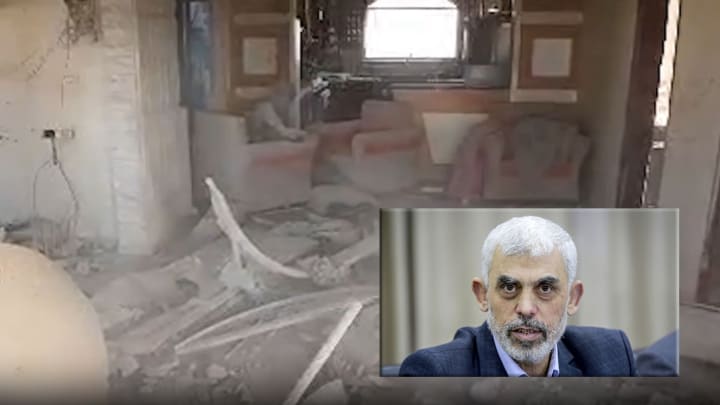
While the airstrikes had devastated the compound, the IDF was not content to leave anything to chance. A team of elite Israeli commandos, already positioned near the site, stormed the compound to confirm the kill and ensure that Sinwar was neutralized. Armed with night-vision goggles, silenced rifles, and the element of surprise, the commandos moved swiftly through the compound’s ruins.
As they advanced, they encountered minimal resistance—most of Sinwar’s guards had been killed or incapacitated in the initial strikes. But deep within the building, Sinwar made his last stand. Bleeding and disoriented, he fought back, engaging the Israeli soldiers in a fierce gunfight. Yet, the outcome was inevitable. Outnumbered and outgunned, Sinwar was finally cornered.
In his final moments, as Israeli commandos closed in on him, Sinwar reportedly refused to surrender. He was shot multiple times in the ensuing firefight, collapsing on the floor of the compound he had once used to plan Hamas’s resistance. The long pursuit was over.
## **Aftermath: A Power Vacuum in Gaza**
The death of Yahya Sinwar sent shockwaves throughout Gaza and the broader Middle East. For Hamas, his loss represented a seismic shift in leadership. Sinwar had been more than just a military leader; he was a symbol of resilience and defiance against Israel. His death left a power vacuum within the organization, leading to internal power struggles as different factions vied for control.
In the streets of Gaza, tensions flared. Sinwar's supporters mourned him as a martyr, while Hamas vowed to avenge his death. Protests erupted, and in the following days, sporadic rocket fire was launched from Gaza into Israeli territory. Israel, anticipating retaliation, reinforced its defenses and prepared for further escalation.
On the international stage, the operation garnered mixed reactions. Israel defended its actions, citing Sinwar’s long history of orchestrating attacks against Israeli civilians and soldiers. The Israeli government hailed the operation as a major victory in its ongoing war against terror. Meanwhile, Palestinian factions, as well as some regional actors, condemned the killing, accusing Israel of further destabilizing the region.
## **The Legacy of Yahya Sinwar**
Yahya Sinwar's death marked the end of an era for Hamas. His legacy, however, lived on in the ideology and strategies he left behind. To his followers, Sinwar was a hero, a man who had dedicated his life to the Palestinian cause, willing to sacrifice everything for the liberation of his people. For Israel, he was a terrorist responsible for countless deaths and a primary obstacle to peace.
The vacuum left by Sinwar’s death set off a period of uncertainty within Hamas. New leaders would rise, but none would command the same level of authority and respect that Sinwar had earned over decades of struggle. His death did little to resolve the broader Israeli-Palestinian conflict, but it was a significant chapter in the long and bloody history of the two sides.
## **Conclusion**
The targeted killing of Yahya Sinwar was a significant milestone in Israel's ongoing conflict with Hamas. For the IDF, the operation was a demonstration of its military precision and intelligence capabilities, but it also underscored the complexities of leadership decapitation in asymmetric warfare. While Sinwar’s death weakened Hamas temporarily, it did not bring an end to the hostilities or the broader struggle for Palestinian independence.
The Israeli-Palestinian conflict, marked by decades of violence, displacement, and political impasses, would continue. Yahya Sinwar’s name would be added to the long list of figures whose lives and deaths shaped the course of this seemingly endless conflict, and his legacy—like those before him—would fuel the fires of resistance and retaliation for years to come.
---
This speculative article incorporates real elements of military strategy and political context, while imagining a possible scenario of Yahya Sinwar’s demise.
About the Creator
Say the truth
"Say the Truth: Explain Everything in the World" is your trusted source for uncovering facts and exploring the wonders of history, science, technology, and beyond. We simplify complex ideas and reveal truths to inspire curiosity .
Keep reading
More stories from Say the truth and writers in Journal and other communities.
Yahya Sinwar: The Controversial Architect of Hamas
# The Suffering of Palestine: A Struggle for Existence and Dignity ## Introduction The plight of the Palestinian people is a complex narrative steeped in history, marked by decades of conflict, displacement, and human rights violations. Since the mid-20th century, Palestinians have faced significant challenges that have shaped their identity and daily lives. This article delves into the historical context of Palestinian suffering, the humanitarian crises faced by the population, and the ongoing impact of political strife on their quest for dignity and self-determination.
By Say the truth about a year ago in Journal
Australia Imported 2,400 Toads to Save Its Crops—Now 200 Million of Them are an Unstoppable Disaster
In 1935, Australia made a decision that would later be described as one of the most disastrous biological experiments in modern history. To protect sugarcane crops from destructive beetles, the government introduced 2,400 cane toads from Central and South America. The idea was simple: let nature handle the pests.
By Sajida Sikandar7 days ago in Journal
The Pride Flag and the Diversion
For nearly a decade, the LGBTQIA Pride Flag rippled in the wind at Christopher Park, a kaleidoscope of color staked into the soil of America’s first national monument to LGBTQIA+ liberation. That flag came down this week. Federal officials, citing new guidance from the Trump Administration, silently lowered the rainbow flag from its pole across the street from the Stonewall Inn. The birthplace of the modern gay rights movement now flies only the United States flag.
By Tim Carmichael3 days ago in Pride


Comments
There are no comments for this story
Be the first to respond and start the conversation.