
🤝 The New Alliance: Why Intel Might Fabricate Apple Silicon for the Budget MacBook Line
Decoding the strategic shift: Analyzing the motivations behind a potential limited partnership where Intel Foundry produces entry-level M-series chips for Apple's affordable notebooks.

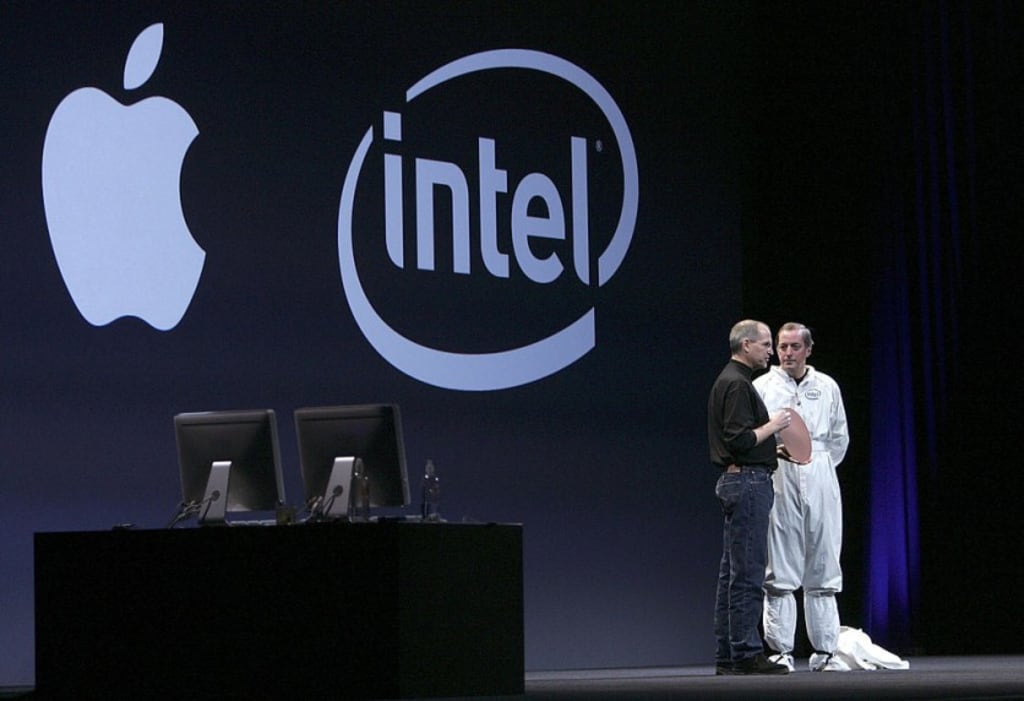
The technology industry has been watching with fascination as Apple systematically replaced Intel processors with its own proprietary Apple Silicon (M-series chips) across the Mac lineup. This transition was widely considered a final, decisive break. However, recent, highly significant rumors suggest that the two giants might be on the verge of rekindling a partnership, albeit in a radically new and strategically limited capacity: Intel’s Foundry Services (IFS) fabricating entry-level Apple Silicon chips for a new budget MacBook line.
This rumored collaboration—focused exclusively on lower-tier M-series chips and not high-end Pro or Max variants—is a win-win scenario driven by mutual commercial necessity: Apple needs to diversify its supply chain and reduce costs, and Intel needs a high-profile, demanding customer to validate its foundry business.
I. Apple’s Strategic Imperative: Diversification and Cost Control
For Apple, the potential move to utilize Intel Foundry Services (IFS) for its lowest-cost chips is a decision based on risk management and market expansion.
De-Risking TSMC Dependency: Apple is currently almost entirely reliant on TSMC (Taiwan Semiconductor Manufacturing Company) for the production of its A-series and M-series chips. This hyper-dependency creates a severe single-point-of-failure risk, particularly given geopolitical tensions in the Asia-Pacific region. By bringing Intel into the mix, even for a limited volume of budget chips, Apple gains a crucial second-source supplier with a manufacturing base in the U.S. and Europe.
Targeting the Budget MacBook: Rumors have long persisted about an "affordable MacBook" designed to challenge the dominance of Chromebooks in the education and entry-level markets. To achieve the aggressive pricing required for this model, Apple must significantly drive down its component costs. Using Intel's U.S. and European fabs, which may offer more favorable pricing for mature or slightly older process nodes required for entry-level chips, could be key to achieving that necessary cost structure.
Technology Maturity: Intel's current advanced process nodes are nearing the performance and efficiency of TSMC’s equivalent nodes, making them viable for lower-tier chips where peak performance isn't the sole metric.
II. Intel’s Strategic Necessity: Validating the Foundry Business
For Intel, securing a contract with Apple, even for budget chips, is an existential necessity for its ambitious IDM 2.0 strategy—the push to transform Intel into a major global foundry player competing directly with TSMC and Samsung.
The Anchor Customer Effect: Having Apple as a confirmed customer, even a limited one, would be a massive coup. Apple is widely recognized as the most demanding customer in the world in terms of volume, quality, and technical specification adherence. Winning an Apple contract would immediately validate the credibility, capacity, and quality of Intel Foundry Services in the eyes of every other potential client (like Qualcomm, NVIDIA, or even AMD).
Process Refinement: Producing chips like the entry-level M-series (which prioritize efficiency over core counts) would allow Intel to stress-test its manufacturing processes, logistics, and quality control systems under Apple's demanding oversight. This provides invaluable experience necessary before attempting to secure high-volume, cutting-edge contracts.
Filling Fab Capacity: Intel is investing billions in building massive new fabs globally (in Arizona, Ohio, and Germany). Securing a large-volume customer like Apple, even for entry-level chips, is essential for ensuring these multi-billion-dollar factories operate at optimal capacity.
III. The Limits of the Partnership
The rumors are explicitly limited: this collaboration would likely not extend to the M-series Pro, Max, or Ultra chips.
The Performance Gap: TSMC remains the leader in the absolute cutting edge (2nm and beyond), which is essential for the extremely demanding performance and power-efficiency metrics required by Apple's high-end professional chips. Apple is unlikely to risk its flagship product line on a new foundry relationship.
Intel’s Own Roadmap: Intel remains committed to its core mission of designing and manufacturing its own CPUs. A limited partnership allows them to gain validation without compromising their competitive intellectual property or fully dedicating their most advanced nodes to their chief rival.
Conclusion: A Mutually Beneficial Détente
The potential return of Apple to Intel’s orbit, albeit as a foundry customer rather than a processor partner, is a fascinating strategic détente driven purely by modern market dynamics. Apple seeks stability and cost control for its ambitious entry-level product, and Intel seeks the undisputed validation necessary to launch its foundry business onto the global stage. If this deal materializes, it will reshape the competitive landscape of semiconductor manufacturing for the decade to come, signaling a new era of selective and necessary cooperation.
About the Creator
from death into life
Young Aldin of Wiloh had never contemplated death. It was almost strange — so many around him had the tendency to obsess over it, to clamor and claw almost desperately at their own perceptions of the end to know death as much as they could: when it would come, why it would come, where it would take them when it did.
By angela hepworth7 days ago in Fiction



Comments
There are no comments for this story
Be the first to respond and start the conversation.