
Understanding Low-Code No-Code Development Platforms
We'll cover the most effective low-code or no-code platforms in the future.


For a longer period of time, there were just two paths that firms could use for application development: Purchase the ready-made applications from the external vendor or develop and customize them from the start through the usage of skilled developers and coders. However, we are also witnessing the growth and maturation of low-code/no-code (LCNC) development options, which offer the power of application development to users across the organization.
As companies look for more efficient ways to create apps and manage operations, the increasing trend of no-code and low-code platforms has generated their attention. Platforms with no code and low code are intended to simplify the development process and minimize the amount of coding required.
According to Gartner, the No-code/Low-code platform industry will expand by about 20% by 2023, with low-code application platforms (LCAP) reaching nearly $10 billion in revenue. It is even expected that citizen automation development platforms (CADP) would be the fastest-growing technology in the hyper-automation technology area in the future years.
With the start of low-code or no-code platforms development of the applications would have become simpler compared to before times.
It can happen to make more complex applications without investing a huge amount, waiting for days or months, or employing multiple developers, it has done because of such technologies.
And you already know how crucial apps are to modern life, whether they are used for personal or professional purposes.
In addition, you don't necessarily need to be an excellent coder to create incredible apps. Modern low-code or no-code development environments ensure that you write little to no code while still creating innovative apps that power your company.
No-code platforms enable simple workflow automation, improve business processes, and offer additional features to support your operations and aid in your growth in addition to the ability to construct apps.
Why Do We Need Low-code or No-code Platforms?
Let's go deeper into this in the next part and see how it may benefit your business. Then we'll talk about the best low-code or no-code platforms for you.
Definitions: Code, low-code, and no-code
Full code, low code, and no code are three approaches to constructing computer software, and each has advantages and disadvantages.
What is the Term Full-code Dfines?
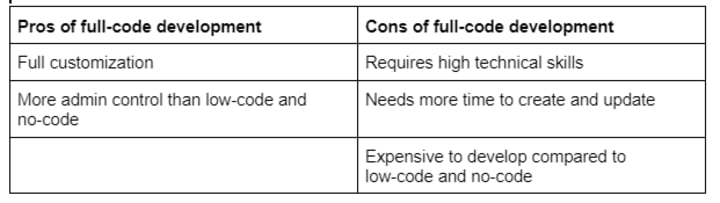
Through the utilization of the programming language, the code short for source code defines the text written by the software developer. A software developer makes the application, website, or background process with code that permits for personalization however the same could be costly and tough to handle. Till now all the software was developed via the software developers however with the assistance of no-code tools all the non-technical workers are able to develop the computer software.
What is The term low-code Elaborates?
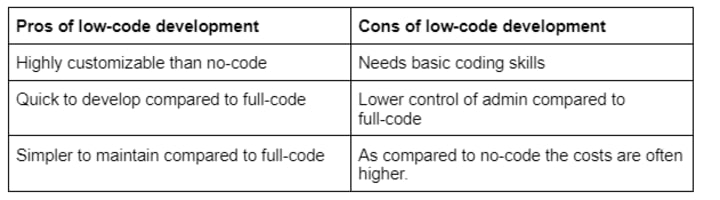
Low-code development necessitates some coding capabilities, but it represents a significant shift from full-code development. Low-code programming allows software engineers to create and alter applications more quickly by using APIs, drag-and-drop capabilities, code templates, process flows, and other features. This makes it more effortless and faster for organizations to deploy new processes and app functionality than if they built through the code only.
What the term No-code defines?
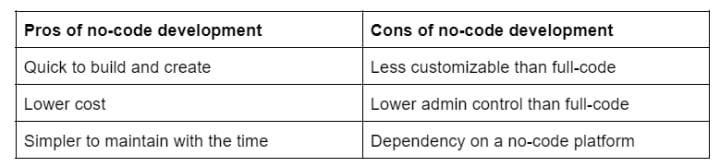
No-code platforms often enable non-programmers to create computer applications. In other words, no-code software enables people with no technical knowledge to create apps that integrate with an organization's existing infrastructure and operations. No-code tools, like low-code tools, contain features such as drag-and-drop functionality, process flows, visual tools, and more.
No-code development is appealing to organizations since it is versatile and simple to build—and anybody can use it.
For instance, what can you perform with the no-code automation tool? With zero usage of code, SDMT permits you to build the workflows that send the data to thousands of applications.
What is low-code and no-code AI?
These words are simply used to describe tools that authorize anyone to construct AI applications without having to write technical code. AI can assist people in almost every profession, from physicians and attorneys to marketers, teachers, and project managers. Many of these folks will lack the technical abilities required to develop code, as well as the time to learn them.
No-code/low-code solutions work in one of two ways: Either using a drag-and-drop interface, in which users select the components they wish to include in their app and arrange them visually, or through a wizard, in which users answer questions and select options from drop-down menus.
When you previously learn the method to code then it might be feasible to tweak and fine-tune the results for building the app which functions in a certain way. The skills of structure and syntax of computer code would be quite assistive.
Top 8 Benefits of Low-Code/No-Code Platforms
The popularity of LCNC (Low-Code No-Code) platforms is increasing day by day as a non-IT person can also introduce himself/herself to the tech world. It reflects the huge advantages of using these platforms for businesses. Utilising LCNC platforms entails-
Useful and easy to use
No doubt the apps were not created from scratch, development was made simpler, allowing developers to concentrate more on meeting the needs and wants of consumers. With LCNC platforms, you don't need to write code—just command the requirements, and the computer will do it for you.
Improved Development Speed
Users may quickly modify and alter the primary elements and foundational code of their apps, which make the development process more facile. Users can also link and integrate workflows, processes, and applications from already-existing applications. According to Forrester, low-code platforms can speed up development projects by up to 20 times compared to traditional coding methods.
Automated processes
Users can automate the design of workflows that can subsequently be deployed across various information systems by creating fundamental principles for decision-making. Many LCNC platforms make recommendations for automation based on available data sets using RPA, Artificial Intelligence (AI), and machine learning.
Cheaper Prices
Saving time may result in the saving of important resources as well. Additionally, LCNC simplifies maintenance tasks, lowering expenses and the unnecessary load on IT. Moreover, it is quite affordable to implement new ideas from almost any department. Then, these ideas can revamp entire procedures while boosting productivity and efficiency in the effort.
Integration of Data with Greater Simplicity
Data integration is made easier and more flexible by creating workflows where information is gathered, shared, processed, and stored. Users can easily track, process, and utilise data within a process with the help of LCNC platforms. Making informed decisions with clarity will be possible as a result of being able to identify the source, ownership, veracity, and quality of data across processes.
More Flexibility
Quick and simple development enables you to respond fast—often in real time—to evolving possibilities as well as regulatory and compliance challenges. Additionally, without the need for significant IT investments or outside resources, developers can explore and test new ideas on LCNC platforms owing to their flexibility. Additionally, LCNC facilitates development, expanding the pool of developers and enabling more people to participate in the development of technology-based applications.
Good Customer Knowledge
The ability to maintain workflows and apps up to date while being receptive to consumer feedback improves customer experience as well as keep them loyal. CX experts may also create tailored consumer surveys, e-commerce, customer support, and loyalty applications using LCNC platforms.
Greater Security and Privacy
LCNC enables businesses to carry out development work that is too delicate to be contracted out to outside parties, reducing the likelihood of hacks or other cybercrimes.
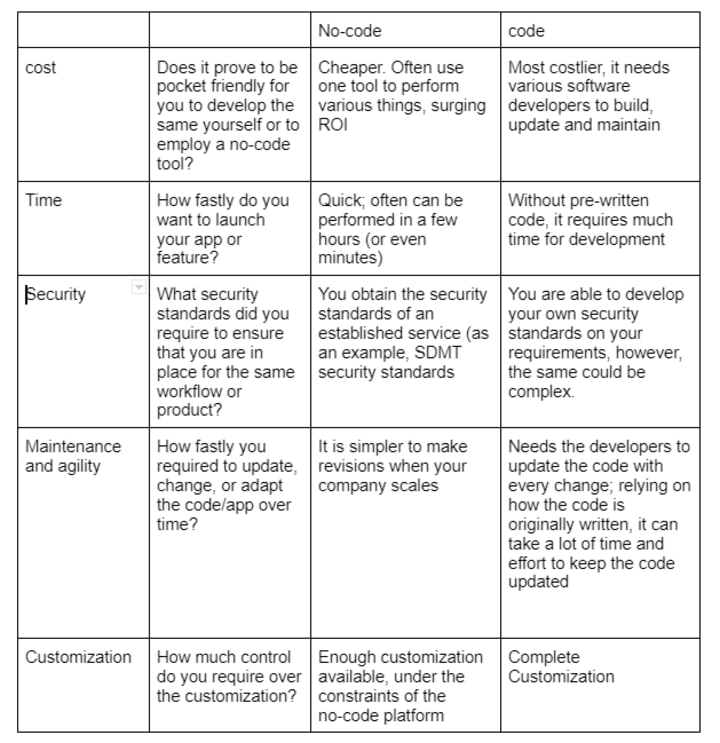
When to opt for the no-code vs. full-code
The additional things here that your business must learn about on deciding between the code no-code solutions:
Best Future of Business is No-code
In one of our market studies, we discovered that 90% of no-code users believe their business has grown more quickly as a result of using no-code. For companies aiming to simplify development and procedures, a low-code or no-code strategy is a preferable choice since it requires less time and money. Expert coders and traditional developers won't be replaced by low- and no-code platforms. Even so, they are a potent instrument for the future since they enable firms to expand in ways that weren't previously feasible.
I thus advised my dad to test no-code first to see whether it works. If so, there is no need to invest resources in a full-code solution unless he is certain that it is required.
SDMT is a future LCAP/LCNC platform that is primarily created using Java, Angular, and its practical features such as IDE, framework, and development tools, but it does not include any third-party software. SDMT's low-code no-code development platform includes a number of in-house built tools, utilities, and APIs that may be utilized independently.
The market for mobiles and tablets has expanded dramatically, and technological advancements have supplanted the value of laptops/PCs in our lives. As a result, there is a significant need for mobile applications and software nowadays. The SDMT low code no code (LCNC) platform building program may be deployed as a mobile app and does not require internet access.
About the Creator
Vikas Sharma
Vikas Sharma is a qualified IT and mobile app development based researcher and author who writes about market trends and helps your online business Mobile App and expert web design company India as per his expertise.
Keep reading
More stories from Vikas Sharma and writers in Journal and other communities.
Why No-Code Automation Defines the Future of Business
In the past, programming required a lot of complex code to automate tasks and manage workflows, which could be quite heavy and challenging. However, things changed with the introduction of no-code automation. This new approach has transformed the way businesses function. Nowadays, using no-code tools to create automation is crucial for companies that want to simplify their processes, lighten their workloads, and improve overall efficiency.
By Vikas Sharma10 months ago in Journal
Solo Mio Review: A Valentine’s Day Getaway That’s Sweet, Scenic, and Slightly Forgettable
Today, we’re talking about Solo Mio, the latest romantic comedy-drama from Angel Studios. It tells the story of a man who gets left at the altar and then has to go on his already-booked Italian honeymoon… completely alone.
By Bella Anderson3 days ago in Journal
When True Love Never Questions Your Soul
“And she’s going to learn that this life will hit you, hard, in the face, wait for you to get back up, just so it can kick you in the stomach but getting the wind knocked out of you is the only way to remind your lungs how much they like the taste of air.” — Sarah Kay’s Poem — If I Should Have a Daughter
By Chantal Christie Weiss5 days ago in Humans



Comments
There are no comments for this story
Be the first to respond and start the conversation.