
What if God is All?
What If God Is Everything: Exploring Divinity as the Essence of Existence
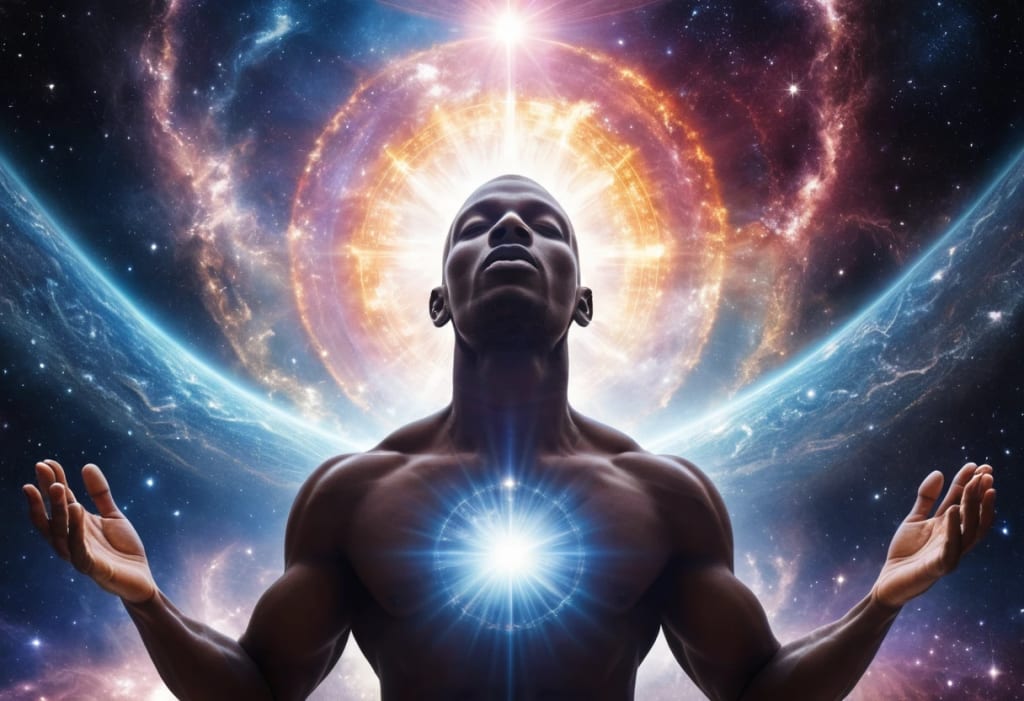
Imagine a scenario in which God is All.
Envision a Divine being not as a solitary, human being but as the actual texture of presence — a vast, nebulous embodiment that infests all things. Imagine a scenario where God is the energy flowing through the underlying foundations of old trees, the liquid effortlessness of seas, the complex dance of bugs, the heaviness of earth underneath our feet, the imperceptible murmur of air, and the immense span of the skies above. God should have been visible not as isolated from creation but rather as creation itself: a widespread cognizance, that the entirety of all that exists, has existed or will exist.
In the Book of Scriptures, we track down a sprinkle of this point of view in the most natural-sounding way for Paul:
*"For in him we live and move and have our being."* (Acts 17:28)
This recommends a Divine being not far away yet personally woven into the embodiment of our reality, a heavenly presence wherein all life unfurls.
Such an idea rethinks divine nature not as an outer manager but rather as an inherent reality. God turns into the beat of the universe, the mood of presence. This lines up with otherworldly customs like polytheism, where God is viewed as indistinguishable from the universe, or panentheism, which sees God as both natural in creation and extraordinary past it.
---
God's "Structure" in This Perspective
On the off chance that God is widely inclusive, how would we envision God's structure? In the Bhagavad Gita, Krishna depicts the heavenly as endless, saying:
*"I'm the wellspring of all creation; everything continues from Me."* (Bhagavad Gita 10:8)
Additionally, in the Book of Scriptures, God's ubiquity is proclaimed in the Songs:
*"Where might I at any point go from your Soul? Where could I at any point escape from your presence? If I go up to the sky, you are there; assuming I make my bed in the profundities, you are there."* (Song 139:7-8)
God's "structure" could be the perpetual motion of creation itself: the patterns of birth, development, rot, and reestablishment. Picture a whirling embroidery of energies and components, steadily changing and boundless. This idea lines up with the Quranic announcement of God as the wellspring of all life:
*"He is the First and the Last, the Ascendant and the Cozy, and He is, for goodness' sake, Knowing."* (Quran 57:3)
Such a Divine being doesn't stay in a far-off domain yet is available in each particle, each collaboration, and each heartbeat. Looking for God wouldn't be tied in with searching externally or up yet internally and all around — perceiving the hallowed in each second and everything.
How This Affects Humanity
If God is everything, we also are heavenly, for we are important for this perplexing snare of presence. The Book of Scriptures states:
*"Do you not realize that you are God's sanctuary and that God's Soul stays in you?"* (1 Corinthians 3:16)
This point of view welcomes us to treat one another, and all of creation, with worship. The Quran highlights this interconnectedness:
*"Furthermore, He has made you replacements upon the earth and has raised some of you above others in degrees [of rank] that He might attempt you through what He has given you."* (Quran 6:165)
Hurting others or the regular world becomes, it could be said, hurting God and ourselves. On the other hand, thoughtful gestures, care, and imagination become approaches to regarding this heavenly energy. This lines up with the lessons of Jesus, who said:
*"Genuinely I tell you, anything that you accomplished for one of the least of these family of mine, you accomplished for me."* (Matthew 25:40)
In this structure, love shifts from customs guided toward an outer god to living amicably with the world and one another. It calls us to be stewards of the earth, defenders of life, and searchers of solidarity.
Challenges and Wonder
This thought of God as everything may not offer the solace of a god who intercedes or gives unambiguous responses. It requests that we view significance and ethical quality inside the setting of our common presence instead of focusing on an outer source. However, it additionally welcomes wonderment, interest, and obligation. It requests that we wonder about the intricacy and magnificence of the universe, embrace its secret, and live with modesty and reason.
In the Tao Te Ching, Lao Tzu composes:
*"The Tao is perfect; the sky is perfect; the earth is perfect; humankind is perfect. These are the four extraordinary powers."* (Tao Te Ching, Part 25)
This lines up with the possibility of God as the Tao, the boundless stream and substance, everything being equal.
Conclusion
Imagine a scenario in which God isn't a being by any means yet *being itself*. Such an idea reshapes how we might interpret godliness, obscuring the lines between the hallowed and the ordinary. It provokes us to see the heavenly in a piece of sod, in the spread of the universe, and the pulsating of our hearts.
This is a dream of God as endless and personal, ever-present and sweeping — a Divine being whose structure is, essentially, *everything*. As the Quran states:
*"To Allah belongs the east and the west, so wherever you turn, there is the face of Allah. Indeed, Allah is all-encompassing and knowing."* (Quran 2:115)
---
By entwining these statements with the account, we can perceive how this viewpoint reverberates across numerous strict customs, welcoming us to see God as the pith of presence itself.
About the Creator
Keep reading
More stories from Bongani Mahlangu and writers in Journal and other communities.
~ Fired ~
— Ai Intrusion ~ Are you Next ~ Is Ai Evolution after your job? — Few workplaces haven't been affected. Ai is in supermarkets, at doctors' offices, and even monitoring farms. I just can't think of anything this machine is not getting into, can you? For instance: Education ~ Law and Tech jobs will one day have a major influence or be taken over by these inanimate machines, with accuracy and vigor. From mechanics' diagnoses to a wide variety of everyday jobs, including fast food workers, with this input having the ability to cut their unnecessary work hours. I'm certain all of us have been touched by this with our short stories and colorful headings, have you? Even comments are very questionable 'Non-Robot' insertions.
By Jay Kantor24 days ago in Journal


Comments
There are no comments for this story
Be the first to respond and start the conversation.