
When the Space Finally Felt Supportive Instead of Neutral
The moment I realized neutrality isn’t the same as comfort

For a long time, I described my workspace as “fine.”
It wasn’t uncomfortable. It wasn’t distracting in any obvious way. The lighting worked. The air circulated. The temperature was reasonable. Nothing about it demanded complaint. If someone had asked how it felt to work there, I would have said it was neutral.
But neutral, I learned, isn’t the same as supportive.
I noticed the difference on a day that felt unusually steady. I had been working for hours, yet my body didn’t feel compressed or tense. My shoulders weren’t gradually rising toward my ears. My breathing stayed even. My eyes didn’t ache in that familiar, dull way that usually crept in by mid-afternoon.
There was no dramatic shift. Just an absence of friction.
At first, I couldn’t identify what had changed. The desk was the same. The tasks were the same. The pace of the day hadn’t slowed. But the room itself felt different. It felt like it was helping rather than simply existing.
That subtle distinction reshaped how I understood space.
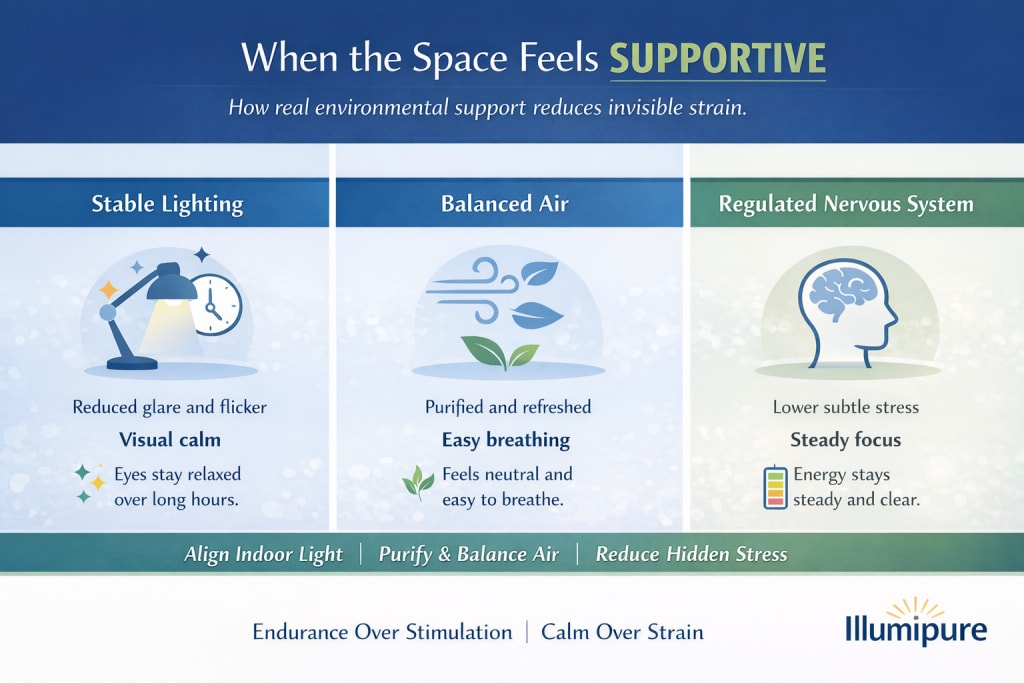
A neutral space doesn’t actively harm you, but it doesn’t actively support you either. It meets basic standards. It illuminates the room. It circulates air. It maintains temperature. But it doesn’t align with how the human nervous system actually functions.
A supportive space, on the other hand, works with your biology.
The difference often begins with light. The human visual system evolved under natural daylight, where intensity and spectral composition shift gradually and predictably. Many indoor environments replicate brightness but not stability. Flicker, sharp spectral peaks, and glare create constant micro-adjustments in the visual cortex.
Even when we don’t consciously perceive those fluctuations, the brain does. It spends energy correcting them. That correction feels like fatigue later.
In the space that felt supportive, the lighting was steady and balanced. There was no hidden flicker pulling at peripheral vision. No harsh overhead glare forcing my eyes to narrow slightly. The illumination felt calm, almost invisible.
That invisibility mattered more than I expected.
Air was another factor. In neutral environments, air may technically meet ventilation standards but still feel subtly heavy. Slight increases in carbon dioxide or particulate matter can influence alertness and breathing patterns. The body compensates automatically, often by tightening respiratory muscles or increasing subtle stress responses.
In the supportive space, breathing felt easy. I didn’t need to adjust my posture to inhale fully. My chest expanded naturally. The air didn’t draw attention to itself.
The nervous system is constantly scanning for instability. It asks silent questions: Is this environment predictable? Is it safe? Is there something I need to adapt to?
In a merely neutral space, the answer is often “mostly.” That lingering uncertainty keeps the autonomic system slightly engaged. Muscles brace. Focus fragments. Energy drains gradually.
In a supportive space, the answer becomes “yes.” The environment is stable. The sensory input is consistent. There’s nothing to correct.
That day, I noticed how long I could remain engaged without strain. My thoughts felt continuous instead of interrupted. My posture stayed relaxed without conscious effort. I wasn’t pushing through the afternoon. I was moving with it.
Support didn’t feel dramatic. It felt subtle.
We often assume that productivity and comfort are opposing forces. That to accomplish meaningful work, we must tolerate some level of strain. But the body performs best when it isn’t defending itself against small, cumulative stressors.
A supportive space reduces those stressors. It stabilizes light in a way that aligns with circadian signaling. It maintains air quality that allows efficient oxygen exchange. It minimizes visual noise so the brain can allocate resources to thinking rather than correcting.
The shift from neutral to supportive doesn’t announce itself loudly. It appears as steadiness. As sustained clarity. As the absence of that end-of-day depletion that feels disproportionate to the work completed.
By evening, I realized something important. I wasn’t as tired as I usually was. Not because I had done less, but because I had spent less energy adapting.
That’s when I understood that neutrality is not enough.
A space that simply avoids harm still leaves the body compensating. A space that actively supports human biology removes the need for that compensation.
The difference is quiet but transformative.
Now, when I enter a room, I pay attention to how long I can remain present without subtle strain. If my breathing stays steady, if my eyes remain relaxed, if my thoughts move without interruption, I know the space is doing more than existing.
It’s supporting.
And once you experience that difference, neutral no longer feels neutral at all.
About the Creator
illumipure
Sharing insights on indoor air quality, sustainable lighting, and healthier built environments. Here to help people understand the science behind cleaner indoor spaces.
Keep reading
More stories from illumipure and writers in Journal and other communities.
Why I Felt Steadier Even Late in the Afternoon
Late afternoon used to be predictable. Around 3:30 or 4:00 p.m., something in me would dip. Not dramatically. Not enough to stop working. But enough to notice. My thoughts would slow slightly. My posture would collapse inward. I’d reread sentences more than once. Even conversations felt a little heavier to participate in.
By illumipurea day ago in Journal
How the Brain Adapts to Building Digital Products Consistently
Consistency sits at the center of every successful digital product. Ideas matter. Skills matter. Execution over time matters most. Many people struggle not because they lack creativity or knowledge, but because they underestimate how much consistency reshapes the brain.
By Edina Jackson-Yussif 3 days ago in Journal


Comments
There are no comments for this story
Be the first to respond and start the conversation.