
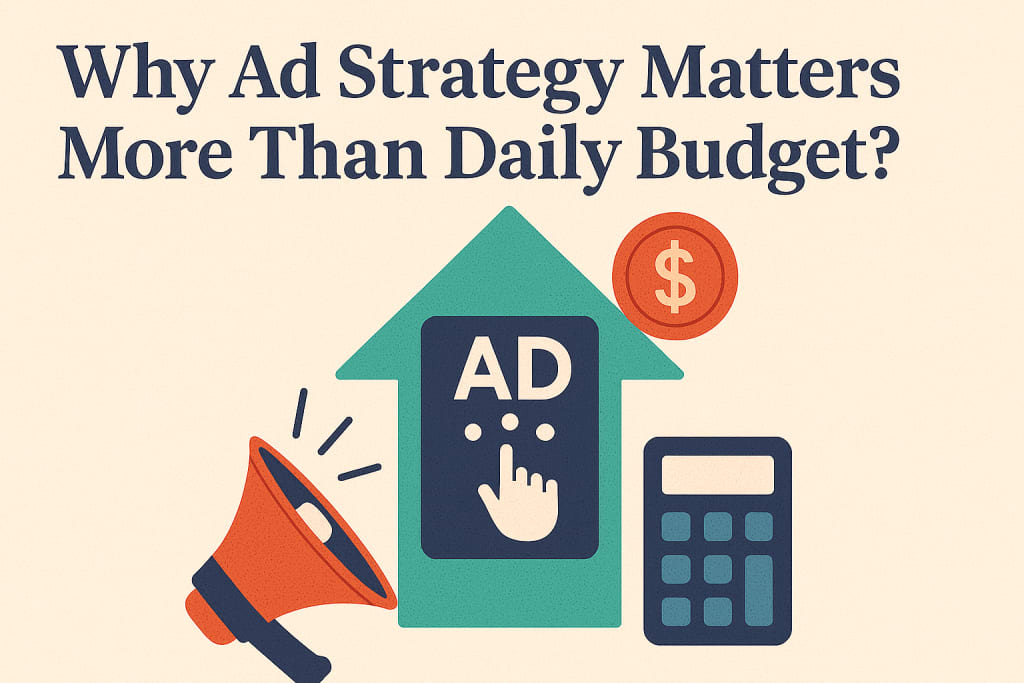
Why Ad Strategy Matters More Than Daily Budget?
How planning became the difference between noise and outcomes in a campaign that looked healthy from the outside?

I still remember the late evening when I stared at the dashboard that looked perfectly stable from the outside. Numbers updated every few seconds, charts moved in gentle curves, and the spend graph flowed upward with quiet confidence. Nothing looked wrong. The daily budget was sizable. The impressions count looked strong. The clicks rose gradually. Yet behind that quiet surface was a campaign that had stopped converting weeks earlier.
The office had thinned out by then. Someone’s coffee sat half-finished on the counter near the glass wall. A warm table lamp dimmed slowly beside my laptop while the screen kept blinking with automated reports. That was the night I learned something that didn’t reveal itself easily. You cannot spend your way into relevance. You cannot raise daily budget and expect the result to follow. Strategy does the work long before the first currency leaves your account.
When the numbers appear successful but nothing moves
The campaign that night belonged to a mid-market brand preparing for a new release. They had decided to raise daily spend as a shortcut. It looked logical at the time. The creative was new, the product was new, the landing flow was simple. Leadership wanted speed. My job was to keep everything stable while bringing in quick results.
For the first three days, everything looked promising. Click charts moved like clean slopes. Traffic doubled. People reached the landing page. Analytics lit up with green highlights. Yet somewhere around Day Four, the conversions stopped rising. Then they froze. It felt like watching a fast crowd running into a corridor that narrowed without warning. Noise continued. Output stalled.
I looked closer. People clicked. People reached the form. But no one stayed long enough to complete anything meaningful. Money had movement. Nothing meaningful took shape.
That is when strategy begins its interrogation.
- What exactly are we attracting
- Who feels addressed
- Who feels interrupted
- Who is arriving without intent
Budget cannot answer those questions. Spending simply magnifies whatever is already happening.
When the audience looks large but feels distant
A campaign without proper thinking behind it behaves like a loud announcement in a room where no one asked to listen. Tracking logs were telling me something subtle. People bounced in seconds. They arrived without intention. The targeting was wide because earlier decisions leaned on volume rather than relevance.
I paused everything for a moment and opened the segmentation view. I wanted to see where the drop actually occurred. It wasn’t inside the page. It wasn’t the price point. It wasn’t even clarity. The real problem was that the message sounded like a broadcast instead of a doorway.
Strategy begins before invitation appears. It shapes why someone is entering, not only how many enter.
When you slow down long enough to ask the right question
The change that followed did not begin with spend. It began with curiosity.
I rewrote the narrative that audience would first meet. I closed every distracting variation. I stabilized the campaign to a single intention. The brand needed people who had already been comparing similar solutions. Not cold traffic. Not browsing visitors. Not those who clicked because of attractive phrasing.
It took most of that night to rebuild the structure. It wasn’t complicated. It was intentional. Sometimes rebuilding is nothing more than subtracting noise.
- Budget remained unchanged.
- The message changed.
- The entry point changed.
- The qualification changed.
- That is when something shifted.
When ads stop being invitations and become confirmations
What arrived after that revision wasn’t explosive. It was natural. Instead of visitors wandering through quickly and disappearing, people stayed longer. They reached the second screen. They interacted with content. They clicked through deeper pages. They submitted their details not because the campaign persuaded them, but because they already wanted what it was offering.
The brand felt different. The product felt familiar. The decision felt like continuation rather than conversion.
Strategy often behaves like alignment rather than persuasion.
The next morning, the performance report looked calmer. Spend was nearly identical. Click count was lower than earlier days. Yet conversions had doubled. Someone from the team walked past my desk and nodded without saying anything. That is what improvement usually looks like. Quiet acceptance instead of celebration.
When you realize spend is not a lever but an amplifier
Time teaches something that numbers alone rarely explain. When strategy is unfinished and budget climbs, the mistake becomes louder. When strategy is precise and budget climbs, progress scales without shaking foundations.
That evening taught me that the best campaigns rarely start with spending. They begin with truth about audience, clarity about entry point, and acceptance that quality traffic does not arrive through force.
Later that month, we scheduled a second push. The brand wanted broader reach again. The difference was that now the message was built for the right person. We weren’t shouting at everyone. We were calling someone already prepared to respond.
That time, the results did not freeze.
They grew in proportion.
The moment strategy reveals itself through timing
There was one particular metric that stayed with me. Average delay between first touch and final decision shortened. People did not hover. They moved with intention. They returned sooner. They completed sooner. It felt like the whole journey became a straight corridor instead of an intersection.
One afternoon, a teammate asked whether we had increased overall ad quality. I smiled and simply said we changed why someone arrived, not how many arrived. Strategy doesn’t decorate. It directs.
That is when I used google ads optimization principles without thinking of them technically. The idea wasn’t about bidding adjustments. It was about arrival logic.
When leadership finally sees something that doesn’t look dramatic
Leaders rarely ask about the one moment that shifts an outcome. They usually look at charts, totals, averages. This time, when the weekly report circulated, cost per meaningful action dropped quietly. Bounce rates lowered. Form completions increased. Nothing massive. Nothing sudden.
Just progress that looked ordinary.
That is what real strategic change feels like. Not noise. Not a spike. A steady pattern that holds even when spend rises.
The budget remained the same through most of that sequence. The success did not come from pushing harder. It came from shaping intention first.
Why budgets don’t protect you when alignment is missing
Money cannot compensate for mismatch. A campaign without direction can spend endlessly without creating traction. Looking back, I think about how easily someone might look at that early campaign and assume everything was working. Smart people sometimes mistake motion for progress. Spend becomes illusion. Charts become comfort.
But performance is not movement. It is completion.
No daily budget can rescue a message that does not land with the right person.
The quiet evening when I understood what mattered most
On the final night of that cycle, the report closed the day with consistent movement. The team had already left. The lights reflected along the glass window again, just like that first evening, but this time the environment didn’t carry tension. There was relief in the room. Not triumphant relief. Just grounded stillness.
Strategy doesn’t ask for applause. It asks for honesty.
- When you know who you are speaking to
- When you know why they should step closer
- When you know what moment they enter through
budget becomes scale, not direction.
I closed my laptop slowly and walked out into the hallway that smelled faintly of paper and warm air. Nothing remarkable happened that night. No loud result. No dramatic announcement.
But that is how the right decisions usually arrive.
They feel natural, steady, quiet and unmistakably correct.
About the Creator
Jane Smith
Jane Smith is a content writer and strategist with 10+ years of experience in tech, lifestyle, and business. She specializes in digital marketing, SEO, HubSpot, Salesforce, web development, and marketing automation.
Keep reading
More stories from Jane Smith and writers in Journal and other communities.
Why Rankings Drop Out of Nowhere and How Businesses Can Respond?
I still remember the morning a business owner stared at her screen as if the numbers might shift just because she needed them to. We were sitting in a small office above a bakery, and the smell of warm bread drifted through the vents the way it always did at that hour. The sunlight fell across her desk in long strips, almost gentle, which made the sharp drop in her rankings feel even more out of place. She kept refreshing the analytics page every few minutes, hoping the chart would rise again out of pure kindness.
By Jane Smith2 months ago in Journal
~ Fired ~
— Ai Intrusion ~ Are you Next ~ Is Ai Evolution after your job? — Few workplaces haven't been affected. Ai is in supermarkets, at doctors' offices, and even monitoring farms. I just can't think of anything this machine is not getting into, can you? For instance: Education ~ Law and Tech jobs will one day have a major influence or be taken over by these inanimate machines, with accuracy and vigor. From mechanics' diagnoses to a wide variety of everyday jobs, including fast food workers, with this input having the ability to cut their unnecessary work hours. I'm certain all of us have been touched by this with our short stories and colorful headings, have you? Even comments are very questionable 'Non-Robot' insertions.
By Jay Kantor5 days ago in Journal
Several Wounded in Attack on Bus Carrying Mineworkers in Dnipro
Several people were reportedly wounded following an attack on a bus carrying mineworkers in the southeastern Ukrainian city of Dnipro, drawing renewed attention to the dangers faced by civilian workers in areas affected by ongoing regional tensions and conflict. The incident has raised concerns about worker safety, infrastructure vulnerability, and the broader humanitarian impact of violence in industrial regions.
By Aarif Lashari5 days ago in Journal
Book Review: Atmosphere by Taylor Jenkins Reid
I flipped the book over in my hands in the centre of the small airport book shop. Although I had heard promising reviews of Atmosphere by Taylor Jenkins Reid, I hesitated. The synopsis didn’t compel me - I wasn’t much of a space girly. In high school it made me cringe when my peers would talk about the stars.
By sleepy drafts3 days ago in BookClub



Comments
There are no comments for this story
Be the first to respond and start the conversation.