
Why Some Spaces Drain You Even on Easy Days
The hidden biological cost of environments that quietly demand too much

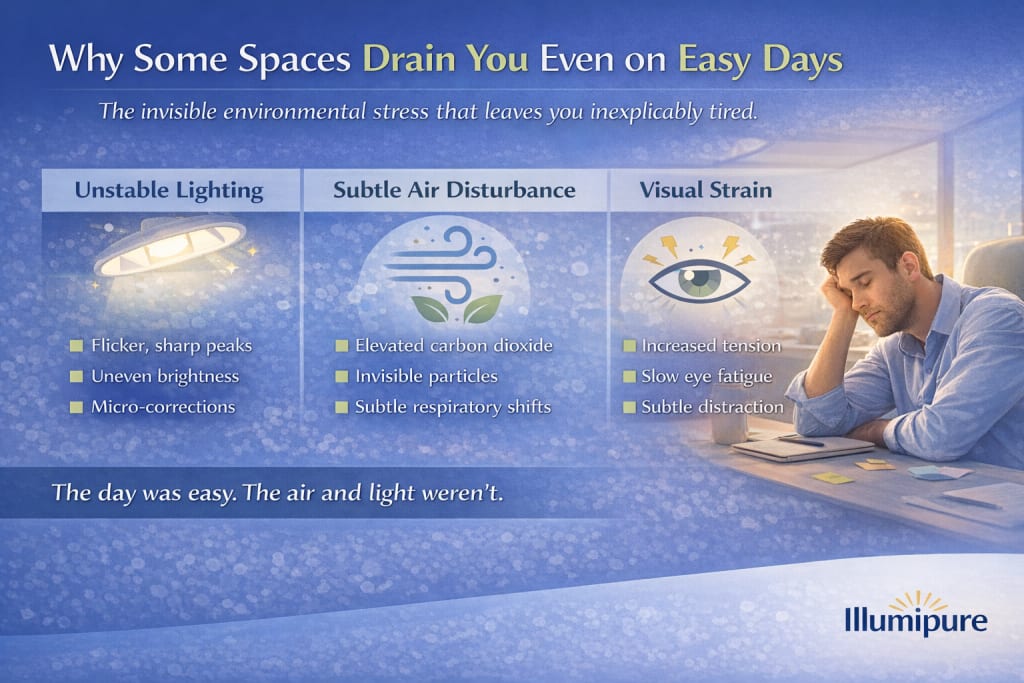
There are days when the work itself is light.
No urgent deadlines. No difficult conversations. No mental strain beyond the usual rhythm of emails and small tasks. By all reasonable standards, it should feel like an easy day.
And yet, sometimes those are the days you leave feeling inexplicably tired.
I used to dismiss that fatigue as random. Maybe I hadn’t slept well. Maybe I needed more water. Maybe I was just “off.” But the pattern became too consistent to ignore. In certain spaces, even simple days left me feeling depleted. In others, busier days felt surprisingly manageable.
The difference wasn’t workload. It was the room.
At first glance, these draining spaces looked perfectly functional. Clean desks. Bright overhead lights. Climate control humming in the background. Nothing overtly uncomfortable. But by mid-afternoon, I would feel heavy. My eyes strained. My shoulders tightened. My thoughts slowed in a way that felt disproportionate to what I had actually done.
The body was working harder than the mind.
What I began to understand is that the nervous system doesn’t measure difficulty the same way we do. It doesn’t care whether your task list is long or short. It responds to environmental stability.
When lighting is harsh or uneven, the visual system must constantly adapt. Flicker—often invisible to conscious perception—forces the brain to stabilize the image repeatedly. Glare creates micro-adjustments in pupil size and eye movement. Sharp spectral peaks, particularly in the blue range, can signal alertness more intensely than needed, keeping the sympathetic nervous system slightly activated.
That activation costs energy.
It doesn’t feel like effort in the moment. It feels like subtle tension. But hour after hour, the energy used for correction accumulates.
Air quality plays a similar role. Even minor elevations in carbon dioxide or airborne particulates can influence alertness and respiration. The body compensates automatically. Breathing may become slightly shallower. Heart rate may adjust. Muscles may remain partially engaged.
Again, the effort is invisible but real.
In spaces that drain you, the body is constantly adapting.
That adaptation is often so small that it feels normal. You shift in your chair without thinking. You rub your temples briefly. You take a deeper breath every so often. These gestures seem insignificant, but they are signs of compensation.
On easy days, when cognitive demands are low, the contrast becomes clearer. There’s no heavy mental workload to blame for fatigue. And yet, by the end of the day, you feel spent.
The fatigue isn’t from thinking. It’s from adapting.
I noticed the difference most clearly when I spent time in a space designed with biological alignment in mind. The lighting was steady and balanced. No flicker tugging at peripheral vision. No harsh glare bouncing off surfaces. The air felt neutral and fresh without being noticeable.
In that environment, even busy days felt smoother.
My posture remained relaxed without conscious effort. My breathing stayed steady. My eyes didn’t ache. When the workday ended, I felt complete rather than drained.
The human body thrives in predictable sensory environments. When light intensity is stable and spectrally balanced, circadian signaling remains consistent. When air quality supports efficient oxygen exchange, respiration requires less effort. When visual noise is minimized, the brain doesn’t divert resources to correction.
Energy is preserved.
We often believe that tiredness reflects how much we accomplished. But sometimes it reflects how much the body had to endure.
Spaces that drain you are not necessarily loud or uncomfortable. They are simply misaligned in subtle ways. They require constant micro-adjustments. And the nervous system, always vigilant, responds accordingly.
That vigilance is costly.
It keeps muscles partially tense. It maintains a low-grade sympathetic state. It divides attention between task and environment. Over hours, those small demands accumulate into fatigue.
On days when the workload is light, that accumulation becomes more obvious. You expect to feel fine. Instead, you feel inexplicably worn down.
Once I understood this, I stopped blaming myself for that tiredness. I stopped assuming it meant I lacked stamina. I began to notice the difference between cognitive effort and environmental strain.
In supportive spaces, even difficult days feel sustainable. In draining spaces, even easy days feel heavy.
The realization was freeing.
Fatigue isn’t always a reflection of weakness or overwork. Sometimes it’s a sign that the body has been adapting all day long to conditions that could have been steadier.
When a space supports biological regulation instead of challenging it, energy lasts longer than you expect.
And that’s how I learned that some rooms don’t just hold your work. They quietly shape how much of you it costs.
About the Creator
illumipure
Sharing insights on indoor air quality, sustainable lighting, and healthier built environments. Here to help people understand the science behind cleaner indoor spaces.
Keep reading
More stories from illumipure and writers in Journal and other communities.
The Moment I Realized My Body Was No Longer on Alert
I didn’t notice the tension leaving. I noticed its absence. For months, maybe years, I had been carrying a subtle sense of readiness. Not anxiety exactly. Not fear. Just a constant low-level alertness that hummed beneath everything I did. My shoulders were rarely fully relaxed. My breathing stayed slightly shallow. Even when I sat still, my body felt prepared for something.
By illumipure4 days ago in Journal


Comments
There are no comments for this story
Be the first to respond and start the conversation.