
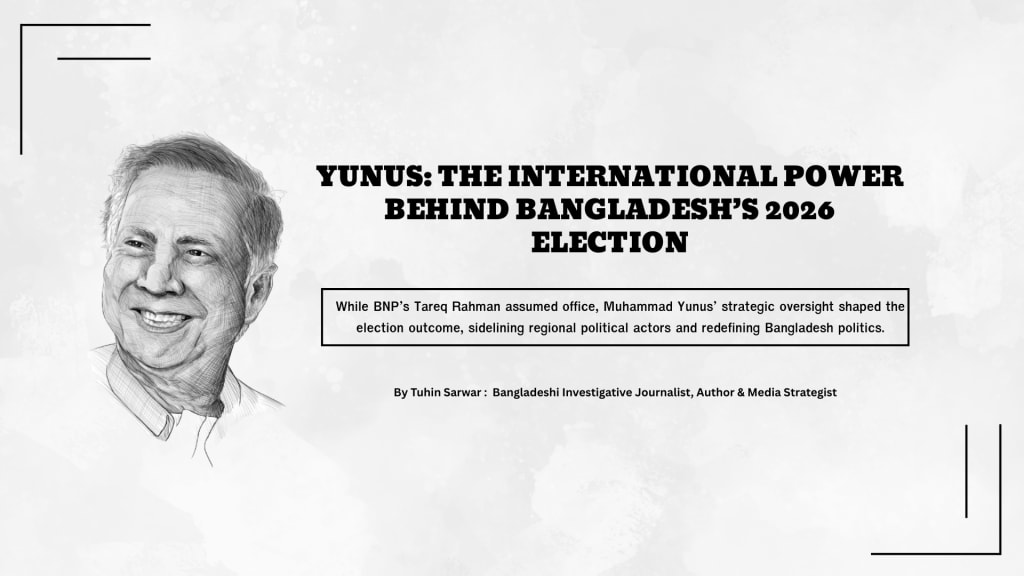
Yunus: The International Power Behind Bangladesh’s 2026 Election
Bangladesh Politics After the 2026 Election: How Muhammad Yunus Positioned Himself as the Only Global Player While Others Remained Regional

By: Tuhin Sarwar। Dhaka । February 18, 2026 ।
Eight months after Bangladesh’s caretaker government assumed power following the collapse of the previous administration in August 2024, the nation experienced one of its most closely watched democratic transitions in recent memory. On 12 February 2026, the country concluded a general election that delivered a two-thirds parliamentary majority to the Bangladesh Nationalist Party (BNP), enabling Tarique Rahman to take office as Prime Minister. Yet an analysis by India Today reflected across global media outlets frames the story differently: the true strategic victor of Bangladesh’s 18‑month political transition was Muhammad Yunus, the Nobel laureate economist whose international stature and tactical maneuvering shaped the nation’s political landscape in ways no conventional politician has before.
This report examines that interpretation through a rigorous, data‑driven lens, integrating verified statistics, human testimonies, policy analysis, and contextual geopolitical insight. Rather than recounting mere ballot outcomes, it investigates how an individual with no political party, parliamentary base, or grassroots machinery was able to engineer an election that redefined the country’s power dynamics and how this achievement positions him not only as a domestic transitional figure but as an international player in the politics of a deeply regionalized democratic context
Strong Lead: Election Outcome
Election Snapshot Bangladesh General Election 2026
───────────────────────────────────────────────
Total Parliamentary Seats : 300
Seats Won by BNP : ~200 (~66%)
Participation by Awami League : None
July Charter Referendum “Yes” Vote Share : 62%
Duration of Interim Administration : 18 months
Chief Adviser : Muhammad Yunus : Aug 2024 – Feb 2026
Sources: Bangladesh Election Commission; India Today.
This configuration an election conducted without participation by one of the country’s two principal political parties—is virtually unprecedented. In most consolidated democracies, opposition participation is seen as a prerequisite for electoral legitimacy. Yet Bangladesh’s transition was recognized by major Western capitals, indicating a broader diplomatic acceptance of the process.
According to India Today’s analysis, this divergence between procedure and party participation is where Yunus’s strategic influence became manifest—not merely in administering elections, but in defining the conditions under which they were held and internationally understood.
Political Strategy and International Dynamics
Muhammad Yunus entered Bangladeshi politics in August 2024 at age 85 with no formal party affiliation. Rather than building a traditional political base, his strategy combined domestic coordination with international diplomatic engagement. Analysts point to three major mechanisms through which he exerted influence:
1. Managing Domestic Stakeholders Without a Political Party
Instead of forming a party, Yunus coordinated with key political actors, including:Bangladesh Nationalist Party
This multi‑vector coordination blurred traditional party boundaries and allowed interim governance to function as a technocratic bridge, rather than a partisan regime.
This multi‑vector coordination blurred traditional party boundaries and allowed interim governance to function as a technocratic bridge, rather than a partisan regime.
2. International Recognition and Diplomatic Engagement
Yunus leveraged decades of international credibility—stemming from his work in microfinance and global development—to secure diplomatic acceptance of the electoral process. Coverage in major outlets underscored this:
- BBC News highlighted the election’s regional implications and the need for stability in the Bay of Bengal geopolitics.
- Al Jazeera questioned human rights conditions during the transition, illustrating the global lens through which Bangladesh was viewed.
- The New York Times placed the election within broader South Asian democratic trends.
- The Guardian focused on civil liberties and governance oversight.
- The Hindu explored India’s strategic calculations regarding the electoral outcome.
None dismissed the legitimacy of the election outright, even as they reported concerns about participation and rights suggesting diplomatic pragmatism shaped by economic and security interests.
ASCII Data Visualization Election Impact Metrics
BNP ██████████████████████████ 66%
Awami League █ 0%
Others ██ 8%
Parliamentary Composition BNP vs Others
uly Charter Referendum Result
Yes ██████████████████████████ 62%
No ████████████ 38%
Interim Governance Performance Indicators
Economic Stabilization ████████ Medium
International Recognition █████████ Very High
Law & Order ██████ Moderate
Electoral Management ███████ High
Human Layer: Societal Impacts and Testimonies
Behind macro‑level transitions are lived experience families, communities, and ordinary citizens shaped by political change:
In metropolitan Dhaka, young professionals spoke of cautious optimism about stability and prospects for foreign investment—reflecting economic hopes tied to international recognition.
In rural Rajshahi and Barisal, smaller communities reported residual tensions from election‑related clashes, with local leaders emphasizing concerns over political inclusion and security.
Civil liberties activists referenced ongoing concerns about press freedom and minority protections, highlighting gaps between procedural electoral success and deep‑rooted societal trust in institutions.
Local journalist comments reflect this duality
The election was orderly, but a significant portion of the population felt excluded from the process, said a Dhaka‑based civic analyst.
We saw ballots, but we did not necessarily see consensus, said a Barisal community organizer, illustrating that procedural legitimacy does not automatically translate to societal legitimacy
Governance, Institutions, and Reform
While the election concluded peacefully, governance challenges in Bangladesh remain deeply structural:
Law Enforcement and Rule of Law
Experts noted that while large‑scale violence did not erupt, concerns about extrajudicial enforcement, custodial practices, and uneven legal application persist raising questions about citizen rights.
Reform Implementation
The July Charter referendum, in which 62 percent of participants voted in favor of granting parliament 180 days to enact constitutional reform, reveals ongoing tension between legal frameworks and political will. Despite broad endorsement, actual reform progress remains uncertain.
Professor Asif Mohammad Shahan (Dhaka University) notes:
Elections are a milestone. Institutional reform is a marathon. This transition succeeded in procedure but did not complete structural transformation.
Geopolitical Implications
Bangladesh’s location and economy render it consequential for regional powers:
India watched for continuity and security cooperation.
China maintained investment ties and infrastructure engagement.
US and EU prioritized democratic process metrics, cautious not to destabilize economic or strategic cooperation.
Analysts suggest Yunus’s global connections facilitated a diplomatic balance that allowed procedural legitimacy to be recognized even without conventional party participation.
Conclusion: The Single International Player in a Regional Contest
The 2026 Bangladesh election was more than a partisan tally of votes. It was the outcome of a strategic transitional period in which:
- BNP now controls parliament,
- Tarique Rahman holds executive authority,
- But the architecture of political continuity and international acceptance was shaped by Muhammad Yunus.
In the regional theatre of South Asian democracy—often dominated by entrenched party politics Yunus stands out as a figure whose international reputation, diplomatic engagement, and technocratic coordination positioned him as the only leader to successfully operate on the global stage during a turbulent transition.
While history will judge whether this constitutes lasting democratic reform, the interim period’s dynamics illustrate that in Bangladesh’s 2026 election, power was as much engineered as it was won at the ballot box.
References
India Today Analysis of Muhammad Yunus’s role in Bangladesh politics
- https://www.indiatoday.in/world/story/tarique-rahman-takes-oath-as-bangladesh-pm-but-is-muhammad-yunus-real-winner-will-history-be-kind-explainer-2869334-2026-02-17
- Bangladesh Election Commission — Election Overview (Wikipedia page collating official data)
- https://en.wikipedia.org/wiki/2026_Bangladeshi_general_election
- BBC News Election and Geopolitics Coverage (Bangladesh focus)
- https://www.bbc.com/news/world-asia
- Al Jazeera Reporting on Bangladesh election context and human rights
- https://www.aljazeera.com/news/2026/2/5/country-of-the-blind-how-will-bangladesh-remember-muhammad-yunus
- The Guardian Civil liberties & governance reporting on Bangladesh politics
- https://www.theguardian.com/world/2026/feb/13/bangladesh-election-bnp-wins
- The Hindu / Times of India - South Asia regional context & Bangladesh election analysis
- https://timesofindia.indiatimes.com/world/south-asia/bangladesh-elections-before-ramadan-muhammad-yunus-announces-february-2026-election-here-are-the-details/articleshow/123122951.cms
✨ By Tuhin Sarwar Bangladeshi Investigative Journalist, Author & Media Strategist : https://tuhinjournalist.medium.com/
About the Creator
Tuhin Sarwar
Tuhin Sarwar is a Bangladesh-based investigative journalist reporting on human rights, child labor, and the Rohingya refugee crisis through field-based research. Explore his verified portfolio at https://tuhinsarwar.com/
Keep reading
More stories from Tuhin Sarwar and writers in Journal and other communities.
Digital Landlords: Algorithmic Control in Bangladesh Ride-Sharing
By Tuhin Sarwar । Published: 13 January । 2024 । DHAKA, BANGLADESH At 4:30 AM, when most of Dhaka still sleeps, Mohammad Rahman starts his daily negotiation with an algorithm. He opens three ride-hailing apps simultaneously – Uber, Pathao, and local newcomer Shohoz watching the digital maps light up. His motorcycle, purchased with a high-interest loan, waits as he does. The algorithm will decide his day's fate.
By Tuhin Sarwarabout a month ago in Journal
~ Fired ~
— Ai Intrusion ~ Are you Next ~ Is Ai Evolution after your job? — Few workplaces haven't been affected. Ai is in supermarkets, at doctors' offices, and even monitoring farms. I just can't think of anything this machine is not getting into, can you? For instance: Education ~ Law and Tech jobs will one day have a major influence or be taken over by these inanimate machines, with accuracy and vigor. From mechanics' diagnoses to a wide variety of everyday jobs, including fast food workers, with this input having the ability to cut their unnecessary work hours. I'm certain all of us have been touched by this with our short stories and colorful headings, have you? Even comments are very questionable 'Non-Robot' insertions.
By Jay Kantor18 days ago in Journal
Adriana Kostov Appointed to Lead Australian Chapter of the Hedge Fund Association
The appointment of Adriana Kostov as head of the Hedge Fund Association’s newly established Australian chapter marks a significant milestone not only in her career but also in the continued evolution of Australia’s alternative investment landscape. With a background that bridges law, commerce, and high-level financial strategy, Kostov’s professional journey reflects the kind of global perspective and disciplined expertise required in today’s complex hedge fund environment.
By Financial Services Mediaabout 11 hours ago in Journal




Comments
There are no comments for this story
Be the first to respond and start the conversation.