
The Rise of "Green" Code: Mobile App Development Trends in Portland (2026)
How Optimization Evolved from Performance Metrics to Sustainability Metrics — And Why Energy Efficiency Is Becoming a Core Development Goal

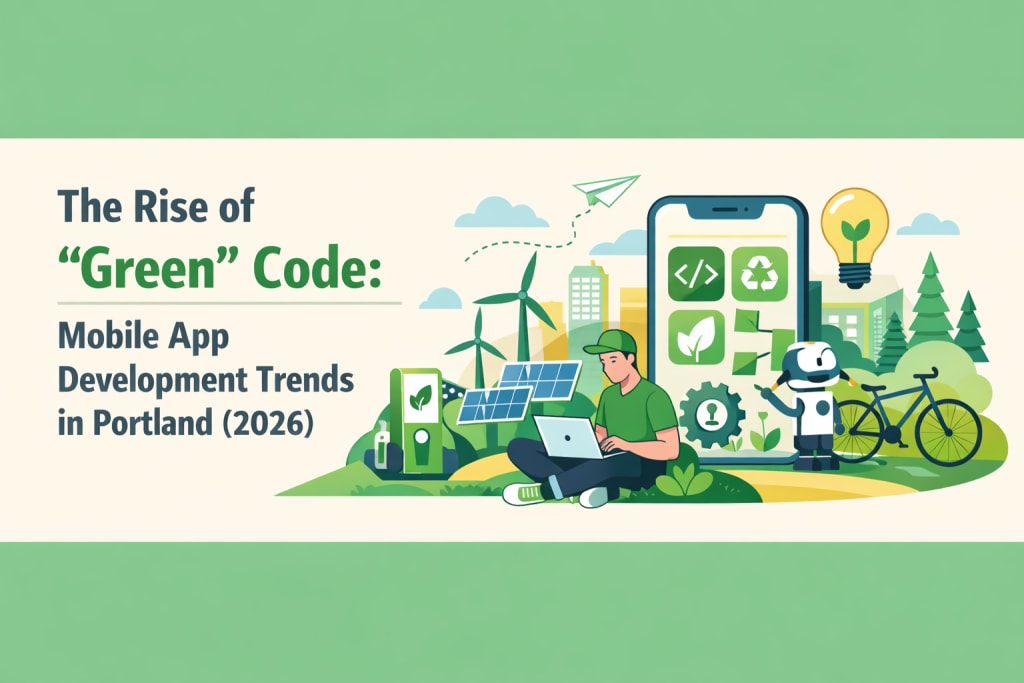
Alex didn’t notice the shift immediately. At first, it appeared as a small comment from a client during a routine planning call: “Can we measure how energy-efficient our app is?” It sounded unusual, almost niche — until similar questions began appearing in proposal meetings, design discussions, and even investor reviews.
By early 2026, sustainability wasn’t just shaping physical products or office spaces. It was entering conversations about software architecture, app performance, and the invisible environmental cost of digital experiences.
For years, developers optimized for speed, scalability, and user engagement. Now, another metric was entering the equation: efficiency not just for users — but for the planet.
This isn’t a sudden revolution. It’s a slow recalibration of priorities, particularly in cities where technology and environmental awareness intersect naturally.
Why “green code” is no longer a fringe idea
The concept of sustainable coding has existed for years, but only recently has it begun influencing mainstream development decisions. Several forces are converging:
- Rising energy consumption from global data centers.
- Increased transparency around carbon emissions reporting.
- Growing awareness of digital waste — inefficient code that increases processing demand.
- Pressure from environmentally conscious consumers and investors.
Recent industry analyses suggest that information technology infrastructure accounts for roughly 2–4% of global carbon emissions — comparable to the aviation sector. While individual apps may seem insignificant, their cumulative effect across billions of devices is substantial.
This realization is changing how companies approach development. Instead of simply adding features or scaling infrastructure, teams are asking deeper questions:
- Can we reduce server calls?
- Are animations consuming unnecessary battery power?
- Is our architecture forcing devices to work harder than necessary?
Green coding is less about radical new tools and more about intentional design choices.
Portland’s culture shaping technical decisions
Every tech ecosystem reflects the culture around it. In some cities, speed-to-market dominates conversations; in others, enterprise reliability leads decision-making.
In Portland, environmental consciousness has long influenced industries ranging from urban planning to retail. As software development matures within this environment, similar values are appearing in technical discussions.
Local startups increasingly highlight sustainability in hiring materials and product positioning. Developers are experimenting with:
- Lightweight frameworks that reduce processing overhead.
- Minimalist design approaches that avoid resource-heavy elements.
- Efficient backend architectures that minimize cloud resource consumption.
This cultural alignment makes experimentation easier. Developers aren’t being asked to justify sustainability as an extra feature — it’s becoming part of the baseline expectation.
The hidden cost of inefficient apps
For many years, optimization focused primarily on performance benchmarks. But inefficiency carries more consequences than slower load times.
Poorly optimized code can:
- Increase CPU usage on mobile devices.
- Drain battery life faster.
- Require additional server infrastructure.
- Raise long-term operational costs.
Studies indicate that optimizing software efficiency can reduce energy usage by anywhere from 20% to 40%, depending on architecture changes and optimization strategies. These improvements often translate directly into cost savings — a factor that attracts leadership attention as much as environmental impact.
Developers are starting to realize that sustainability and performance optimization often align rather than conflict.
What “green” development actually looks like in practice
The phrase “green code” may sound abstract, but its implementation is surprisingly practical. Instead of reinventing development entirely, teams are revisiting familiar practices through a sustainability lens.
Key approaches include:
- Writing cleaner, more efficient algorithms to reduce computational load.
- Minimizing background processes that constantly consume resources.
- Reducing unnecessary data transfer between device and server.
- Leveraging caching strategies to avoid repeated calculations.
- Choosing cloud providers or hosting configurations optimized for energy efficiency.
Interestingly, many of these techniques echo older engineering philosophies focused on elegance and simplicity — ideas that became less emphasized during the rapid expansion of cloud resources.
The role of frameworks and tooling
One of Alex’s biggest questions was whether sustainability required abandoning existing frameworks. The answer turned out to be more nuanced.
No framework is inherently “green,” but certain development choices influence efficiency:
- Cross-platform tools can reduce duplicated codebases, lowering maintenance overhead.
- Native development may allow deeper hardware optimization in specific cases.
- Progressive loading strategies reduce initial energy consumption.
- Efficient state management reduces unnecessary processing cycles.
Tooling is also evolving. Some platforms now provide insights into energy usage patterns or performance efficiency beyond traditional metrics like response time.
This shift represents a broader trend: measuring success not just by speed, but by resource impact.
Why developers are embracing this shift
At first glance, sustainability might seem like an added burden. Yet many developers are embracing green practices for reasons beyond environmental responsibility.
Several benefits stand out:
- Improved performance: Efficient code often feels faster and more responsive.
- Lower infrastructure costs: Reduced server demand translates into financial savings.
- Future-proofing: As regulations evolve, sustainable architecture positions companies ahead of compliance requirements.
- Brand differentiation: Companies increasingly communicate sustainability commitments through their technology choices.
- Developer satisfaction: Many engineers find renewed creativity in optimization challenges.
This combination of ethical motivation and practical advantages accelerates adoption.
Measuring impact: the emerging challenge
One of the hardest questions remains measurement. Unlike physical manufacturing, digital emissions are less visible and harder to quantify.
Developers are experimenting with:
- Monitoring energy consumption through device profiling.
- Tracking server usage efficiency.
- Estimating carbon footprint based on hosting infrastructure.
While no universal standard exists yet, momentum is growing toward clearer measurement frameworks. Analysts predict that within a few years, sustainability reporting may include digital product metrics alongside traditional environmental indicators.
Cultural momentum meets technical innovation
The growing interest in sustainable software isn’t driven by developers alone. Investors increasingly include ESG considerations in funding decisions. Consumers favor brands aligned with environmental values. Governments explore regulatory frameworks encouraging energy-efficient technology.
When these forces converge, technical trends accelerate rapidly.
The evolving landscape of mobile app development Portland reflects this convergence — where cultural priorities align with technological innovation, creating a natural environment for green coding practices to flourish.
Lessons from the transition toward sustainable software
Looking at teams already adopting these approaches, several patterns emerge:
- Sustainability works best when integrated early into design decisions.
- Small optimizations compound into meaningful impact over time.
- Developers need education and tools to understand energy implications.
- Organizational buy-in matters as much as technical capability.
- Efficiency often enhances user experience rather than limiting creativity.
These lessons suggest that green development is less about dramatic reinvention and more about mindful evolution.
Looking ahead: from trend to expectation
What began as isolated experimentation is gradually becoming an industry shift. Sustainability in software may follow the same trajectory as security or accessibility — once optional, eventually essential.
For professionals like Alex, the realization is clear: efficiency is no longer only about speed or cost. It’s about responsibility, resilience, and thoughtful design in an increasingly connected world.
The most interesting part of this transformation isn’t a new tool or framework. It’s a change in mindset — recognizing that every line of code shapes not only user experience but also the invisible infrastructure powering modern life.
As development continues to evolve, green coding may stop feeling like a trend altogether. Instead, it may simply become what good engineering looks like.
About the Creator
Why an Ergonomic Foot Rest Is One of the Most Underrated Remote Work Tools
Remote work has made many people rethink how they set up their workspaces. While most attention goes to desks, chairs, and monitors, one essential item is often overlooked: an ergonomic foot rest. It may seem like a minor accessory, but for anyone spending long hours seated at a desk, a foot rest can play a surprisingly important role in comfort, posture, and overall well-being.
By Bahati Mulishi6 days ago in Lifehack
A City of Transitions
Killeen, Texas, is a place where movement feels natural. People arrive with anticipation, settle into routines, and eventually prepare to leave, often sooner than expected. This pattern is not a flaw of the city. It is part of its identity. Anchored by Fort Cavazos, Killeen exists in a constant state of transition, shaped by lives that intersect briefly before continuing elsewhere.
By House Doctor3 days ago in Lifehack



Comments
There are no comments for this story
Be the first to respond and start the conversation.