
Why Most Remote Workers Stay Stuck
And How to Level Up Without Changing Jobs
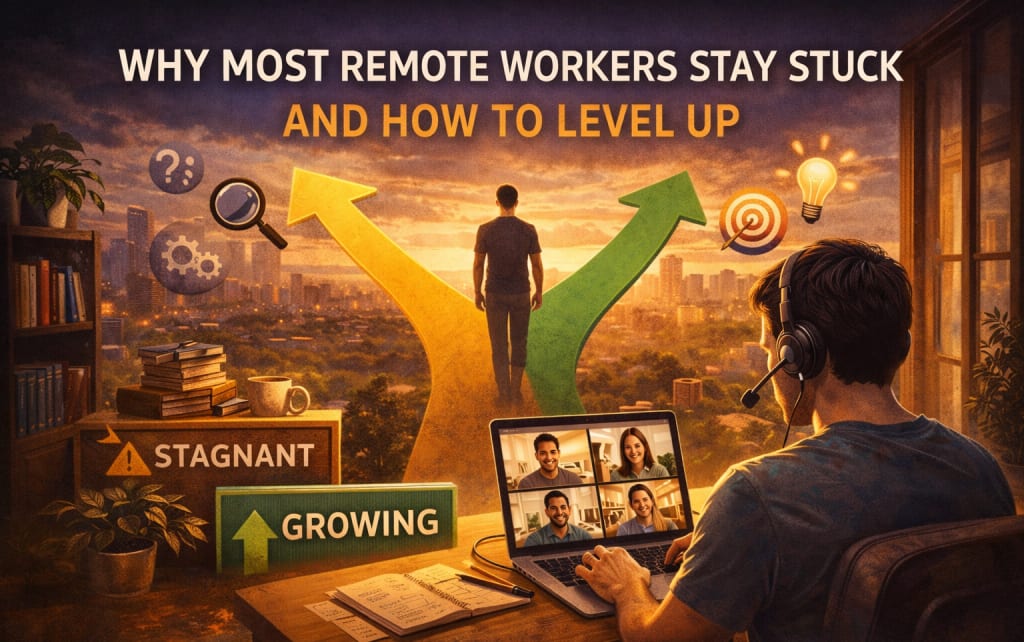
Remote work promises freedom.
Flexible schedule.
No commute.
Work from anywhere.
But here’s what nobody tells you:
A lot of remote professionals stay in the same position for years.
Same pay.
Same responsibilities.
Same level of visibility.
Not because they’re incompetent.
But because they misunderstand how growth works in remote environments.
Let’s break it down.
1. They Confuse Comfort With Progress
Remote work can feel comfortable.
You know your tasks.
You’ve mastered your workflow.
Your days are predictable.
But comfort is dangerous.
When your work becomes easy, it often means you’ve stopped stretching.
In traditional offices, growth sometimes happens automatically — you see new projects, overhear opportunities, get pulled into discussions.
In remote work, growth doesn’t happen accidentally.
If you’re not intentionally increasing your skills, responsibilities, or impact, you are quietly stagnating.
Ask yourself:
Are you doing the same level of work you were doing six months ago?
If the answer is yes, that’s a red flag.
Leveling up requires deliberate discomfort.
2. They Only Do What They’re Assigned
This is the biggest trap.
Many remote workers think:
“If I complete my tasks well, promotion will come.”
But remote environments reward initiative.
If you only complete assigned work, you’re replaceable.
Growth happens when you:
Suggest process improvements
Take ownership beyond your job description
Volunteer for high-impact tasks
Solve problems before being asked
In remote work, visibility comes from contribution — not presence.
No one sees how long you worked.
They see what you improved.
3. They Don’t Make Their Work Visible
Out of sight can easily become out of mind.
If your manager doesn’t clearly see your impact, you blend in.
High-performing remote professionals don’t assume people know what they’re doing.
They document.
They send weekly summaries:
What was completed
What results were achieved
What challenges were solved
What’s coming next
That simple habit changes everything.
It positions you as proactive.
And proactive professionals get promoted.
4. They Stop Learning
This one is subtle.
When you first start a remote job, you’re learning constantly.
New systems.
New tools.
New communication styles.
But once you become comfortable, learning slows down.
And growth slows with it.
If you want to level up remotely, you must continuously upgrade your value.
Learn:
Better communication skills
Automation tools
Industry-specific knowledge
Leadership principles
The market rewards those who expand their capability.
Stagnation is usually a learning problem.
5. They Avoid Strategic Conversations
Here’s something most people never do:
They don’t ask what growth looks like.
Instead of hoping for recognition, ask directly:
“What would I need to demonstrate to move to the next level?”
That question alone separates professionals from employees.
When you know the criteria, you can build toward it intentionally.
Without clarity, you drift.
Remote careers don’t grow on autopilot.
They grow by design.
6. They Wait Instead of Positioning Themselves
Waiting is passive.
Positioning is active.
If you want:
A raise
A leadership role
More influence
You need proof of impact.
Track your wins.
Document measurable outcomes:
Increased efficiency
Revenue impact
Reduced costs
Improved workflow
When you ask for growth, bring evidence — not emotion.
Remote decision-makers promote value, not effort.
7. They Don’t Think Long-Term
Some remote workers treat their role like a paycheck.
Thriving professionals treat it like leverage.
Every project is a portfolio piece.
Every challenge is skill-building.
Every responsibility is leadership training.
Ask yourself:
If I stay in this role another year, what will I have mastered?
If the answer is unclear, you need a strategy.
The Truth About Remote Growth
Remote work doesn’t limit your career.
Lack of strategy does.
If you:
Increase your skill level
Make your impact visible
Seek clarity on advancement
Take initiative consistently
You won’t stay stuck.
You’ll stand out.
And standing out remotely is powerful — because fewer people are willing to do the extra thinking.
Final Thought
Staying stuck isn’t about talent.
It’s about intentional growth.
Comfort feels safe.
But growth feels uncomfortable — and that’s the point.
If you’re working remotely right now, ask yourself honestly:
Are you coasting… or are you building leverage?
The answer determines your trajectory.
About the Creator
Keep reading
More stories from Bahati Mulishi and writers in Lifehack and other communities.
Between Two Cities, One Unfinished Love
Between Two Cities, One Unfinished Love In 2010, my life quietly changed when I met her. There was nothing dramatic about that moment—no promises, no loud confessions—just a simple meeting that slowly found its place in my heart. She lived in Rawalpindi, surrounded by busy streets and constant movement, while I lived in Swat, among mountains that taught patience and silence. We belonged to two different cities, two different worlds, yet something unspoken connected us from the very beginning.
By Wings of Time 4 days ago in Lifehack
Why the Right Rug Changes Everything
You know that feeling when you step into someone's place and it just feels... right? Like everything belongs there, including you? Sometimes it's your best friend's basement hangout. Other times it's walking into your aunt's kitchen. That cozy vibe you get? More often than not, there's a rug involved.
By Muhammad Hanzla6 days ago in Lifehack




Comments
There are no comments for this story
Be the first to respond and start the conversation.