
The Narratives We Tell Ourselves About Happiness and Marriage
When a social scientist “proved” that married people are happier, the media had a field day. But are we even asking the appropriate question?


As a youngster, I understood two things about my future to be true: One, I would eventually be a writer. Two, I would never, ever get divorced.
There were a few kids in my class with divorced parents, and their lives struck me as horrifically fragmented. They continuously had to traipse between several households with different regulations and different parents, often losing track of what was where. I enjoyed that I had all my possessions in one location, and I treasured how close-knit my family was, even if my own parents didn’t always get along. The one negative of my secure upbringing was that I couldn’t become the tormented writer we love to laud, one whose creativity was developed by early years full of suffering and tragedy.
That I will marry someone someday was a certainty. Even on the heels of the 1960s and 1970s counterculture movement, in which both my parents took part, I was nevertheless given a regular diet of “damsel in distress meets Prince Charming” tales. I spent quite a bit of time pontificating on who this Prince Charming may be and whether we would live in a mansion or (God forbid) an apartment during recess games of MASH.
Whoever I ended up marrying, I knew we would weather all of life’s storms together. We would stick it out till death do us part. Because when I make a promise, I prefer to follow through.
It strikes me as the ultimate of ironies that I now find myself separated, facing down the barrel of the D word, wondering what awaits me on the other side.
With the exception of my separated spouse and his mother, most individuals in my life have been supportive and understanding during my separation. But again, I wonder what some of them are actually thinking. I ponder this because until very recently, when I got news of someone else’s approaching divorce, I was the one expressing support and sympathy while also feeling unconsciously smug since I wasn’t ever going to simply “give up.” Other individuals could do this, and I would respect their decisions. But I would never cause this type of misery on my family.
Well, the destruction has now been caused. In the process, I’ve come to see how passionately our culture still clings to the myths we tell ourselves about marriage and the nuclear family—the same stories I’ve been telling myself for years. Even if divorce memoirs are flying off the shelves, even though non-monogamy is on the increase, and even though women are choosing out of marriage and parenthood at historic rates, it is still difficult to dislodge the obstinate myth that marriage leads to eternal joy. Or, if not pleasure, at least relative satisfaction and security.
This stubborn narrative also seems to be receiving reinforcement from academia, most recently by emeritus economics professor at the University of Chicago, Sam Peltzman, who released a paper in 2023 that examined the 2022 General Social Survey (GSS) results and found a “surprising” correlation between marriage and happiness.
The subsequent flurry of response news items and opinion pieces was almost euphoric. Emanating from them was an air of false amazement with clear “I told you so” undercurrents. From The Atlantic: Take a Wife … Please! Why are married individuals happier than the restPlease! From Gallup: Married Americans Thriving at Higher Rates Than Unmarried Adults. From The New York Times: To Be Happy, Marriage Matters More Than Career.
Divorcees, single females, and all you newfangled non-monogamous types, beware; these tales appear to warn. Society was correct all along about this marriage issue.
And of course, this being the Internet, there was the magnifying effect. Even while some of the pieces do address the issues and paradoxes that surface when you look into the data, they are now routinely quoted as evidence that marriage “makes” us happy.
As a case in point, a fairly nasty New York Times book review of This American Ex-Wife (one of many divorce memoirs in my very long queue) slams the author because
She’s dismissive of studies that demonstrate divorce may be devastating to children, and she omits huge banks of evidence suggesting that married individuals are happier than unmarried ones.
Slate has previously called into serious doubt the coverage of research regarding the apparently catastrophic impacts of divorce on children, especially the ways major media sources have mostly disregarded studies indicating otherwise. For instance, a study of 131 children from a single California county that reinforced the “divorce = childhood trauma” narrative was cited six to 14 times more often by the media than a far more significant longitudinal study of 1,400 children that found “the vast majority of kids of divorce [become] well-adjusted adults.” Decades later, the conclusions of inferior research marketed by the Marriage Industrial Complex continue to be widely accepted and casually repeated, even by well-respected journals with rigorous fact-checking teams.
Google, of course, helps drive this magnifying effect, so much so that when you search for “divorce effects on children,” as I did, you are deluged with terrible warnings about children who are maladjusted, mentally sick, and criminally inclined. (The aforementioned Slate story is buried on page 5 of my search results.) Similarly, a Google search for “marriage happiness” gets snippets like:
Married individuals tend to be significantly happier than those who are not, according to new data…
Despite shifting popular opinions, the reality remains married individuals truly are happier…
Married persons, especially those aged 25 to 50, regularly reported greater levels of well-being compared to singles…
Married individuals are significantly happier than the single, according to this data…
Married women and men both enjoy a 20-percentage-point advantage compared to unmarried same-sex peers…
These bold conclusions rub me the wrong way, and possibly for obvious reasons. As someone who was unhappy enough in my marriage to seek a separation, I find it hard to connect to all this happiness and contentment I was obviously meant to be feeling. And it’s not that I want other married people to be miserable—it's simply that I’d want to have an equal opportunity at happiness on the other side of divorce.
But the attention-grabbing headlines and excerpts push me the wrong way for deeper reasons, too. Perhaps that’s because the institution of marriage has a long history of commoditizing and subjugating women. Today, we could wax lyrical about romance and love, yet gender disparities in heterosexual marriage still prevail.
Studies from Gallup, Pew Research Center, The Lancet Public Health, the National Library of Medicine, and other sources too numerous to name indicate that even when men and women contribute about the same amount to the waged economy, women routinely put in considerably more unpaid hours at home. When it comes to marital discord, we conceal the societal value of women’s work and time as an individual “communication problem” rather than a systemic source of unfairness and sexism.
So if somebody is going to promote the institution of marriage with grandiose claims about its potential for making us healthier and happier, I truly hope they have done their due research and thought everything through
Unfortunately, that’s not what I’ve discovered.
The first thing we should be asking ourselves here is whether or not we’re even asking the appropriate question. Because in the backdrop of our contemporary social reality, why is a connection between marriage and perceived happiness really all that surprising? Why is it even newsworthy?
After all, “love and belonging” rank third on Maslow’s hierarchy of wants, and the relationship between felt well-being and belonging is well demonstrated. If you have a kid in middle school, as I do, this intense desire for belonging slaps you in the face, scares you, and crushes your heart on a daily basis.
Despite the fact that almost four in 10 U.S. individuals (ages 25–54) are unpartnered, we still live in a culture in which marriage is our major method of attaining emotional intimacy, affiliation, and belonging. In fact, with the rising isolation of nuclear families and severe losses in friendship and in-person social involvement outside of romantic relationships, this could be even more true today than it was a few decades ago.
New York Times writer David Brooks informs us, “There are mountains of evidence to show that intimate relationships, not careers, are at the core of life,” and then utilizes this information to make the argument that marriage matters more for our happiness than our employment. The underlying premise is that marriage is our sole method of obtaining an intimate connection. Interestingly, he published this piece three years after his blistering essay in The Atlantic, The Nuclear Family Was a Mistake. Even those who are actively and openly criticizing current family systems still perceive marriage to be the default.
There is also still a major stigma linked to singledom, especially for women and particularly for women over 30. Even The Atlantic piece, Take a Wife… Please! Why are married individuals happier than the rest of us? — one of the numerous overhyped pieces replete with knee-jerk responses to Peltzman’s work—closes with this admission from the author: “For me, getting married is more optical than emotional. I’m bored of being a woman reaching 40 who has a ‘boyfriend.’”
It’s impossible to feel joyful about being alone or unmarried when we’re constantly being told it’s not really acceptable. And the “marriage Kool-aid,” if you will, is forced even more forcibly onto women in many religious societies. When I read about Peltzman’s article, my immediate query was, “What percentage of people surveyed identify as religious?” Interestingly, not many other individuals appeared to be asking that question. According to a 2019 study:
“Existing literature has provided ample evidence indicating a positive relationship between marriage and happiness across many countries except Taiwan, where marriage seems irrelevant to happiness. No study to date has objectively established what precisely leads to such a phenomenon. This research, utilizing the Taiwan Social Change Survey for 2012 as the study sample, indicated that religion greatly matters in predicting the relationship between marriage and happiness. More precisely, data clearly show that married individuals are happier among Christians, whereas such a phenomenon is unobserved among those connected with other religions.”
Considering the considerable degree to which Peltzman’s study has been quoted by Christians as statistical confirmation of the sacredness of marriage, these findings are not unexpected. When religion is your means of belonging, and when your religion preaches that marriage is part of God’s plan, and when women in particular are told that their life’s purpose and self-worth hinges on marriage and procreation, true believers will do what it takes to convince themselves that they are happy in their holy unions.
And honestly, who can blame them?
Here’s the trouble with “proving” a link between marriage and happiness, though: there’s no control group. In reality, married individuals are the control group, the ones preserving the status quo. Then we “inject” others, if you will, with dosages of non-monogamy, singledom, and divorce, and we want to know which group is happiest. But unmarried, divorced, and non-monogamous persons aren’t controlled for characteristics like access to the social status, legal protections, and financial incentives that marriage gives.
Why did LGBTQ+ campaigners battle for same-sex marriage? They desired equal social position. And as the Human Rights Campaign reminds us, they also sought access to the more than “1,100 federal rights and responsibilities associated with the institution.”
“Are married people happier?” is, without a doubt, the incorrect question. Because really—duh. It’s a no-brainer that individuals who aren’t in actively awful marriages—or, importantly, who have yet to confess to themselves that they are in actively miserable marriages—perceive themselves to be happier. After all, they’re in the “in” group. They not only enjoy a greater feeling of belonging but also very substantial legal and financial safeguards.
Here’s the question we should really be asking: Why, despite all of the emotional, social, financial, and legal advantages of marriage, are such an incredible amount of us choosing out? Nearly 1 in 2 U.S. people are single, which includes individuals who have never married or are divorced or widowed. There is around one divorce for every 2.5 marriages, and remarriage rates have undergone substantial reductions.
Here’s a related and as crucial question: Why are women opting out at larger rates? While approximately 70 percent of divorces are begun by women, women are not more likely to initiate non-marital breakups. And among divorcees and widows, women are substantially less likely to remarry.
In an ironic twist, even the author of the aforementioned The Atlantic essay, Take a Wife… Please!, has—after being married and having a baby—changed her tune. Her new piece, Doomed to Be a Tradwife, bemoans the inequitable dynamics that so many women confront and questions whether marriage can ever be genuinely equal.
Stories that support the institution of marriage by fanning ill-founded anxieties about the misery and poor health awaiting the unmarried merely prolong a status quo that is plainly not benefitting a substantial percentage of the U.S. population, especially the female component.
Here’s what I would like to see (Peltzman, please take note): a longitudinal study that compares the relative happiness of economically stable people in status quo social settings to economically stable people in socially supportive cohousing communities and/or cooperative childrearing networks where emotionally intimate relationships abound but where marriage is not the default.
Then let’s explore whether the myths we tell ourselves about marriage and happiness truly hold water.
__________________________________
Simple Habits for Marital Happiness: Practical Skills and Tools That Build a Strong Satisfying Relationship
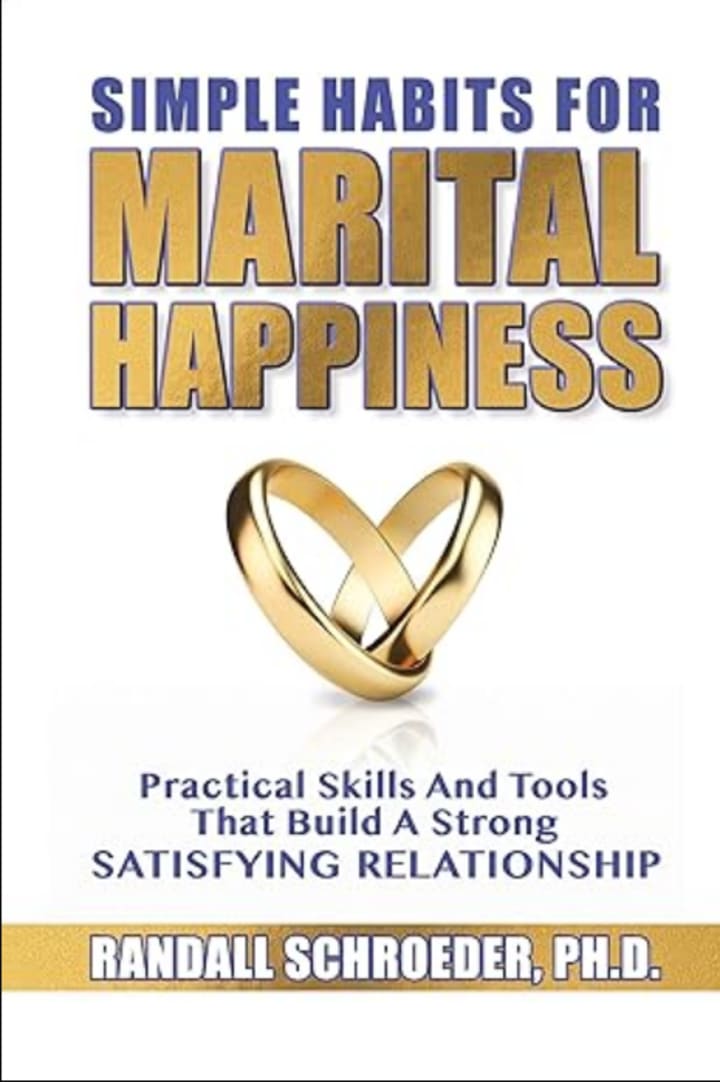
a great guidebook . . . giving practical insight on how to make immediate and lasting improvements in any marriage." Stephen Arterburn, New York Times bestselling author....The book is here
About the Creator
souhila
In addition to my professional pursuits that inspire my creativity and perspective,I am constantly looking for new opportunities to learn, grow,and make a positive impact in the world.
Let's connect and create something amazing together!
The Man Who Returned Lost Things
Every city has a person nobody remembers seeing. In this city, it was Kareem. He worked inside a narrow glass office beside the last metro platform — the lost-and-found department. The place where forgotten pieces of life gathered quietly: umbrellas still wet from rain, single gloves without partners, wallets filled with family photos, school bags heavier with responsibility than books.
By shakir hamida day ago in Marriage




Comments
There are no comments for this story
Be the first to respond and start the conversation.