
The Ghost of the Varsity List: How Michael Jordan Turned a "No" into a Dynasty
Before he was His Airness, he was just Mike. A skinny kid in North Carolina who looked at a piece of paper on a gym wall and realized he wasn't good enough. This is the story of the most famous failure in sports history

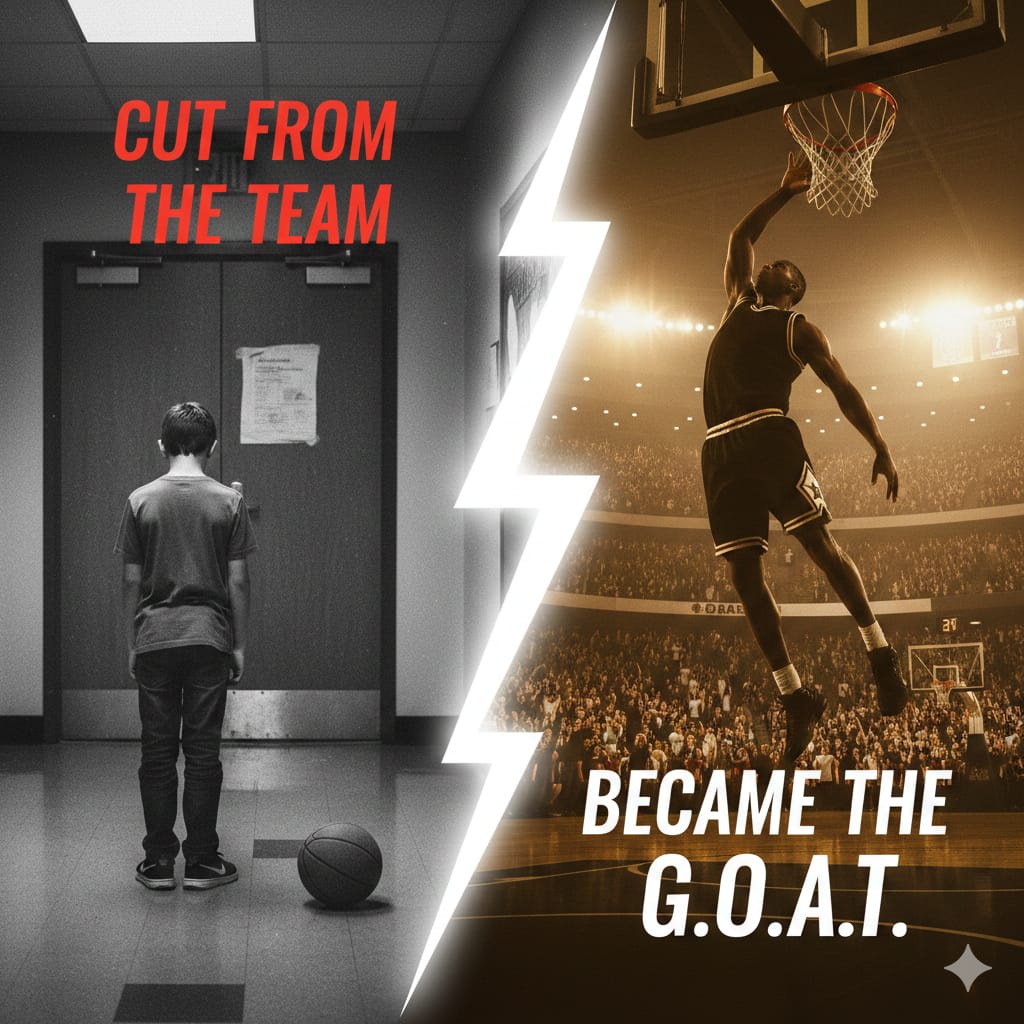
The definitive story of Michael Jordan being cut from his high school basketball team, and how that single moment of rejection created the most dominant athlete the world has ever seen.
Introduction: The God Disguised as a Man
If you walk into any city on Earth—from Beijing to Buenos Aires, from Chicago to Cape Town—and you show a stranger the silhouette of a man jumping with a ball in his hand, they know who it is.
The Jumpman.
Michael Jordan is not just an athlete. He is a logo. He is a billion-dollar industry. He is the global shorthand for "The Best."
When we look at him now, we see perfection. We see the six rings. We see the tongue wagging. We see the buzzer-beaters that seemed destined, as if the universe itself bent to his will.
It is easy to look at a god and assume he was born on Mount Olympus. It is easy to assume that greatness was his birthright.
But history is a revisionist. It scrubs away the scars.
To understand Michael Jordan, you have to erase the statue outside the United Center. You have to erase the Nike commercials. You have to erase the fame.
You have to go back to a humid afternoon in Wilmington, North Carolina, in 1978.
You have to go back to a 15-year-old boy standing in a crowded gymnasium, scanning a piece of paper taped to a wall, and realizing that his name wasn't there.
Part I: The Backyard Wars
Greatness usually starts in a backyard. For Michael, the backyard was a war zone.
He wasn't the prodigy of the family. That title belonged to his older brother, Larry.
Larry Jordan was smaller, but he was ferocious. He was stronger. He was more athletic. On the dirt court behind their house, Larry beat Michael every single day.
They fought. They scratched. They bled.
Michael wanted his father’s approval. James Jordan, a hard-working man who worked at an electric plant, admired grit. And Larry had grit.
Michael was the "lazy" one. He was the one who liked to joke around. He was the one who had talent but lacked the killer instinct.
“Go inside and help your mother,” his father would say when Michael was slacking off on chores. “You’re just taking up space out here.”
Those words cut deeper than any knife. Taking up space.
Michael grew up with a desperate, burning need to prove that he belonged. He wasn't fighting for a trophy; he was fighting for his father's gaze.
Part II: The List
Sophomore year. Emsley A. Laney High School.
The varsity basketball team was the kingdom. If you made varsity, you were a king. You got the jacket. You got the girls. You got the respect.
Michael was 5'10". He was skinny. But he was good. He was fast. He thought he had a shot.
He tried out alongside his friend, Harvest Leroy Smith. Leroy was 6'7". In high school basketball, height is currency.
The tryouts were grueling. The coach, Clifton "Pop" Herring, watched them run suicides. He watched them shoot layups.
Then came the day of the list.
The locker room was buzzing. The list was taped to the door of the coach’s office.
Michael pushed through the crowd. He scanned the names. The list was alphabetical.
H... I... J...
He looked for "Jordan."
He saw "Jones." He saw "Johnson."
He didn't see "Jordan."
He looked again. Maybe he missed it. Maybe it was a typo.
He looked for his friend.
Smith, Harvest Leroy.
Leroy made it.
Michael didn't.
The feeling that washed over him wasn't anger. It was humiliation. It was a physical blow to the stomach.
“You’re not good enough.”
It wasn't a suggestion. It was a fact, typed on paper.
He had been relegated to the Junior Varsity (JV) team. The "losers" team.
Michael didn't cause a scene. He didn't yell at the coach.
He walked home. He walked through the front door. He walked past his mother, Deloris.
“Did you make it?” she asked.
He didn't answer. He went to his room, closed the door, and locked it.
And then, the future king of the world buried his face in his pillow and cried until he couldn't breathe.
Part III: The Alchemist of Anger
Most people, when they face that kind of rejection, create a defense mechanism.
The coach is an idiot.
I don't care about basketball anyway.
I’ll try something else.
They protect their ego by lowering their ambition.
Michael Jordan did something strange. He decided that the pain was necessary.
He didn't want to forget the feeling of that list. He wanted to marinate in it. He wanted to burn it into his DNA.
The next morning, the tears were gone. In their place was a cold, terrifying resolve.
He told his mother, “I’m going to show him. I’m going to show everybody.”
He joined the JV team. And he became a demon.
When the varsity team played, Michael would sit in the stands and watch. He wouldn't cheer. He would stare. He would visualize himself out there.
And then, he went to work.
He started the "Breakfast Club" before it was a marketing term. He would wake up at 6:00 AM. He would go to the gym before school. He practiced ball handling. He practiced shooting.
But mostly, he practiced intensity.
Every time he got tired, every time his lungs burned and he wanted to stop, he visualized the list. He visualized the name Harvest Leroy Smith.
He hallucinated rejection to fuel his engine.
That summer, biology finally decided to help. Michael grew four inches. He was now 6'3".
But the height didn't make him Michael Jordan. The cut made him Michael Jordan.
By his junior year, he made the varsity team. He dominated. He averaged 20 points a game. By his senior year, he was a McDonald's All-American.
But the chip on his shoulder didn't disappear. It calcified.
Part IV: The Shot That Changed the Name
He went to the University of North Carolina (UNC).
He was a freshman. He was talented, but he was still "Mike Jordan."
1982 NCAA Championship game. UNC vs. Georgetown.
Georgetown was led by Patrick Ewing, a giant. The game was a war.
With 15 seconds left, UNC was down by one point.
The coach, Dean Smith, called a timeout. He drew up a play. Everyone expected the ball to go to James Worthy, the team’s star.
Instead, the ball swung to the freshman on the wing.
Mike Jordan caught it. 16 feet out.
In that moment, the ghost of the Laney High School gym could have whispered, You’re not good enough.
Instead, Mike rose up. The form was perfect. The release was silky.
Swish.
UNC won.
In that second, "Mike" died. "Michael" was born.
He later said, “That was the birth of Michael Jordan. Before that, I was just Mike.”
Part V: The Detroit Rules
He entered the NBA in 1984. He was drafted by the Chicago Bulls, a franchise that was a laughingstock.
He changed the culture immediately. He was a scoring machine. He could fly. He dunked from the free-throw line. The world fell in love with him.
But the NBA had a gatekeeper.
The Detroit Pistons. The "Bad Boys."
They were a team of brawlers. Isiah Thomas, Bill Laimbeer, Dennis Rodman.
They looked at Michael Jordan and realized they couldn't stop him with skill. So they decided to stop him with pain.
They invented "The Jordan Rules."
The rule was simple: If he drives to the basket, put him on the ground.
Not just foul him. Hurt him. Make him bleed.
For three straight years (1988, 1989, 1990), the Pistons beat the Bulls in the playoffs.
They battered Michael. They threw him to the floor. They physically dominated him.
After the 1990 loss, Michael was in the locker room. He was crying again. Not the tears of a teenager, but the tears of a man who has hit a wall.
The critics started chirping.
“He’s a scorer, not a winner.”
“He can’t lead a team.”
“He’ll never win a ring.”
It was the varsity list all over again. You’re not good enough.
Part VI: The 6 AM Solution
Michael didn't complain to the league office. He didn't ask for the rules to be changed.
He called his trainer, Tim Grover.
“I need to get stronger,” Michael said.
“It will mess up your shot,” people warned. “Basketball players shouldn't lift heavy weights.”
Michael didn't care.
He spent the summer of 1990 in the "Breakfast Club." He lifted weights until his muscles screamed. He added 15 pounds of muscle to his frame. He transformed his body into armor.
He wasn't training to look good. He was training to survive the beating.
The next season, 1991, the Bulls met the Pistons in the playoffs again.
The Pistons tried the Jordan Rules. They hammered him. They pushed him.
But this time, Michael didn't bounce off. He absorbed the contact. He finished the layups. He pushed back.
The Bulls swept the Pistons 4-0.
As the clock wound down in the final game, the Pistons walked off the court without shaking hands.
Michael didn't care. He watched them leave. He had conquered the bully.
Part VII: The Philosophy of Failure
Then came the rings. 1991, 1992, 1993.
Retirement. Baseball.
The Return.
1996, 1997, 1998.
Six championships. Two three-peats.
He became a god.
But Michael Jordan never let himself believe he was a god. He knew the truth.
In 1997, Nike released a commercial. It is perhaps the most important sports commercial ever made.
Michael steps out of a car. He walks into the arena. The camera is close on his face.
He says:
“I’ve missed more than 9,000 shots in my career.”
“I’ve lost almost 300 games.”
“26 times, I’ve been trusted to take the game-winning shot and missed.”
“I’ve failed over and over and over again in my life.”
“And that is why I succeed.”
This wasn't false modesty. This was his operating system.
Michael Jordan understood that failure is the tuition you pay for success.
Every missed shot was data. Every loss was a lesson. Every rejection was fuel.
He wasn't afraid to take the last shot because he had already survived the worst thing that could happen: being told he wasn't good enough.
Once you have survived the death of your dream at 15, missing a buzzer-beater at 30 is nothing.
Part VIII: The Hall of Fame Speech
In 2009, Michael was inducted into the Basketball Hall of Fame.
Most athletes use this speech to thank their families and hug their teammates. It’s a victory lap.
Michael Jordan’s speech was different. It was uncomfortable. It was raw.
He stood on stage, tears streaming down his face (the "Crying Jordan" meme was born here), and he started listing every single person who had ever slighted him.
He mentioned the coach, Pop Herring.
He mentioned Leroy Smith.
He invited Leroy Smith to the ceremony!
He looked at Leroy in the audience and told the world: “You made the team, and I didn’t.”
People laughed. But it was a nervous laugh.
They realized that even at 46 years old, with six rings and billions of dollars, Michael was still motivated by that list.
He had never let it go.
He kept the fire burning for 30 years.
Some called it petty.
Others recognized it for what it was: The source.
He needed the enemy. He needed the doubt. He needed the ghost of the boy who wasn't good enough to keep driving the man who was the best.
Conclusion: The Gift of the "No"
We live in a world that tries to protect us from rejection. We give participation trophies. We tell kids that everyone is a winner.
Michael Jordan’s story is a violent rejection of that comfort.
It teaches us that rejection is a gift.
If Michael had made that varsity team as a sophomore, he might have been satisfied. He might have thought, I’m good. He might have skipped the 6 AM workouts. He might have been a decent college player, and then a car salesman.
The "No" saved him.
The "No" created him.
The Real Lesson
Right now, somewhere in the world, someone is reading a rejection letter.
Someone is getting fired.
Someone is looking at a list and realizing their name isn't there.
It feels like the end of the world. It feels like the universe is saying, You don't matter.
But Michael Jordan is standing in the shadows of history, wagging his finger.
He is telling you that this moment is not the verdict. It is the test.
It is the moment where you decide who you are.
Are you the person who goes home, locks the door, and quits?
Or are you the person who wakes up the next morning, wipes the tears, and builds a legend?
Greatness isn't about catching the ball.
It's about what you do after you drop it.
Be the one who wakes up early.
About the Creator
Frank Massey
Tech, AI, and social media writer with a passion for storytelling. I turn complex trends into engaging, relatable content. Exploring the future, one story at a time
Keep reading
More stories from Frank Massey and writers in Motivation and other communities.
One Hard Thing
Stop me if you’ve heard this one before: You have the number, you know your schedule- you’ve even picked out the perfect day and time to make this appointment. Shoot, you’ve even picked out alternative days and times just in case their schedules can’t accommodate you!
By Taylor Rigsby23 days ago in Motivation



Comments
There are no comments for this story
Be the first to respond and start the conversation.