
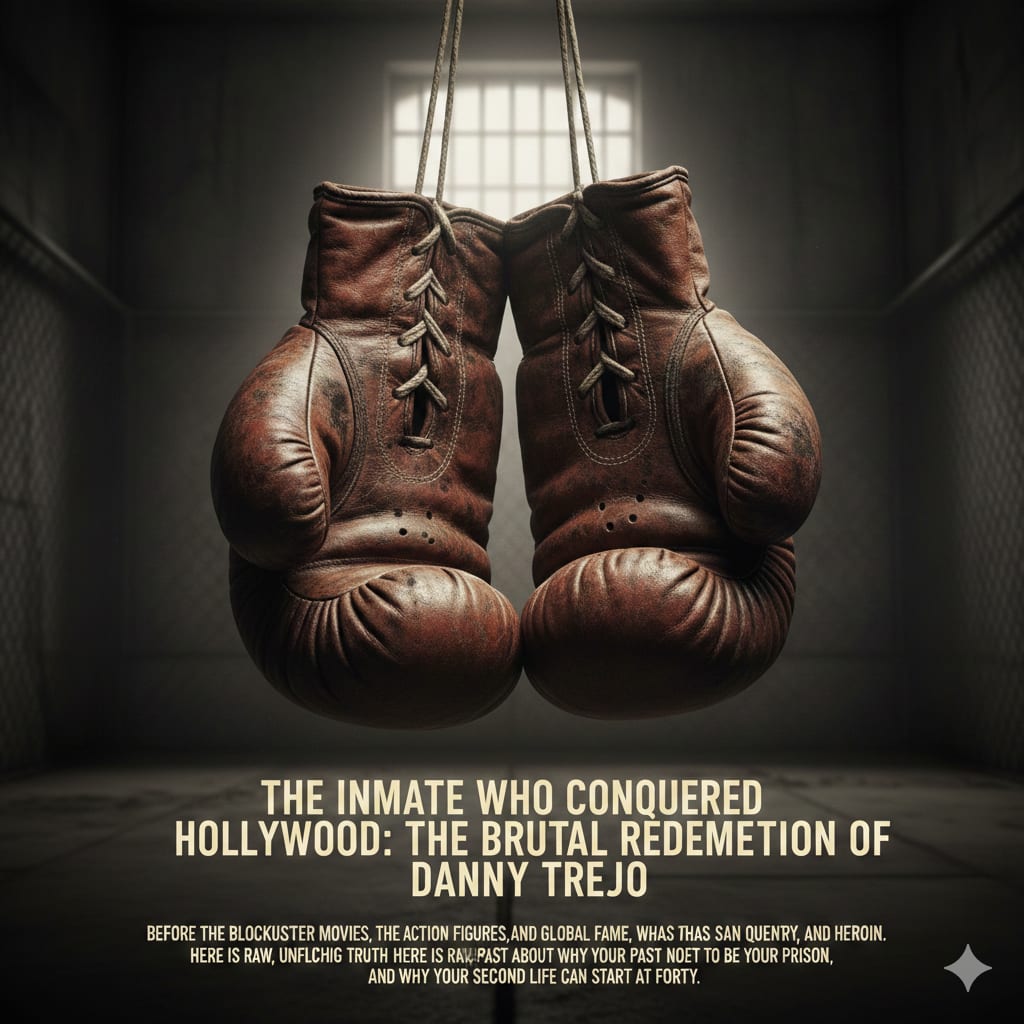
The Inmate Who Conquered Hollywood: The Brutal Redemption of Danny Trejo
Before the blockbuster movies, the action figures, and the global fame, there was San Quentin, armed robbery, and heroin. Here is the raw, unflinching truth about why your past does not have to be your prison, and why your second life can start at forty

You already know the face.
It is one of the most unmistakable visages in the history of modern cinema. Deeply lined, scarred, and weathered like worn leather, framed by a sweeping mustache and a gaze that looks right through you. When Danny Trejo walks onto a screen, he does not have to act tough. The toughness is etched directly into his bone structure. He is the ultimate Hollywood enforcer, the cartel boss, the rugged anti-hero swinging a blade in Machete.
Today, he is a beloved pop-culture icon with hundreds of film credits, successful restaurant chains, and an inspiring legacy.
But Hollywood was never supposed to be his future.
In fact, according to every statistical probability and societal rule, Danny Trejo was never supposed to see his fortieth birthday as a free man. His destiny was not written on a movie script; it was written on a rap sheet.
This is the story of a man who went to the absolute bottom of the human experience and found a way to claw his way back out. It is a cinematic, harsh, and deeply philosophical look at a truth most people ignore: Redemption has no expiration date, and sometimes, you have to walk through hell to find your actual purpose.
A Childhood Headed Toward the Concrete
The origin story of Danny Trejo does not feature drama school, talent agents, or childhood theater productions. It features the gritty, sun-baked, unforgiving streets of Los Angeles in the 1950s and 60s.
Trejo grew up surrounded by a suffocating atmosphere of crime, addiction, and normalized violence. In his neighborhood, toughness wasn't a stylistic choice; it was the only currency that mattered. By the time most kids were worrying about middle school homework, Trejo was being introduced to a life of serious crime by his uncle.
He smoked marijuana at eight years old. He was drinking heavily by twelve. By his early teens, he was introduced to the demon that would come to define his early life: heroin.
Addiction is a thief that steals your future one day at a time, but for Trejo, the theft was violent and rapid. Heroin became the anchor of his daily existence. To feed the beast, he turned to armed robbery. The progression was terrifyingly inevitable. He wasn't a kid making a few bad choices; he was a hardened criminal caught in a downward spiral that only ever ends in two places: a coffin or a cage.
Arrests followed. Then county jail. Then, inevitably, the heavy steel doors of the California state prison system slammed shut behind him.
Surviving the Gladiator School
Trejo didn't just go to prison; he went to the most notorious, violent, and unforgiving penitentiaries in the world. He spent over a decade cycling through the belly of the beast: Folsom, Soledad, and the infamous San Quentin.
To understand the magnitude of his turnaround, you have to understand the environment that forged him. 1960s San Quentin was not a place focused on rehabilitation. It was a gladiator school. Violence was the daily weather. Riots, shivvies, and brutal yard politics were the reality of every waking moment.
Survival in that environment required a terrifying level of aggression. You either became the predator, or you became the prey. Trejo, with his heavily tattooed chest and unyielding demeanor, became the former.
At this point, his future looked permanently sealed. Society had written him off. There was no career waiting for him. There was no grand redemption arc in the works. There was just the bleak, gray repetition of concrete walls, yard time, and survival.
But inside the terrifying structure of the prison system, Trejo found something entirely unexpected. He found a different kind of violence—one that required discipline.
He found boxing.
Trejo was a natural fighter, but the boxing ring inside the prison yard demanded more than just blind rage. It demanded focus. It demanded conditioning, strategy, and respect. Trejo threw himself into the sport, eventually becoming a lightweight and welterweight boxing champion within the prison system.
For the first time in his chaotic, drug-addled life, effort produced structure. He wasn't just surviving; he was training. It was a tiny, brutal glimmer of discipline in an otherwise hopeless world.
The Turning Point in the Dark
The true pivot in Danny Trejo's life did not happen on a red carpet. It happened in solitary confinement.
During a massive prison riot, Trejo was accused of hitting a guard with a rock. It was a charge that could have resulted in the gas chamber. Sitting in the pitch-black silence of "the hole" (solitary confinement), facing the very real prospect of execution, Trejo hit his absolute, undeniable rock bottom.
He made a deal with whatever higher power was listening. He promised that if he was allowed to die with dignity, he would dedicate the rest of his life to helping others.
By a stroke of luck—or divine intervention—the charges were dropped on a technicality. Trejo was released from solitary. But unlike countless times before, he did not forget the promise he made in the dark.
When he finally walked out of prison in 1969, a free man, he did something radical. He completely committed to sobriety. He joined a 12-step program. He recognized that his survival depended entirely on his ability to stay clean, and more importantly, his ability to keep his promise.
He became a drug counselor. He spent his days driving to rough neighborhoods, sitting with addicts who were shaking, sweating, and dying from the same disease that had stolen a decade of his life. He wasn't looking for fame. He was looking for salvation through service.
The Accidental Hollywood Break
For fifteen years, Trejo lived a quiet, sober life. He worked as a counselor, stayed out of trouble, and helped others.
Then, in 1985, the universe delivered the payoff for a decade and a half of quiet discipline.
One of the young men Trejo was counseling called him in a panic. The kid was working as a production assistant on a movie set in Los Angeles and felt completely surrounded by cocaine. He was terrified he was going to relapse. He begged Trejo to come down to the set to support him.
Trejo agreed. He drove down to the set of a movie called Runaway Train.
He walked onto the lot, a heavily tattooed, scarred, intimidating Mexican-American man in his forties. He didn't look like an actor. He looked like exactly what he was: a man who had survived the worst places on earth.
The screenwriter of the film, an ex-convict named Edward Bunker who actually remembered Trejo from his time in San Quentin, recognized him. He knew Trejo had been a prison boxing champion.
Bunker approached the director, Andrei Konchalovsky, and suggested they hire Trejo to train the film's star, Eric Roberts, how to box for a scene. They offered Trejo $320 a day—a staggering amount of money for a drug counselor.
Trejo started training Roberts. But the director noticed something incredible. When Trejo stepped into the ring to spar, he possessed a raw, terrifying authenticity that no Juilliard-trained actor could ever fake. You cannot teach the kind of intensity that comes from surviving San Quentin.
The director decided on the spot to cast Trejo as Eric Roberts' opponent in the film.
There was no audition. There was no headshot. There was only a man who showed up to help a friend stay sober, and accidentally walked into a career.
Reinvention at Forty
There is a toxic narrative in our culture that says if you haven't "made it" by your late twenties, the window of opportunity has closed. We obsess over "30 under 30" lists. We act as if success has a strict expiration date.
Danny Trejo shatters that illusion entirely.
He did not become an actor at twenty. He got his first role in his forties. He was a middle-aged ex-convict with a rap sheet longer than most movie scripts.
But Hollywood recognized exactly what he brought to the table: undeniable reality. He started small. For the first few years of his career, he didn't even have a name in the scripts. He was credited as "Inmate #1," "Tough Guy," or "Bartender." Directors would literally point to him and say, "Just stand there and look menacing."
But role by role, he built credibility. He was professional. He was sober. He hit his marks, treated the crew with massive respect, and brought an unmatched presence to the screen.
Eventually, he caught the eye of visionary directors like Robert Rodriguez and Quentin Tarantino. His roles expanded. From Desperado to Heat, from Con Air to the ultimate starring role in the wildly successful Machete franchise, Trejo evolved from a background extra into a global superstar.
He went from being identified by an inmate number to having his name above the title on movie posters around the world.
The Real Lesson: The Philosophy of the Second Life
If you look closely at Danny Trejo’s story, the success isn't really about fame, and it certainly isn't about acting technique.
It is a story about the profound mechanics of timing, transformation, and service.
We live in a world where people are paralyzed by their past mistakes. A failed business, a bad divorce, a period of depression, or a youthful indiscretion can convince a person that their narrative is ruined. Many people believe they have driven too far down the wrong road to ever turn back.
Trejo proves something incredibly powerful: Your past may explain you, but it does not have to define you.
The scars on his face, the tattoos on his chest, and the horrors of his youth did not disqualify him from a brilliant future. In a magnificent twist of irony, the very things that made him an outcast from society became the exact assets that made him a millionaire. His trauma became his trademark.
But the true philosophical core of Trejo's life is not just resilience; it is his absolute commitment to service.
Trejo is famous for saying: "Everything good that has happened to me happened as a direct result of helping someone else."
It wasn't ambition that brought him to that movie set in 1985. It wasn't a desire for fame or money. It was the simple, unglamorous act of driving across town to stop a friend from using drugs. The universe rewarded a moment of selfless service with a lifetime of unimaginable success.
The Motivation to Keep Moving
Sometimes, your second life starts long after everyone else has stopped expecting anything from you.
If you feel like you are starting too late, remember the man who was sitting in a maximum-security prison cell while other actors were attending theater school.
If you feel like your past mistakes have disqualified you from future success, remember the man who turned an armed robbery conviction into a multi-million dollar acting career.
Redemption is not a gift that is handed to you; it is a territory you have to violently conquer through discipline, sobriety of mind, and an unwavering commitment to moving forward.
The script of your life is not finished yet. You are allowed to write a plot twist. You are allowed to become a completely different character in the next act.
Just keep swinging.
About the Creator
Frank Massey
Tech, AI, and social media writer with a passion for storytelling. I turn complex trends into engaging, relatable content. Exploring the future, one story at a time
Keep reading
More stories from Frank Massey and writers in Motivation and other communities.
The Comedian Who Survived Three Years in a Car: The Brutal Reality of Steve Harvey’s Success
Turn on a television almost anywhere in the world today, and you are likely to see Steve Harvey. He is an undeniable force of modern entertainment. With his signature tailored suits, booming laugh, and razor-sharp wit, he commands stages, hosts globally syndicated game shows, and writes bestselling books. His net worth is estimated in the hundreds of millions. He is the picture of a man who has completely mastered his domain, projecting an aura of untouchable confidence.
By Frank Massey about 20 hours ago in Motivation
One Hard Thing
Stop me if you’ve heard this one before: You have the number, you know your schedule- you’ve even picked out the perfect day and time to make this appointment. Shoot, you’ve even picked out alternative days and times just in case their schedules can’t accommodate you!
By Taylor Rigsbyabout a month ago in Motivation




Comments
There are no comments for this story
Be the first to respond and start the conversation.