
The Man Who Couldn’t Walk but Climbed Everest
From a devastating accident to the world’s highest peak, her journey proves that no mountain is too high when you refuse to give up.

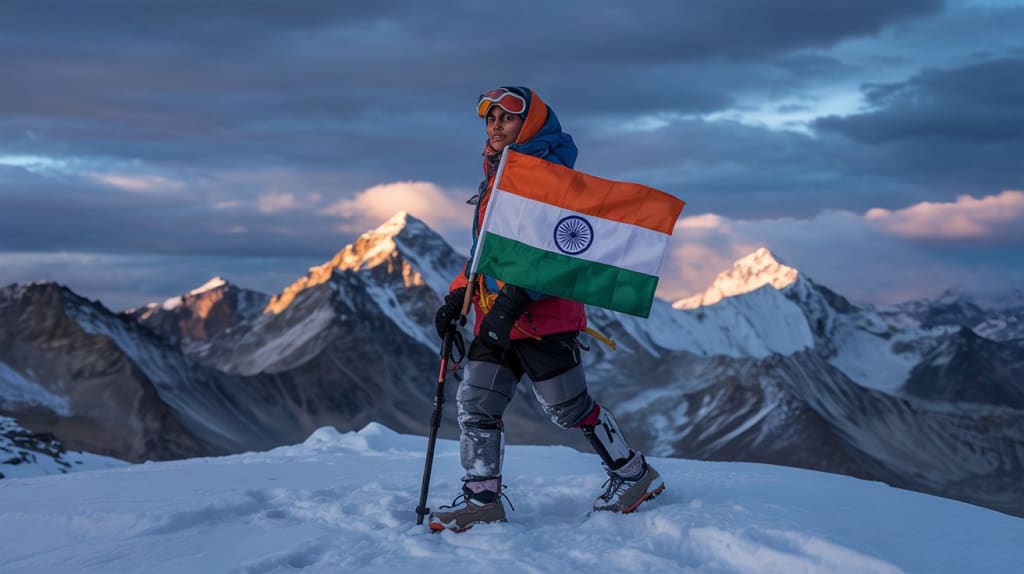
In April 2011, Arunima Sinha was a promising young athlete from India with dreams of playing national-level volleyball. She had grown up in a modest household, where discipline and hard work were a part of daily life. At just 24 years old, her future looked bright. But one ordinary train journey would change everything.
She boarded the Padmavat Express in Lucknow, carrying nothing but her sports bag and the determination of an athlete chasing her dream. As the train sped through the night, a group of robbers entered her compartment. They demanded her valuables, but Arunima refused to hand over her belongings. She had always been strong-willed, but this time, her courage came at a heavy cost. The robbers pushed her out of the moving train.
She fell onto the tracks with unimaginable force. In the darkness, she saw the blinding light of another train approaching. Before she could move, it ran over her left leg. She lay there for hours, bleeding and in agony, until villagers finally found her and rushed her to a hospital. Doctors fought to save her life, but her leg had to be amputated below the knee. The promising volleyball career she had worked so hard for seemed to end in that moment.
The days that followed were the hardest of her life. Physical pain was constant, but the emotional pain cut even deeper. Whispers filled the hospital — people calling her life “finished,” her dreams “impossible.” But Arunima refused to accept that her story was over. She decided that if life had taken her leg, she would give it a reason to remember her. She would do something so extraordinary that no one could ever pity her again.
In the hospital bed, she announced her new dream: to climb Mount Everest. Most thought it was impossible. She had never climbed a mountain before. She was recovering from a life-changing injury. She had no training, no funding, and a prosthetic leg. But her mind was made up.
After her recovery, she reached out to Bachendri Pal, the first Indian woman to climb Everest. Pal agreed to train her at the Tata Steel Adventure Foundation. The training was grueling — rock climbing, endurance runs, carrying heavy backpacks uphill for hours. Her prosthetic leg caused blisters and pain, but she pushed through it all. Every climb, every step was a battle against the voice in her head telling her to quit.
She started with smaller peaks, each one building her strength and confidence. By the time she stood at the base camp of Mount Everest in 2013, she had transformed into a mountaineer in both body and spirit. But Everest is no ordinary mountain. Its thin air, unpredictable weather, and deadly slopes have claimed the lives of even the most experienced climbers.
For 52 days, Arunima fought against exhaustion, freezing temperatures, and the constant threat of avalanches. Her prosthetic leg made every step harder, but it also became her symbol of strength. She reminded herself why she was there — to prove that nothing is truly impossible.
On May 21, 2013, she reached the summit of Mount Everest. Standing at 8,848 meters above sea level, with the Indian flag in her hands and tears in her eyes, she felt the weight of every obstacle she had overcome. The girl who had once lain on train tracks, broken and bleeding, was now on top of the world.
Her achievement made her the first female amputee to climb Mount Everest. But she didn’t stop there. Arunima went on to climb the highest peaks on every continent, including Kilimanjaro in Africa, Elbrus in Europe, and Aconcagua in South America. She became a global symbol of courage, resilience, and determination.
Arunima has since dedicated her life to inspiring others. She founded a sports academy for people with disabilities and underprivileged youth, giving them the opportunities she had once fought so hard to find. She often says, “You can either accept the pain and stay down, or accept the pain and rise.”
Her journey is more than just a mountaineering story — it’s a lesson in the power of the human spirit. We all face mountains in our lives. They might not be made of ice and rock, but they stand in our way just the same. Arunima’s life proves that with enough willpower, no summit is unreachable.
The next time you feel like giving up, remember Arunima Sinha. Remember that the difference between impossible and possible is often just the decision to try, and to keep trying no matter how steep the climb. She didn’t just conquer Everest — she conquered every fear, doubt, and limitation that dared to stand in her way.
About the Creator
Farzad
I write A best history story for read it see and read my story in injoy it .
Keep reading
More stories from Farzad and writers in Motivation and other communities.
From College Dropout to Tech Visionary: The Inspiring Journey of Steve Jobs
In the spring of 1976, a young man named Steve Jobs stood in a small suburban garage in Los Altos, California. The space was cluttered with wires, circuit boards, and the faint smell of solder. This garage didn’t look like the birthplace of a revolution, but it was. Jobs, only 21 years old, had no idea that he was about to change the world forever.
By Farzad6 months ago in Motivation
One Hard Thing
Stop me if you’ve heard this one before: You have the number, you know your schedule- you’ve even picked out the perfect day and time to make this appointment. Shoot, you’ve even picked out alternative days and times just in case their schedules can’t accommodate you!
By Taylor Rigsby19 days ago in Motivation
Proving You’re Disabled Enough
The hardest part of applying for disability benefits was not the paperwork. It was the translation. A life quietly reshaped by illness had to be reduced to tick boxes, descriptors, and carefully worded answers. Pain had to become evidence. Fatigue had to become measurable. Personal limitation had to be presented as a case strong enough to be believed.
By Millie Hardy-Simsabout 18 hours ago in Motivation
Public Announcement Challenge Winners
For the Public Announcement Challenge, writers were asked to work inside voices built for control. These were notices, warnings, and updates meant to inform rather than confess. The strongest entries committed to that form and didn't break from it. Corporate memos, formal government alerts, and internal policy language were held consistently, allowing emotion, fear, grief, or humor to surface indirectly through pressure rather than declaration. The following poems recognize the voice of authority, and let human feeling slip through despite all its rules and restraint.
By Vocal Curation Team7 days ago in Resources




Comments
There are no comments for this story
Be the first to respond and start the conversation.