
The Man Who Saw the World Through His Fingertips: Erik Weihenmayer’s Vertical Braille
In a world that equates "seeing" with "believing," one man proved that vision has nothing to do with eyes. Erik Weihenmayer didn't just climb Mount Everest blind; he climbed the highest peak on every continent, teaching the world that the summit is not a place—it is a mindset

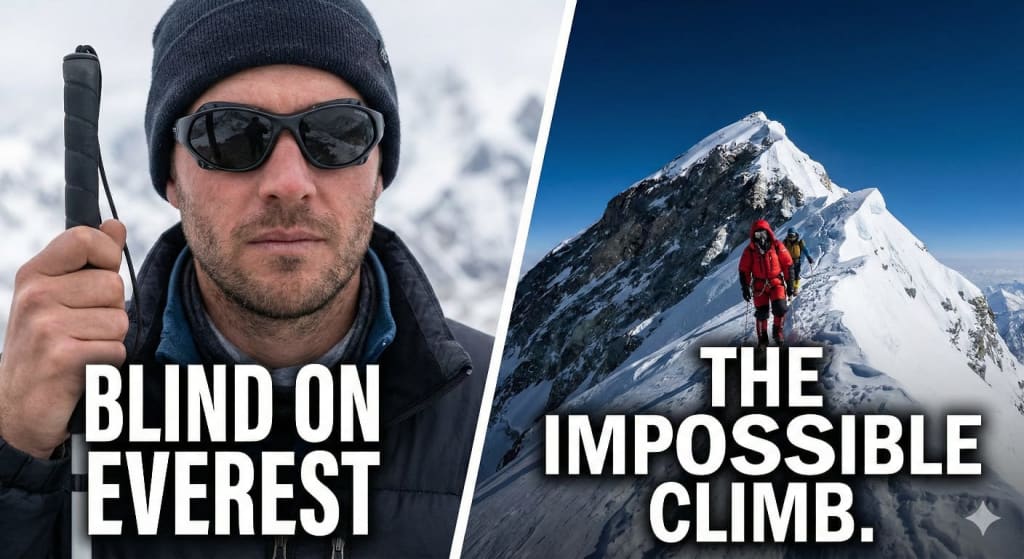
The incredible true story of Erik Weihenmayer, the first blind man to summit Mount Everest and conquer the Seven Summits, redefining the limits of human potential.
Introduction: The Ladder Over the Abyss
Imagine standing at 19,000 feet. The air is thin, stripping the oxygen from your blood with every gasp. You are freezing. The wind is howling at forty miles per hour, a sound like a freight train that never arrives.
In front of you lies the Khumbu Icefall. It is the most terrifying section of Mount Everest. It is a shifting river of ice blocks the size of apartment buildings, separated by crevasses so deep you cannot see the bottom.
To cross them, you must walk across aluminum ladders lashed together with rope. The ladders are wobbly. You are wearing crampons—spikes on your boots—that skate against the metal rungs. One slip, one misstep, and you fall into the blue void.
Now, imagine doing this with your eyes closed.
Imagine doing it knowing that opening your eyes won’t change anything.
In May 2001, Erik Weihenmayer stood at the edge of that abyss. He could feel the cold on his face. He could hear the terrifying groan of the glacier shifting beneath his feet. He could hear the jingling of the bell attached to the climber in front of him.
But he could not see the ladder. He could not see the drop.
Critics said he was crazy. They said he was a liability. They said a blind man on Everest would not only kill himself but would likely kill the team trying to save him.
Erik took a breath. He reached out with his trekking pole, tapping the metal rung. Clink.
He stepped out into the void.
Part I: The Fading of the Light
Erik was not born blind. He was born in New Jersey in 1968 with a condition called juvenile retinoschisis. It is a cruel disease because it doesn't take your sight all at once. It steals it by degrees.
As a young boy, he could see well enough to play, to run, to watch TV. But every year, the world got a little fuzzier. The edges of the room darkened. The faces of his parents blurred.
He lived in a state of terrified anticipation. He knew the darkness was coming. He fought it. He denied it. He raged against it.
By the time he was thirteen, he was legally blind. By fourteen, the light was gone completely.
For a teenager, this is a death sentence for social life, for independence, for identity. Erik didn't want to be the "blind kid." He didn't want to be the kid with the white cane shuffling down the hallway while others played sports.
He broke his cane in frustration. He refused to learn Braille. He was angry at a universe that had taken away his primary way of engaging with it.
But anger, if channeled correctly, is a fuel.
Erik discovered wrestling. Wrestling is the only sport where you start in contact with your opponent. You don't need to see them; you need to feel them. You need to sense their weight, their balance, their leverage.
On the wrestling mat, Erik wasn't disabled. He was dangerous. He learned that while he couldn't see the world, he could still grapple with it. He could still pin it to the ground.
Part II: The Discovery of Vertical Braille
Then, he found the rocks.
During a recreational program for the blind, Erik was introduced to rock climbing. Most people assume climbing is 90% visual. You look for the hold, you look for the foothold, you plan your route.
Erik couldn't do any of that.
But he discovered something else. Rock is tactile. It has texture. It has temperature. It has shape.
He learned to scan the face of the cliff with his hands, moving them in frantic, sweeping arcs until his fingers found a crimp, a jug, a crack. He called it "scanning."
He learned to listen to the rock. He learned that a solid hold sounds different than a loose one when you tap it.
He developed a system. He would climb with a partner. The partner would call out directions using a clock system.
"Hold at two o'clock, high reach."
"Foot hold at six o'clock, knee level."
Erik realized that climbing wasn't about conquering the mountain with his eyes. It was about solving a puzzle with his body.
He became obsessed. He climbed in the Shawangunks. He climbed in Yosemite. He climbed the nose of El Capitan.
But he wanted more. He wanted the thin air.
Part III: The "Liability" on Everest
When Erik announced he wanted to climb Everest, the mountaineering community was split. Some called it inspiring. Many called it a publicity stunt that would end in tragedy.
Everest is hard enough for people with perfect vision. You have to navigate whiteouts where the snow blinds you. You have to see the weather turning. You have to see the knots in your ropes.
Erik had a team, led by Pasquale Scaturro. They developed a system. Erik would follow the sound of a bell tied to the pack of the climber in front of him. They would use verbal cues for the terrain.
"Rock step here."
"Ice patch."
"Big drop on the right."
But the real challenge was the speed. On Everest, speed is safety. If you move too slowly, you run out of oxygen, or you get caught in a storm. A blind climber naturally moves slower because every step must be verified by touch.
Erik had to train himself to be faster than a sighted climber. He had to be an athlete of the highest caliber.
May 25, 2001. Camp 4. The Death Zone.
At 26,000 feet, the human body begins to die. The brain swells. The blood thickens.
Erik and his team began the final push to the summit in the middle of the night.
For a sighted climber, the night is terrifying because you can only see the beam of your headlamp. For Erik, it was just another Tuesday. He lived in the dark. In a strange way, the night leveled the playing field.
But the physical toll was immense. Erik’s oxygen mask leaked. He was gasping for air. The terrain was steep, icy, and unforgiving.
They reached the Hillary Step—a 40-foot vertical rock face near the summit. It is the bottleneck of Everest. On one side, a 10,000-foot drop to Tibet. On the other, a 8,000-foot drop to Nepal.
Erik couldn't see the drop. But he could feel the exposure. The wind tore at his suit.
He reached up. He found the rock. He pulled.
He didn't think about the drop. He thought about his next handhold. He thought about the trust he had in his team.
At shortly after 10:00 AM, the ground leveled out.
The climber in front of him stopped.
"Erik," the voice cracked over the wind. "There's nowhere else to go."
He was standing on the roof of the world.
He couldn't see the curvature of the earth. He couldn't see the sea of clouds below him.
But he could feel it. He could feel the vibration of the planet. He could hear the sound of the infinite wind. He felt a sense of space that was absolute.
He had become the first blind person in history to stand on the highest point of Earth.
Part IV: The Seven Summits
Most people would have retired. They would have written the book, done the talk show circuit, and bought a comfortable house.
Erik Weihenmayer is not most people.
He realized that Everest was just one kind of mountain. There were others.
He set his sights on the "Seven Summits"—the highest peak on every continent.
It is a checklist that kills even expert climbers.
* Mount McKinley (Denali) - North America: Brutal cold and hauling heavy sleds.
* Mount Kilimanjaro - Africa: Altitude and endurance.
* Mount Elbrus - Europe: Unpredictable, violent weather.
* Aconcagua - South America: The "Stone Sentinel," known for ferocious winds.
* Vinson Massif - Antarctica: The bottom of the world, where isolation is total.
* Mount Everest - Asia: The highest.
* Mount Kosciuszko - Australia: The finish line.
(And later, the Carstensz Pyramid in Indonesia, the harder version of the list).
Each mountain required a different set of skills. On Vinson, in Antarctica, the whiteness was so pure that sighted climbers often got vertigo. Erik, immune to the "whiteout," became the steady anchor for the team.
On the Carstensz Pyramid, he had to navigate a Tyrolean traverse—pulling himself hand-over-hand across a rope suspended over a jungle chasm.
In September 2002, standing atop Kosciuszko in Australia, Erik completed the circuit.
He had done what only about 100 people in history had done at the time. And he had done it without seeing a single inch of the path.
Part V: The Vision
Why did he do it?
It wasn't to prove he wasn't blind. He knew he was blind. He bumped into coffee tables at home. He couldn't drive a car.
He did it to prove that blindness wasn't a wall. It was just a different kind of road.
Erik co-founded an organization called No Barriers. The philosophy is simple: What’s within you is stronger than what’s in your way.
He began taking other disabled people on expeditions. He took injured soldiers climbing. He took blind teenagers trekking in Peru.
He taught them what the mountain taught him:
The Alchemy of Struggle.
Lead can be turned into gold. Pain can be turned into power. Confusion can be turned into clarity.
He realized that the "sighted" world often suffers from a different kind of blindness. We are blinded by our biases. We are blinded by our fear. We look at a mountain and we see a barrier.
Erik looked at a barrier and heard a song.
Part VI: The Kayak
Just to prove the point that he wasn't done, years later, Erik decided to kayak the entire length of the Grand Canyon.
277 miles.
Class IV rapids.
Whirlpools that can suck a boat under.
In a kayak, you rely on reading the water. You look for the "V" in the current. You look for the eddies.
Erik couldn't see the water.
So he developed a system using high-tech echolocation and sensors, but mostly, he used his ears. He learned to hear the difference between a wave that would splash you and a hole that would kill you.
He flipped over. He smashed into rocks. He was battered and bruised.
But he finished.
Part VII: The Lesson of the Dark
Erik Weihenmayer’s story is not about a "superhero." He is a man who gets scared. He is a man who gets tired.
It is a story about Adaptation.
When his eyes failed, he didn't try to fix his eyes. He upgraded his other senses. He upgraded his mind.
He teaches us that we spend too much time wishing our circumstances were different.
I wish I had more money.
I wish I had more time.
I wish I could see.
Erik didn't wish. He worked.
He took the tools he had—hands, ears, legs, and heart—and he built a life that most people with 20/20 vision can only dream of.
Conclusion: The Summit Within
We all have our Everests.
Maybe yours is a failing business. Maybe it's a broken marriage. Maybe it's a diagnosis that scared you to death.
We look at these mountains and we think: I can't see the way up.
Erik Weihenmayer tells us: You don't need to see the whole path. You just need to reach out and find the next hold.
You just need to take one step.
And then another.
And then another.
If you keep stepping, eventually, you will run out of mountain.
And when you stand on the top, breathing the thin air, you will realize the truth that Erik found in the dark:
Vision isn't about what you see with your eyes.
It's about what you feel in your soul when you refuse to quit.
The view from the top is beautiful. But the person you become on the climb? That is the real masterpiece.
About the Creator
Frank Massey
Tech, AI, and social media writer with a passion for storytelling. I turn complex trends into engaging, relatable content. Exploring the future, one story at a time
Keep reading
More stories from Frank Massey and writers in Motivation and other communities.
One Hard Thing
Stop me if you’ve heard this one before: You have the number, you know your schedule- you’ve even picked out the perfect day and time to make this appointment. Shoot, you’ve even picked out alternative days and times just in case their schedules can’t accommodate you!
By Taylor Rigsby8 days ago in Motivation
The Real Price of Ignoring Employee Development
In today’s fast-moving business environment, employee development plays a critical role in long-term success. Companies that invest in skill-building programs create adaptable and motivated teams. However, when organizations overlook development, hidden costs begin to accumulate. At first, the impact may seem minimal. Over time, though, gaps in skills, engagement, and productivity become increasingly visible. As competition intensifies, organizations that fail to develop their workforce struggle to keep pace. Consequently, employee growth becomes not just an advantage but a necessity.
By Anthony Qiabout 5 hours ago in Motivation


Comments
There are no comments for this story
Be the first to respond and start the conversation.