
The Man Who Threw a $400,000 Dream in the Trash: The Real Stephen King Story
Before the global fame, blockbusters, and millions of books sold, there was a freezing trailer, a pile of rejection slips, and a dream that was almost abandoned. Here is why true success is often just one draft past your breaking point

If you walk into any bookstore in the world today, you will see an entire section dedicated to a single man.
Stephen King is a titan of modern literature. He has published over 60 novels, sold more than 350 million copies worldwide, and seen dozens of his works adapted into massive Hollywood films. His name is synonymous with suspense, imagination, and unparalleled literary success. He is a multi-millionaire, a cultural icon, and a master of his craft.
Because of this towering legacy, it is incredibly easy to look at Stephen King and assume his path was paved with destiny. We look at his massive catalog and think, “Of course he made it. He’s a genius. Talent like that cannot be ignored.”
But that is a comfortable lie we tell ourselves to excuse our own struggles.
The truth is much darker, far more stressful, and infinitely more relatable. Long before the world recognized his genius, Stephen King was a desperately broke, exhausted school teacher who genuinely believed his dream was dead.
This is the story of the day the Master of Horror almost quit—and why the world’s most famous author is proof that your darkest moment of self-doubt is often the final test before a breakthrough.
The Weight of an Ordinary Struggle
The year was 1973. Stephen King and his wife, Tabitha, were living in a cramped, drafty double-wide trailer in Hermon, Maine.
They were not just poor; they were suffocating under the kind of poverty that dictates every waking thought. They had two young children and a mountain of bills that never seemed to shrink. To keep the family afloat, King worked as a high school English teacher at Hampden Academy, earning a meager salary of $6,400 a year.
Because teaching didn’t pay enough to cover the groceries, King spent his summers and weekends working grueling shifts at a commercial laundry facility. He washed hospital sheets stained with blood and restaurant tablecloths caked in grease. He smelled like industrial bleach and exhaustion.
Money was so incredibly tight that they had to ask the telephone company to disconnect their landline. They simply couldn't afford the monthly bill. When one of their children needed antibiotics, they had to scrape together spare change from the couch cushions just to pay the pharmacist.
But through it all, King wrote.
He didn't have a quiet, mahogany-lined study. He had a cramped laundry room in the trailer. He set up a tiny desk between the washing machine and the dryer, and every night, after dealing with high schoolers and grading papers, he would sit down at a battered portable typewriter.
He wrote short stories and submitted them to men’s magazines. Occasionally, he would get a check for $200. It was enough to buy groceries or pay off a medical bill, but it wasn't enough to escape the trailer.
And then, the rejection slips started piling up.
The Stinging Reality of Rejection
King wanted to write novels. He poured his soul into his longer manuscripts, hoping one of them would be his ticket out of poverty.
But the publishing world is ruthless. King sent his work to literary agents and publishing houses, waiting weeks or months for a reply. When the mail arrived, it almost always brought the same crushing outcome: a standardized, impersonal rejection letter.
Not for us. Doesn't fit our current lineup. We pass.
Every writer, artist, and entrepreneur knows the sting of rejection. The first few times, you can brush it off. You tell yourself it’s part of the process. But when the rejections mount into the dozens—when you are exhausted, broke, and staring at your children wondering if you can afford to buy them winter coats—rejection stops feeling like a business decision. It starts feeling like a personal verdict.
It whispers a toxic lie in your ear: You are not good enough, and you never will be.
The Breaking Point and the Trash Can
During this period of intense financial and emotional stress, King started working on a new idea. It was a story about a bullied teenage girl with telekinetic powers who takes revenge on her high school tormentors.
He called it Carrie.
From the very beginning, King hated it. He was a 26-year-old man; he felt he didn’t understand the psychology of teenage girls. He thought the dialogue was clunky, the pacing was off, and the premise was absurd. He struggled to find the voice of the protagonist.
He managed to type out three single-spaced pages of the manuscript, but the weight of his previous failures sat heavily on his shoulders. He looked at the words on the page and saw only another impending rejection.
Why bother? he thought. Why spend months writing this just to receive another 'No, thank you' in the mail?
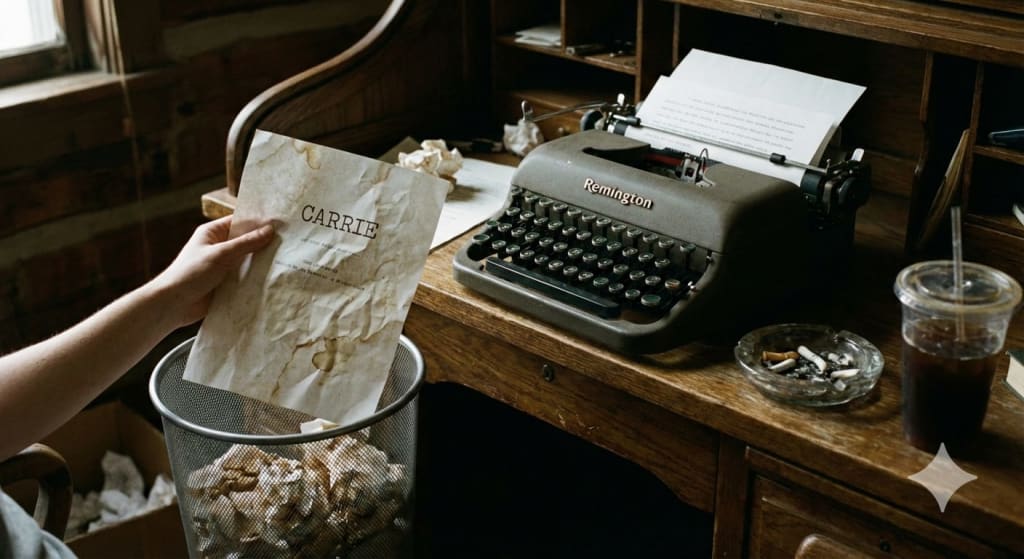
Frustration, exhaustion, and the crushing reality of his life in the trailer finally took over. King pulled the pages from his typewriter, crumpled them into tight paper balls, and aggressively threw them into the trash can.
He walked out of the room. He had made a decision.
Writing wasn’t working. The dream was over. It was time to accept reality, focus on teaching, and resign himself to a life of quiet desperation.
The Rescue That Changed History
If the story ended there, the world would have never known the name Stephen King. We would have lost The Shining, It, Misery, and The Green Mile.
But the story didn't end there, because of one crucial element: Tabitha King.
The next day, Tabitha went into the laundry room to empty the trash. She noticed the crumpled balls of paper coated in cigarette ashes. Instead of throwing them out, she smoothed them over, wiped off the ashes, and sat down to read them.
When Stephen came home, Tabitha handed the slightly stained pages back to him.
She didn't tell him it was a masterpiece. She didn't offer toxic positivity. Instead, she offered the grounding truth of a partner who believed in his potential more than he did in that moment.
"You've got something here," she told him. "I really think this is a good story. If you don't know how teenage girls act, I'll help you with that part. Just finish it."
Because of her quiet insistence, King sat back down at the typewriter. He didn't write with sudden, bursting confidence. He wrote with reluctance. But he wrote.
The $2,500 Lifeline
Months later, the manuscript for Carrie was finished. King sent it out into the void of the publishing world, bracing himself for the inevitable rejections.
Historically, the manuscript faced around 30 rejections from various publishers who didn't know what to do with the strange, dark story of a telekinetic teen. (A common misconception is that it was exactly 12, but the actual number of rejections for Carrie and his previous unpublished works was staggering).
More waiting. More silence. More bills piling up in the trailer.
Then, finally, a breakthrough.
Because the Kings still couldn't afford a telephone, Stephen received a telegram from Bill Thompson, an editor at Doubleday Publishing. The telegram read:
CONGRATULATIONS. CARRIE OFFICIALLY A DOUBLEDAY BOOK. IS $2,500 ADVANCE OKAY? THE FUTURE LIES AHEAD.
King was ecstatic. He used the $2,500 advance to buy a new car (a Ford Pinto) and to finally move his family out of the trailer and into a modest apartment. He bought groceries without checking the price tags first.
It was a victory, but it was not yet life-changing. An advance of $2,500 meant he was a published author, but it did not mean he could quit his day job. He continued to teach high school English, assuming Carrie would sell a few thousand copies and fade into obscurity.
The Mother’s Day Phone Call
The true climax of Stephen King’s journey did not happen when he published the hardcover. It happened on Mother’s Day, May 12, 1973.
King was alone in his apartment when the phone rang. It was his editor, Bill Thompson.
Thompson explained that they had just held an auction for the paperback publishing rights to Carrie.
"Are you sitting down?" Thompson asked.
King was standing in the doorway. "No," he said. "Why?"
"The paperback rights to Carrie just sold to Signet Books," Thompson said. "For four hundred thousand dollars."
King's knees gave out. He literally sank to the floor. Under his publishing contract, he was entitled to exactly half of that money. In an instant, a man who had been washing blood out of hospital sheets and disconnecting his phone to buy medicine was handed $200,000 (the equivalent of well over $1.3 million today).
For the first time in his adult life, the crushing, suffocating fear of financial ruin simply disappeared.
King was in such a state of shock that he left the apartment, walked to a local pharmacy, and bought his wife a hairdryer just to have something to hand her when he broke the news.
Carrie went on to sell over 1 million copies in its first year as a paperback. It launched one of the most prolific and successful writing careers in human history.
And it all started with a manuscript that was sitting in a trash can, covered in cigarette ashes.
The Hidden Truth About Talent
We live in a culture that worships outcomes. We celebrate the bestseller list, the red carpets, and the massive payouts.
But when we look at Stephen King's story, we uncover a profound and somewhat uncomfortable truth: Stephen King wasn’t discovered because he suddenly became talented.
He was incredibly talented when he was living in that trailer. He was talented when he was working in the laundry. He was talented when dozens of publishers were sending him rejection letters.
The difference between Stephen King, the icon, and an anonymous, forgotten writer wasn't a sudden injection of skill. The difference was that he had someone who stopped him from quitting one draft too early.
Many dreams in this world do not fail because of a lack of ability, a lack of intelligence, or a lack of market viability.
They fail because exhaustion convinces people to stop.
They fail because the human brain is wired to avoid pain, and constant rejection is deeply painful. It is entirely logical to want to protect yourself by throwing your manuscript, your business plan, or your invention into the garbage. The world nearly lost Stephen King’s voice forever because the pain of rejection felt permanent.
But it wasn't. The rejection was just a filter.
The Real Lesson: The Cost of the Final Attempt
If there is a lesson to extract from the freezing trailer in Maine, it is this: Success rarely arrives when you are full of energy, optimism, and unshakeable confidence.
More often than not, success is sitting quietly, exactly one attempt beyond the moment you decide you are completely done.
If you are currently facing a wall of rejection—whether you are applying for jobs, pitching a startup, trying to get published, or building a brand—you must understand that your current failure is not a final verdict on your worth.
The story you think isn't good enough might be the exact one that changes your entire life. The project you are ready to throw in the trash might be the very thing the world is waiting for.
Do not let exhaustion make your final decisions. Do not let the sting of hearing "no" convince you that you will never hear a "yes."
Pick the crumpled pages out of the trash. Smooth them over. Sit back down at the desk.
About the Creator
Frank Massey
Tech, AI, and social media writer with a passion for storytelling. I turn complex trends into engaging, relatable content. Exploring the future, one story at a time
Keep reading
More stories from Frank Massey and writers in Motivation and other communities.
The Billionaire Who Failed 5,127 Times: The Radical Persistence of James Dyson
Look around your home, and there is a high probability you will spot a piece of technology that looks like it belongs on a spaceship. It might be a blade-less fan, a supersonic hair dryer, or a sleek, cordless vacuum cleaner humming with a futuristic whine.
By Frank Massey a day ago in Motivation
One Hard Thing
Stop me if you’ve heard this one before: You have the number, you know your schedule- you’ve even picked out the perfect day and time to make this appointment. Shoot, you’ve even picked out alternative days and times just in case their schedules can’t accommodate you!
By Taylor Rigsby29 days ago in Motivation
Why is it so hard to say thank-you?
People do nice things for each other all of the time, but sometimes, the recipients of these good deeds fail to say thank-you or express any gratitude whatsoever. It is almost as if the act was expected instead of appreciated. Unfortunately, this happens a lot, and though the person that did the nice thing might not say anything when greeted with the lack of appreciation, he or she may begin to feel used or as if the other person doesn’t really respect him or her.
By Nicole Higginbotham-Hogue3 days ago in Motivation
It's 2026. Songs Turning 10 This Year
In 2016, we saw the rise of short form videos and what would lead to the birth of TikTok. We cannot forget the Snapchat filters no matter how cringe worthy some of them might have been. It was also the year in which the hit series Stranger Things debuted.
By Jasmine Aguilara day ago in Beat


Comments
There are no comments for this story
Be the first to respond and start the conversation.