
The Power of a Weak Hand
How Letting Go Can Lead to Greater Strength and Success

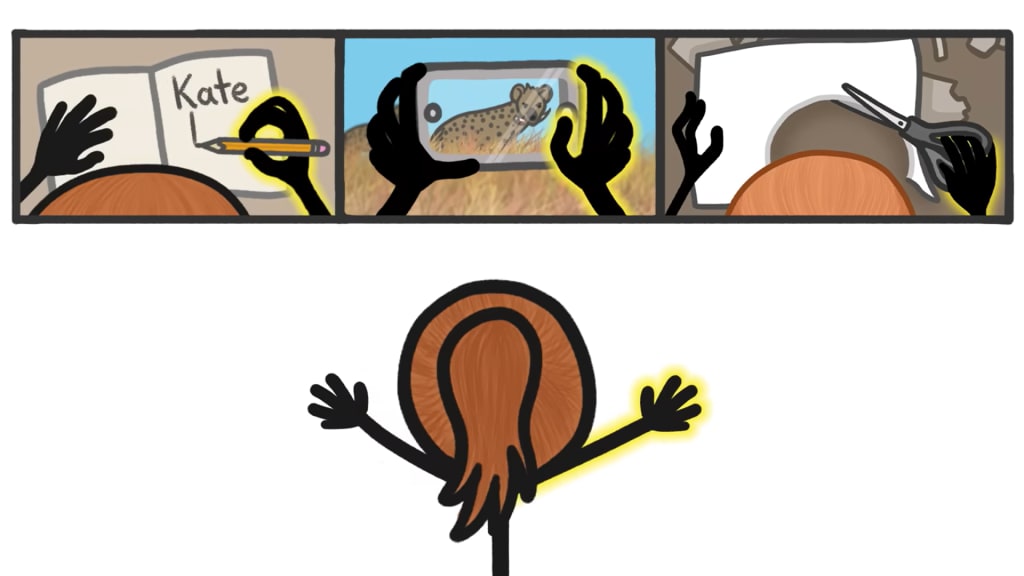
Hi, this is thanvir - with...umm...hands.
Anyway, when I want to write, flip a pancake, or take adorable hyena pictures, like most
people, I use my right hand.
Because despite being a near-mirror image of my right, my left hand is *terrible* at
this stuff.
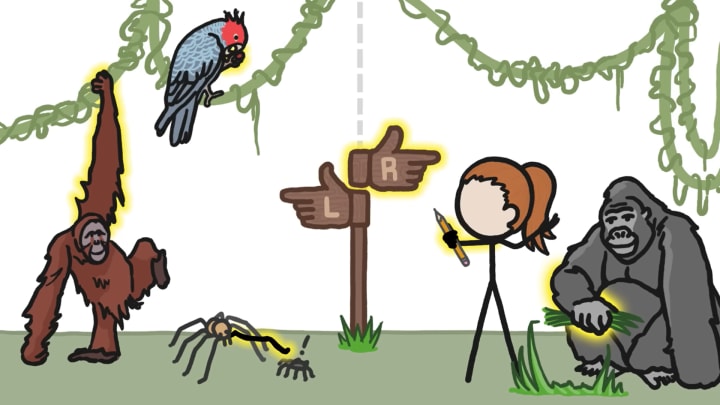
Lots of other animals also have a so-called “preferred” side; gorillas generally use
their right hand for tasks requiring dexterity, while orangutans use their left.
Many parrots hold seeds with their left foot.
And Brazilian spitting spiders tend to favor their left fore-legs while hunting.
And sure, it’s weird that some animals prefer their left and some their right, but what’s
even weirder is why we have a preferred side at all.
Perhaps a hand-ier way to think about it is if having one “good” side is good, why
don’t we have two?
It likely comes down to efficiency.
Most animals have brains with two largely-independent sides that perform somewhat different functions
and control different - and, weirdly - opposite sides of our bodies.
Like, when I write my name, neurons in the left side of my brain send electrical signals
to neurons in my right hand to tell it what to do.
But building and operating that neural circuit takes a lot of time and a lot of energy - and
training that limb to write decently takes even more.
To write decently with my left hand, because of the quirky 2-sidedness of our brains, I'd
need an entirely different circuit, which would take a ton more time and energy to build,
operate, and train.
Instead, it’s much more efficient to rely on a single circuit for writing.
What’s more, the more I use that circuit, the more I reinforce the neural connections
from the brain to my right hand, making that hand even...well...handier, and the more likely
I am to use it for other jobs.
Voilà - handedness.
This efficiency explanation is still somewhat theoretical, but evidence from all sorts of
animals shows that having a preferred side can provide an advantage.
When scientists gave a food-finding test to parrots, some of whom had a strong side preference
and some didn’t - the strongly-sided birds did twice as well.
What’s more, when the task got harder and the birds had to use a series of coordinated
motions to get a snack hanging from a string, the strongly sided birds were way better at
figuring out a clever solution.
And look...during this more complicated task, the “un-preferred” side had something
important to do too, just like how my left hand holds and steadies the paper when I’m
writing, or the camera when I’m snapping a picture.
These jobs are often - literally - supporting roles, but they, too, require circuitry to
perform, and training to perform well.
So maybe our so-called “weaker” side isn’t actually weak after all; it’s just optimized
for different jobs.
Without it, we wouldn’t be able to hammer in a nail, play the guitar, catch and throw
a baseball, perform heart surgery, or deftly wield a sword and shield.
Of course, there’s that question of why I - along with most humans - would swing a
sword with my right hand, while far fewer would choose their left.
Thank you
bye bye
About the Creator
Keep reading
More stories from Mohammed thanvir and writers in Motivation and other communities.
Homeless to Louis Vuitton Motivational Story
Louis Vuitton was a French entrepreneur and fashion designer who founded the world-renowned luxury brand, Louis Vuitton. His story is a true testament to the power of perseverance and dedication in the face of adversity.
By Mohammed thanvir3 years ago in Motivation
One Hard Thing
Stop me if you’ve heard this one before: You have the number, you know your schedule- you’ve even picked out the perfect day and time to make this appointment. Shoot, you’ve even picked out alternative days and times just in case their schedules can’t accommodate you!
By Taylor Rigsby15 days ago in Motivation


Comments
There are no comments for this story
Be the first to respond and start the conversation.