
The Road Between Two Mornings
town was old, the kind where time seemed to sit on a bench and watchThe the world pass by.

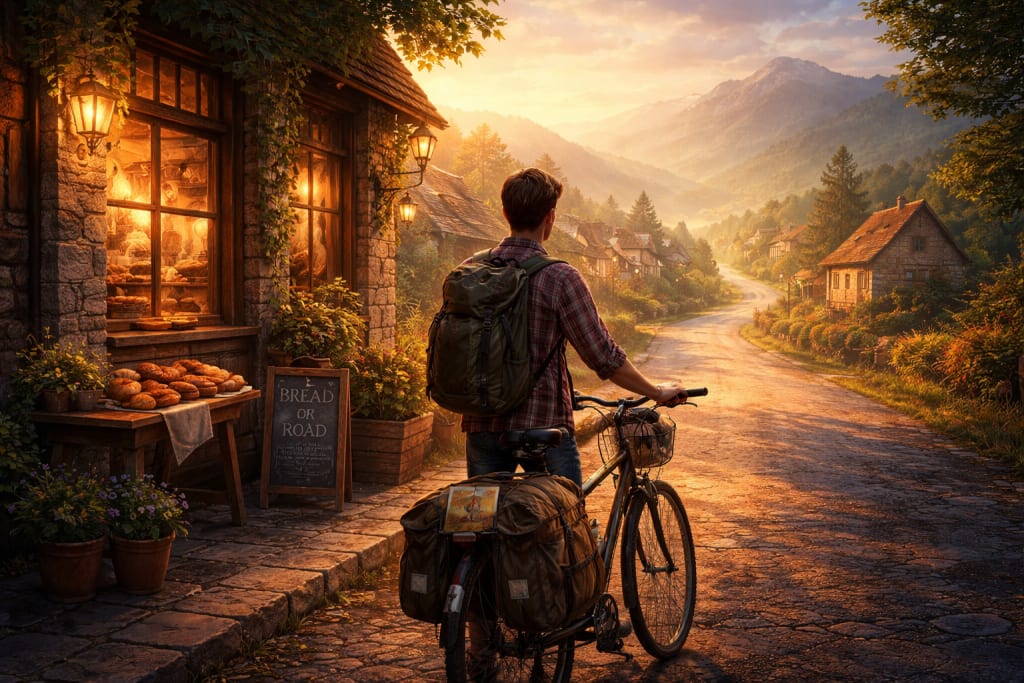
In a quiet town tucked between low green hills and a winding river, there lived a young man named Tomas who believed that his life had already chosen him. Every morning at six, he unlocked the wooden door of his uncle’s bakery, tied on a flour-dusted apron, and baked bread for people who rarely looked up from their newspapers. His hands worked quickly, but his thoughts always moved faster—toward places he had never seen and dreams he had never dared to touch.
Streets curved gently like they were tired of being straight. The bell of the small church rang every hour, reminding everyone that routine was safer than change. Tomas had grown up believing that too. His father used to say, “Stability is a roof over your head. Dreams are only windows.” And so Tomas stayed under the roof.
One rainy morning, as he was carrying a basket of warm bread to the front counter, a stranger walked in. She was soaked, her bicycle leaning outside like a tired animal. She ordered nothing but a glass of water and asked if she could sit by the window. Tomas nodded. He noticed her map spread open on the table, marked with lines and small notes in different colors.
“Where are you going?” he asked without meaning to.
“Everywhere I can,” she smiled. “I’m cycling from the north coast to the southern mountains.”
Tomas laughed softly. “That’s impossible.”
She tilted her head. “Why?”
He had no answer—only a thousand reasons that felt heavy in his chest. Work. Family. Money. Fear. All of them sat between him and the road.
Before leaving, the woman paid for her water and left something else behind: a small postcard of a lighthouse standing alone against the sea. On the back she wrote, You don’t need to see the whole road. Just the first mile.
That night, Tomas lay awake listening to the rain tap the roof. The postcard rested on his table. For the first time in years, he felt restless in a way that wasn’t tiredness. It was as if something inside him had quietly knocked and asked to be noticed.
Days passed. The bakery stayed the same. The town stayed the same. But Tomas did not. He began waking earlier, riding his old bicycle along the river before work. At first, his legs burned and his breath came in short waves. He wanted to stop. Every voice in his head said, “Go back. You’re not made for this.” But another voice, smaller and calmer, replied, “Just one more turn of the wheel.”
One morning, he rode beyond the bridge at the edge of town—the place he had always considered “far enough.” Beyond it, the road climbed slowly into the hills. He felt afraid, but also light, as if the world had widened without warning.
Weeks later, Tomas made a decision that surprised everyone, including himself. He asked his uncle to teach him how to manage the bakery accounts. At night, he watched free lessons online about small businesses and marketing. He learned words like “branding” and “sustainability.” He began experimenting with new recipes—rye bread with seeds, honey rolls shaped like flowers, bread made with local herbs.
Not all of it worked. Some days the dough collapsed. Some customers complained. One afternoon, an entire batch burned because Tomas had stayed too long reading about cycling routes across the continent. He stood in the smoky kitchen, staring at blackened bread, and almost laughed. Failure, he realized, did not mean the end. It meant he was finally moving.
Slowly, the bakery changed. Tomas added a small table outside with a sign that read: Bread for the Road. Cyclists began to stop. Then hikers. Then people from nearby villages. They shared stories of paths, mountains, and storms. Tomas listened as if collecting pieces of a larger world.
A year after the woman with the map had visited, Tomas closed the bakery for two weeks. His uncle grumbled but agreed. Tomas packed a bag, fixed his bicycle, and taped the lighthouse postcard inside the cover of his notebook.
The first day on the road was hard. His legs shook on the hills. His back ached. Rain caught him without warning. At night, he slept in small guesthouses or under open skies. But every morning, when he woke and saw a new horizon, something inside him felt stronger than comfort.
On the fifth day, climbing a narrow road between forests, he wanted to quit. The wind pushed against him like a wall. His thoughts became loud again: This was a mistake. Go home. He stopped, resting his forehead on the handlebars. Then he remembered the words: Just the first mile. He did not need to reach the mountains that day. He only needed to reach the next bend in the road.
So he did.
By the time Tomas returned home, he was not a different man—but he was a wider one. His fears were still there, but they no longer stood in front of him. They walked beside him, quieter than before.
He reopened the bakery with a new idea: each loaf came with a small paper note. On it was a simple message: Where will this bread take you today?
Some people smiled and threw the note away. Others kept it in their pockets. But Tomas knew what those words meant. They were not about travel. They were about courage in small pieces. About learning something new after work. About trying again after burning the bread. About choosing motion over stillness.
In a town that once believed only in roofs, Tomas taught himself—and a few others—to look through the window.
And sometimes, that is all motivation needs: not a loud promise of success, but a quiet reminder that the road always begins where you are standing.
About the Creator
Iazaz hussain
Start writing...
Keep reading
More stories from Iazaz hussain and writers in Motivation and other communities.
The Silence Between the Bells
In the mountain village of San Rivo, the church bells rang every morning at seven and every evening at six. Between those hours, the town lived quietly — farmers worked their fields, bakers sold bread still warm from the ovens, and tourists came only in summer.
By Iazaz hussaina day ago in Motivation
One Hard Thing
Stop me if you’ve heard this one before: You have the number, you know your schedule- you’ve even picked out the perfect day and time to make this appointment. Shoot, you’ve even picked out alternative days and times just in case their schedules can’t accommodate you!
By Taylor Rigsby27 days ago in Motivation
Why is it so hard to say thank-you?
People do nice things for each other all of the time, but sometimes, the recipients of these good deeds fail to say thank-you or express any gratitude whatsoever. It is almost as if the act was expected instead of appreciated. Unfortunately, this happens a lot, and though the person that did the nice thing might not say anything when greeted with the lack of appreciation, he or she may begin to feel used or as if the other person doesn’t really respect him or her.
By Nicole Higginbotham-Hogueabout an hour ago in Motivation
What Happens To Your Brain When You Stop Multitasking
Digital technology is the culprit that is causing us to doom scroll when tired, disengaged and unmotivated with the content that motivated you to log onto your device to consume in the first place. That is only the beginning. In the modern workplace (and even when filing cabinets were around, I confirmed this with my adopted parents to get my facts right); reading files while you are supposed to be present to the caller on the other end of the phone line is another classic example of multitasking that causes your brain (although adaptable and intelligent) to lose focus and concentration.
By Justine Crowley8 days ago in Psyche



Comments
There are no comments for this story
Be the first to respond and start the conversation.