
Why Studying More Is Making You Worse at School (And What Actually Works)
Why More Study Time Could Be Hurting Your Grades — And the Proven Strategies That Actually Work

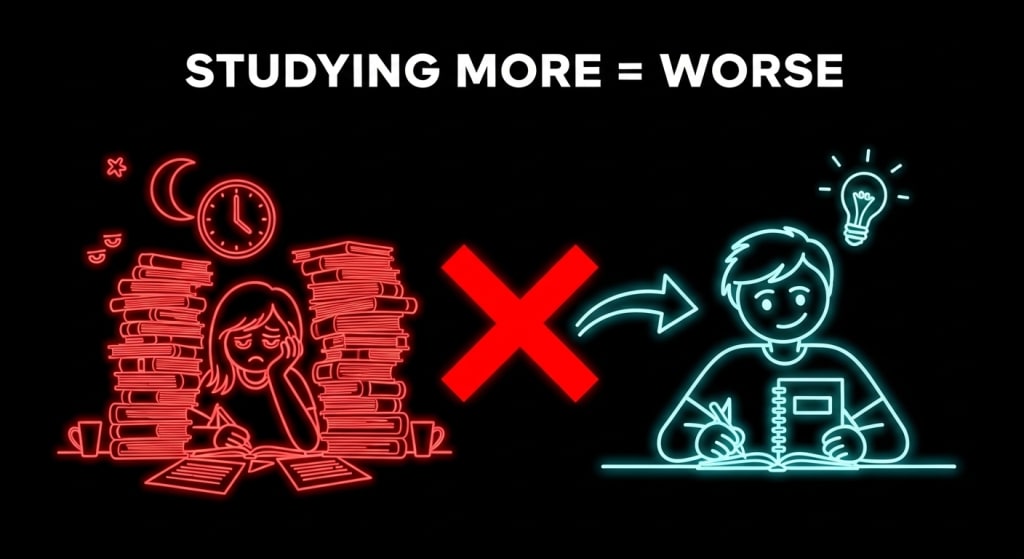
Student A vs Student B
Student A studies for about 30 minutes a day.
They sleep well, have a social life, and still rank in the top 5% of their class.
Student B studies four hours every single day.
They sacrifice sleep, cancel plans, and somehow still struggle to keep a B average.
Same classes. Same exams. Same intelligence.
So what’s the difference?
It’s not discipline.
It’s not motivation.
And it’s definitely not luck.
It’s how they study — not how long.
Before you keep reading, pause for a second.
On a scale of 1 to 10…
How good do you honestly think your study method is?
Hold onto that number.
The Night Everything Fell Apart
There was a time when I thought more hours automatically meant better results.
I followed every “productive student” rule:
Highlight everything
Rewrite notes neatly
Reread chapters again and again
One night during college, that illusion collapsed.
It was 3:00 a.m.
Empty coffee cups everywhere.
Notebooks spread across my desk like trophies of hard work.
I had been studying for over 12 hours straight.
And I still failed the exam.
Not because I didn’t try — but because none of it stuck.
That night forced me to face a painful truth:
I had no idea how to study.
The Productivity Illusion Nobody Talks About
Most students fall into what I now call the productivity illusion.
It feels like you’re learning because:
You’re busy
You’re tired
Your notes look impressive
But feeling productive isn’t the same as retaining information.
Highlighting pages until they look like abstract art.
Rereading the same paragraph hoping it magically sticks.
Creating perfect notes you’ll never look at again.
We confuse time spent with learning achieved.
Schools unintentionally reinforce this by saying things like:
“Study for three hours.”
“Review the entire chapter.”
But your brain doesn’t work like a sponge.
It works more like a muscle.
And muscles don’t grow by endless repetition — they grow by stress, recovery, and intention.
The Formula That Changed Everything
Here’s the mental model that flipped everything for me:
Real Learning = Time × Retention Rate
Two students:
Student 1 studies 5 hours, retains 10%
Student 2 studies 1 hour, retains 50%
They end up with the same retained knowledge.
But one of them wasted four extra hours.
That realization hurt… but it was freeing.
Because it meant the problem wasn’t me.
It was my strategy.
Why “Study Harder” Is Terrible Advice
Most advice online screams:
“Wake up earlier.”
“Study longer.”
“Push harder.”
That advice works only if your retention is already high.
If it’s not, studying more just deepens the frustration.
Passive studying is like pouring water into a bucket full of holes.
No matter how much effort you add, it leaks away.
The Shift That Changed My Grades
Everything changed when I stopped consuming information…
and started using it.
Instead of rereading:
I tested myself
I explained concepts out loud
I applied ideas to real situations
My retention jumped from around 10% to over 60–70%.
And something wild happened.
I studied less — and my grades went up.
Not because I became smarter…
but because my brain was finally engaged.
What Active Learning Actually Looks Like
Active learning doesn’t mean grinding harder.
It means making your brain work during study time.
Here’s the framework that worked:
Short sessions
30–60 minutes max per subject
Test before review
Recall what you know before opening notes
Hunt weak spots
Don’t review what’s easy — attack what’s hard
Explain out loud
If you can’t explain it simply, you don’t know it yet
Connect ideas
The brain remembers networks, not isolated facts
Quick review before sleep
Sleep is when memory consolidates
This approach doesn’t just save time — it lowers stress.
Why Your Brain Needs Less, Not More
Here’s something most people miss:
Your brain learns best when it’s slightly challenged — not overwhelmed.
That’s why short, focused sessions outperform marathon study binges.
And it’s also why mental state matters more than people realize.
When your brain is calm, focused, and alert, learning sticks faster.
This is where things get interesting.
The Role of Mental Readiness in Learning
I used to think studying was purely about discipline.
But after fixing my strategy, I noticed something else:
On days when my mind felt clear and focused, learning was effortless.
On days when my mind felt scattered, even good methods struggled.
That sent me down a rabbit hole of neuroscience, focus, and brain states.
That’s when I first came across tools designed to help the brain enter learning-ready states more easily — not by forcing effort, but by supporting focus naturally.
One of the most interesting concepts I explored was The Genius Wave.
Not as a “miracle fix,” but as a way to help the brain shift into deeper focus and clarity — the same kind of mental state where active learning becomes dramatically easier.
I didn’t see it as a replacement for good study methods.
I saw it as a multiplier.
Why Tools Don’t Replace Strategy — They Enhance It
Let’s be clear:
No tool can fix bad study habits.
But the right environment — mental and physical — can make good habits work better.
When your mind is calm:
You recall faster
You understand deeper
You burn out less
That’s why the combination of active learning + mental readiness is so powerful.
It’s also why simply “studying harder” fails so many students.
Back to Your Number
Remember the number you rated your study method at the beginning?
Ask yourself honestly:
Was it high because it looked productive…
or because it actually worked?
If this article made you question that number — good.
That’s not failure.
That’s growth.
Final Thought
The students who win aren’t the ones who suffer the most.
They’re the ones who understand how learning actually works.
Study less.
Retain more.
Protect your mind.
Use better strategies.
And if you support those strategies with the right mental state — whether through rest, environment, or tools like The Genius Wave — the results compound fast.
Not overnight.
But permanently.
About the Creator
Wealthy moves
Wealthy Moves: Your destination for smart financial strategies and a prosperous mindset. Let's make your money moves count.
Keep reading
More stories from Wealthy moves and writers in Motivation and other communities.
One Hard Thing
Stop me if you’ve heard this one before: You have the number, you know your schedule- you’ve even picked out the perfect day and time to make this appointment. Shoot, you’ve even picked out alternative days and times just in case their schedules can’t accommodate you!
By Taylor Rigsby21 days ago in Motivation
Slow Healing in a Loud World
Healing is often portrayed as a dramatic transformation: quitting a job, changing cities, reinventing identity, or finally choosing yourself in a way that looks brave and decisive. These stories travel well online. They are easy to package, easy to admire, and easy to misunderstand.
By Chilam Wong7 days ago in Motivation
The Tango Connection
I suppose I've become a writer so I wouldn't bore everyone to death telling them my stories. Reading them is reading. Not the same. There's rhythm. And timing and, most importantly, drama and suspense. Unless you have tremendous magnetism and an undeniable stage presence, there's no way you can engage an audience the way you can by writing your story. That's my opinion.
By Rene Volpi a day ago in Beat


Comments
There are no comments for this story
Be the first to respond and start the conversation.