
Wicked and the Reality of Disability
A turning point for representation on film
The Wicked films arrived wrapped in spectacle. Audiences expected soaring vocals, dazzling visuals, and the familiar emotional weight of a beloved musical brought to life. Few viewers expected to encounter one of Hollywood’s most meaningful recent contributions to disability representation.
Beneath its fantasy setting, Wicked tells a story about difference. It explores what happens when someone exists outside society’s expectations, and how quickly that difference becomes a reason for judgement. Through its characters—especially Elphaba and Nessarose—the film reveals both the progress and the persistent problems in how disability is portrayed on screen.
This makes Wicked more than entertainment. It makes it culturally significant.
Difference as Identity: Elphaba’s Story
Elphaba’s green skin immediately marks her as different. People stare, recoil, and form assumptions before she speaks a single word. Her body becomes something others feel entitled to judge, fear, or mock.
This experience reflects a reality familiar to many disabled people. Visible difference often invites unwanted attention and unfair assumptions. Society frequently treats difference as a flaw rather than a neutral part of human diversity.
The film challenges this instinct directly. Elphaba emerges as compassionate, intelligent, and morally driven. Her character exposes the false link between physical difference and moral failure. For generations, cinema used visible difference as shorthand for villainy. Scars, deformities, and physical impairments signalled danger or corruption. Wicked rejects this tradition by showing that society, not the individual, creates the villain.
Her story becomes a powerful metaphor for marginalisation. It asks viewers to reconsider how easily people accept prejudice when it is presented as normal.
Nessarose and Authentic Representation
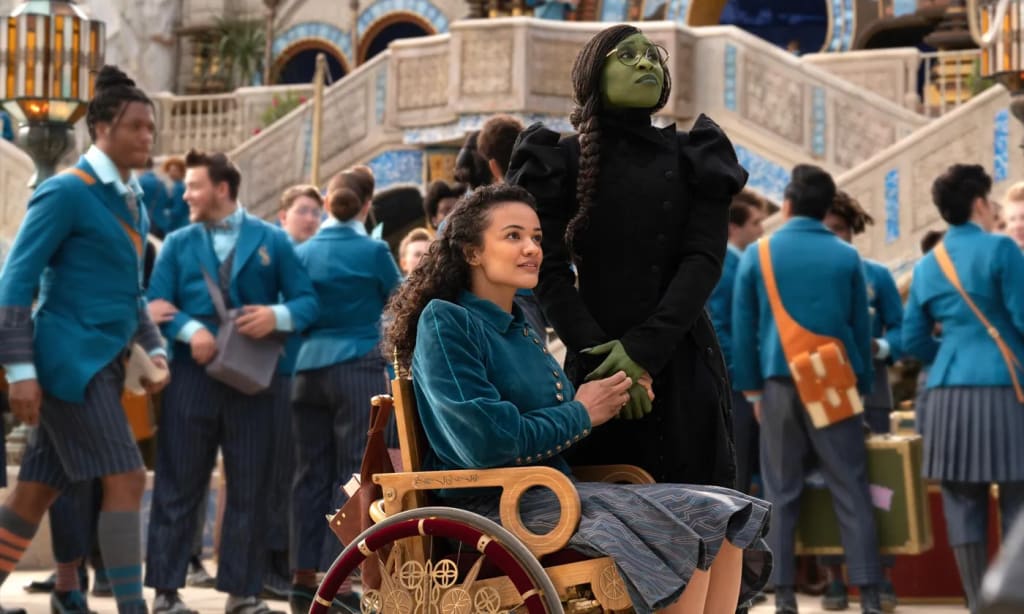
The most groundbreaking element of the film lies in the portrayal of Nessarose. She uses a wheelchair and is played by Marissa Bode, an actor who also uses a wheelchair in real life.
This casting decision represents a meaningful shift. Historically, disabled characters were often portrayed by able-bodied actors. This practice excluded disabled performers while reducing disability to a performance rather than a lived experience.
Marissa Bode’s presence changes that dynamic. Her performance carries authenticity because her disability is not an imitation. Nessarose’s wheelchair exists as part of her daily life, not as a narrative prop designed to evoke sympathy.
Her character experiences love, frustration, ambition, and vulnerability. These qualities allow her to exist as a fully realised person. Disabled characters have often been reduced to symbols of tragedy or inspiration. Nessarose avoids complete reduction to those stereotypes. Her presence alone represents progress.
Visibility has power. Authentic representation allows disabled viewers to see themselves reflected in stories that have historically excluded them.
Complexity and the Risk of Harmful Tropes
Despite its progress, Wicked does not fully escape the weight of cinematic history.
Nessarose’s emotional journey grows darker as the story unfolds. Feelings of isolation, longing, and pain influence her decisions. This complexity makes her human. However, it also risks reinforcing a troubling pattern in which disabled characters are portrayed as emotionally damaged or morally compromised.
This trope has appeared frequently in film. Disabled characters often exist at extremes, presented as either inspirational heroes or bitter antagonists. Such portrayals limit the range of stories disabled characters are allowed to inhabit.
True representation requires balance. Disabled characters deserve the same emotional diversity as any other character, without their disability being framed as the cause of their moral struggles.
The Cultural Obsession with “Fixing” Disability
Another complicated aspect of disability representation appears through the broader narrative tradition surrounding Nessarose. Popular storytelling has long embraced the idea that disability must be cured or corrected. Magical healing, technological repair, or miraculous recovery often appear as narrative resolutions.
This reflects a cultural discomfort with disability itself. Stories frequently treat disabled bodies as problems rather than valid forms of existence.
The film adaptation approaches this theme with more care than earlier versions of the story. Greater emphasis falls on emotional development rather than physical transformation. Even so, the presence of this narrative tradition highlights how deeply rooted these ideas remain.
Acceptance remains more radical than cure.
Why Wicked Matters Now
The Wicked films represent meaningful progress in disability representation. Authentic casting brings visibility to disabled actors. The narrative challenges audiences to empathise with characters who exist outside social norms. Difference becomes something to understand rather than fear.
Imperfection remains part of this progress. Some tropes still linger, reflecting the long history of limited representation in film. Change rarely arrives without contradiction.
What matters most is that disabled characters are allowed to exist fully. Elphaba is not defined solely by her green skin. Nessarose is not defined solely by her wheelchair. Their identities emerge through their choices, relationships, and emotional depth.
Representation shapes perception. Stories influence how audiences understand difference in the real world. When films present disabled characters as complete human beings, they challenge harmful assumptions that have persisted for decades.
Wicked does more than defy gravity. It helps defy expectations. It offers a vision of storytelling where difference is not something to erase or overcome, but something to recognise, respect, and include.
Cinema moves forward when characters once pushed to the margins finally take centre stage.
About the Creator
Keep reading
More stories from Millie Hardy-Sims and writers in Motivation and other communities.
Proving You’re Disabled Enough
The hardest part of applying for disability benefits was not the paperwork. It was the translation. A life quietly reshaped by illness had to be reduced to tick boxes, descriptors, and carefully worded answers. Pain had to become evidence. Fatigue had to become measurable. Personal limitation had to be presented as a case strong enough to be believed.
By Millie Hardy-Simsabout 6 hours ago in Motivation
One Hard Thing
Stop me if you’ve heard this one before: You have the number, you know your schedule- you’ve even picked out the perfect day and time to make this appointment. Shoot, you’ve even picked out alternative days and times just in case their schedules can’t accommodate you!
By Taylor Rigsby18 days ago in Motivation
from death into life
Young Aldin of Wiloh had never contemplated death. It was almost strange — so many around him had the tendency to obsess over it, to clamor and claw almost desperately at their own perceptions of the end to know death as much as they could: when it would come, why it would come, where it would take them when it did.
By angela hepworth4 days ago in Fiction


Comments
There are no comments for this story
Be the first to respond and start the conversation.