
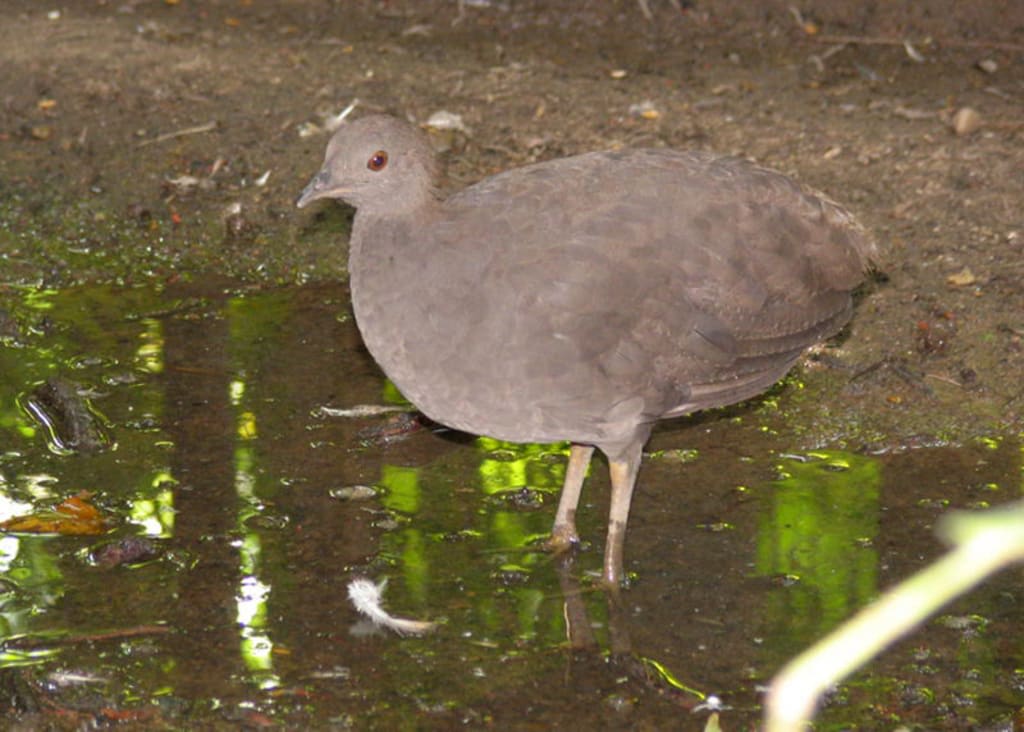
The Cinereous tinamou (Crypturellus cinereus), also known as brushland tinamou, is a sort of ground bird found in northern South America's wetlands and lowland forests. We have other geographical names that are used by the native people, for example in Amazonas, where they are called inambu-pixuna, and in Pará, Brazil, where they are called nambu-sujo. They often refer to their predilection as inhambu-preto. There Cinereous tinamous lived out there for many years. This is one of the world's oldest families today, and has discovered fossils that date back hundreds of millions of years. Their swift reflexes play a role in their ability to survive. The monotypical genus is Cinereous tinamou. Both tinamous are family Tinamidae, and therefore in the larger context are ratites. Unlike other ratites, tinamous can float but typically are not swift fliers. The closest living relative of these birds are both ratites which originated from ancient flying birds, and tinamous. Gmelin originally placed this bird into the Tetrao family, as Tetrao cinereus reveals its apparent yet incorrect similarity to the other game birds. The cinereous tinamou is a dark, mysterious Tinamou. This is about 29–32 cm long, weighing about 435 grammes on the male pigeon, and about 549–602 grammes on the girl of the species. The Berlepsch tinamou is similarly coloured in contrast to soothy brown or brownish coloured black it is deep redd. It looks like a touch of a browner than the Berlepsch tinamou. Typical to this is his smoky-gray to reddish-brown crown and nape. On the side of his head the feather shafts are translucent, sometimes showing quite a bit. Their colour allows them to blend with the environment, allowing the identification of predators easier. The underside of the bird is just slightly darker than that of the body, and the wings are brown and black and white. We have an eye ring that is light-coloured. A bill's got a black top mandible, and a light mandible. They prefer to live in pairs or individually, and typically don't move in clusters. It is especially known as the cinereous tinamou which is easy to hear but very difficult to see. It has a loud, signature whistle which is sometimes heard in the morning and in the evening. Their whistles in each whistle have a different tone which lasts for almost two seconds. A whistles are mostly heard in the morning and in the evening, and are monosyllabic. This is very likely that the bird would change his voice to sound like it originated from a remote location and it is very difficult to hear them and locate their precise spot. The call between the males and the females is similar to the human body but not equal. Generally, their bill is very similar to Berlpesch's tinamou because it looks smaller and thinner. The females are slightly heavier than the males, too. The diurnal tinamou is a smartphone model. Usually take off very easily when they are scared or surprised. Since they're spending their days on the field, they've developed their instincts to run quickly, and they'll easily hide to avoid predators and people never see them. We choose to walk or drive rather than go. They can ride but that's unusual and brief. Although the cinereous tinamou can only fly for a short time, their flight is fast and easy. A distance between calls shortens with the passage of time, and the pace continues to increase. The breeding season of the cinereous tinamou is year-round due to the optimal conditions under which they live; however, between August and October there is a period of choice, except in Colombia, where it is in June; the food habits of the cinereous tinamou depend on the season and environment, although mostly herbivorous, with a heavy focus on berries, similar to those of other Crypt members. Their summer diet contains nuts, tiny fruits and small invertebrates. The butterflies, mole-crickets, and pentatomids are other invertebrates that they eat. Generally, they eat a large range of seeds or berries gathered on the ground during the winter season, with an focus on the acai. Owing to their large intake of insects, the insect pests are considered a threat to ecology. When the cinereous tinamou is young it is more insect- than adult. The cinereous tinamou doesn't seek fruit, but searches under the leaves or is using his bill to dig. A sedentary tropical species, the cinereous tinamou is.
About the Creator
MB
I am a bird aficionado and really enjoy spotting them them on hikes. I greatly appreciate the variety of birds cross North America and the world. They are amazing and intelligent creatures, each so unique and with a wonderful life.
The Summer I Was Chosen by a Northern Mockingbird
During the long, suspended days of the pandemic, a wild mockingbird began visiting my driveway and chose me, again and again. What started as a strange encounter became a brief, meaningful connection that I still carry with me.
By Erica Roberts 19 days ago in Petlife
Clumping Cat Litter and the Necessity to Pick the Right Product for Your Kitty
There is no denying that cats are one of the best animal companions for individuals who lack the space necessary for other, more physically active pets. Sure, nothing beats the companionship of a Golden Retriever or the security brought by a German Shepherd. But dogs are not really suitable for apartment living, and in order to fulfil their physical and behavioural demands, you will need to walk them at least two or three times per day. That’s a bit of a challenge, one that many Aussie pet owners are not prepared to handle.
By Peter Morris2 days ago in Petlife
📢 Raise Your Voice Thread: 02/05/2026
Our “Raise Your Voice Threads” are hosted most alternating Thursdays at 12PM ET to offer creators more avenues to uncover exceptional stories on Vocal. As we are continuously searching for fresh creators and inspiring stories, this thread provides an opportunity to exchange and discuss the stories that have moved and motivated us on Vocal.
By Raise Your Voice by Vocal3 days ago in Resources



Comments
There are no comments for this story
Be the first to respond and start the conversation.