
The Chair That Never Came
A short story inspired by the incident

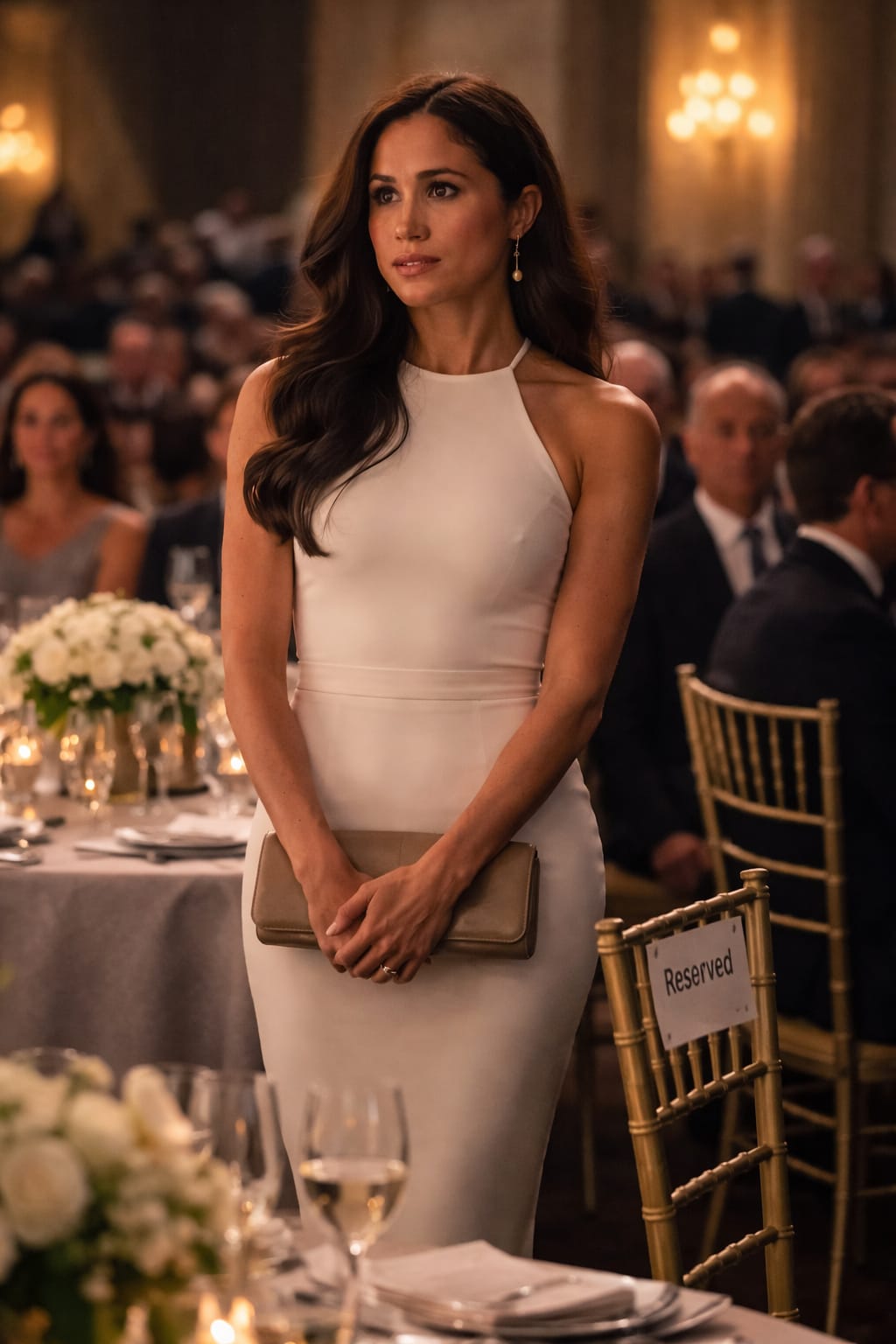
The ballroom shimmered beneath a thousand lights, every breath in the room carrying a quiet note of expectation. It was the annual Global Philanthropy Summit — the kind of gathering where names were whispered, not introduced, and where power did not need to announce itself.
Guests filled the hall in practiced elegance: CEOs, founders, donors whose signatures could build hospitals or topple companies. Their names were printed on cards in the front rows — curated, counted, and arranged weeks ahead of time.
And then, she arrived.
Megan, the Duchess of Sussex, stepped into the room with her aide at her side — unlisted, unexpected, yet walking with the confidence of someone long accustomed to the world bending for her.
A ripple went through the staff. She wasn’t on the schedule. Her name wasn’t on the seating chart. Yet here she was — bright, smiling, certain that a seat had been prepared simply because she had entered.
Her assistant gestured toward the front row — an empty chair, momentarily vacated by a tech billionaire who had stepped away. They approached.
A tap on her shoulder stopped her.
“I’m sorry, ma’am,” an event coordinator said, voice low but firm. “This row is reserved. We have a place for you on the side.”
It was polite. It was professional. But it was also final.
Witnesses described a frozen moment — the duchess pausing, her fixed smile barely shifting. She waited. Surely someone would come. Someone always did. Someone to pull forward a chair, clear a space, make room for The Duchess.
But the room moved without her.
Guests settled. Conversations resumed. Cameras flashed for other faces. No eyes searched for her. No staff scrambled. For a long, awkward stretch of minutes, she stood — a royal silhouette in a space where titles were currency no one traded in.
Only after the keynote began did someone quietly guide her to a chair far off to the side — not ignored, but unmistakably ordinary.
It was a message sharper than any royal protocol.
Here, pedigree meant nothing.
Here, you had to earn your place.
As she sat, her posture perfect, she seemed smaller somehow — not in height, but in certainty. She had left behind a palace she felt confined her. Now she was discovering that the world outside was not a red carpet rolled out on demand, but a maze of circles that chose who belonged.
No one glared. No one mocked.
Worse — no one cared.
And as the lights dimmed and the speaker continued, the duchess realized that a story she controlled for years — of escape, of reinvention, of ranking above the room — had slipped unexpectedly from her hands.
Because in this world, there were no thrones to claim.
Only seats to earn.
And on this night, hers had not yet been built.
Yet the echoes of that evening stretched far beyond the ballroom.
In the days that followed, the incident circulated quietly through private WhatsApp groups, PR offices, and agency boardrooms long before it drifted onto newsfeeds. It became not merely a moment, but a cautionary parable whispered among people who move unseen behind red carpets and televised galas.
The philanthropic summit, for all its glamour, was in essence a workplace — one built on long hours, unglamorous logistics, and delicate balances of influence. Those who earned their seats — hedge fund architects, founders who spent decades scaling companies from kitchen tables, activists who slept more nights in tents than in five-star hotels — had arrived with portfolios of proof. Their chairs symbolized legacy, labor, and investment. That was the silent contradiction that defined the tension of the evening: a clash between earned capital and perceived entitlement.
Long after the lights dimmed, several attendees recalled the most striking image of the night was not Meghan’s presence, but the posture she held. Standing still while those around her settled into ease created a tableau impossible to ignore. The body language told its own story — a woman accustomed to doors opening, suddenly meeting a door that did not move.
But the narrative is not static. Those closest to Hollywood know perception shifts as quickly as ticket sales or social algorithms. For every room closing, another may open. A new initiative, a breakout documentary, a bold charity partnership — any could rewrite the arc.
Indeed, some observers saw the moment less as punishment and more as a turning point. A “reset” disguised as discomfort. Within crisis, opportunity hides — and public figures have reinvented themselves from weaker positions. The industry rewards resilience almost as much as originality.
Whether Meghan interprets the evening as humiliation or instruction remains unseen. What will matter most is the response — not in speeches or statements, but in action. Consistency. Delivery. Showing up in rooms after the spotlight fades, not only before it rises.
The silent lesson of the missing chair was not only you cannot assume your place — it was you can build one.
Chairs — literal or symbolic — are manufactured, funded, and earned. They are pulled up by those willing not just to sit, but to contribute.
The question now hanging over future rooms is simple and powerful:
Will Meghan build her chair — or wait for another one to be offered?
About the Creator
Behind the Curtain
"Exploring the untold stories and hidden truths. From royal rumors to cultural deep dives, Behind the Curtain brings you bold, insightful narratives that spark curiosity and conversation."
Keep reading
More stories from Behind the Curtain and writers in Petlife and other communities.
The Rift Behind the Palace Smile
Behind the polished smiles, glittering gowns, and carefully choreographed royal appearances, a quieter and more complicated story was unfolding. To the world, Kate Middleton and Meghan Markle represented modern royalty: intelligent, elegant, and destined to reshape the future of the British monarchy together. But behind palace walls, the reality was far less harmonious. It began not with shouting matches or public scandals, but with small moments—glances, silences, and subtle discomforts that slowly grew into something impossible to ignore. One of the earliest cracks appeared during the Royal Foundation Forum in 2018. The event was meant to showcase unity between Prince William, Kate, Prince Harry, and Meghan. Cameras captured smiles and friendly conversation. But backstage, tension filled the air. As Meghan prepared for the stage, she casually asked Kate if she could borrow her lip gloss. It was an ordinary request, the kind women make without thinking. Yet Kate hesitated. According to Prince Harry’s later account, Kate looked uncomfortable—almost startled—before reluctantly handing it over. It was a tiny moment, but it spoke volumes. To Meghan, the hesitation felt cold. To Kate, the request felt intrusive. Two women, standing only feet apart, were already operating by completely different emotional rules. Kate had spent nearly a decade learning how to survive inside the royal system. She understood restraint. She believed in caution. Every gesture, every word, every expression was carefully controlled. Meghan came from a world where openness was power. Hollywood had taught her to speak freely, to connect emotionally, and to command attention. She was confident, expressive, and unafraid of being seen. Neither approach was wrong. But together, they collided. At the forum, the contrast became obvious. Meghan spoke passionately, effortlessly engaging the audience. She appeared polished, confident, and natural on stage. Kate, pregnant and exhausted, spoke more quietly and cautiously, following the traditional royal style. Headlines soon praised Meghan’s performance. Some even suggested she had “stolen the show.” For Kate, who had spent years patiently earning her place, it felt unsettling. Behind the scenes, another comment worsened the situation. Meghan reportedly joked about Kate having “baby brain” during her pregnancy. Meghan may have intended it lightly, but Kate was suffering from severe pregnancy sickness and was physically struggling every day. The remark cut deep. Soon, the four royals sat down for a tense private meeting. Emotions were high. No one yelled. No one exploded. But nothing was truly resolved either. They left knowing one truth: coexistence was necessary, but closeness might never be possible. Then came the wedding. In the days before Meghan and Harry’s ceremony, a disagreement broke out over Princess Charlotte’s bridesmaid dress. Rumors spread quickly that Meghan had made Kate cry. Meghan was labeled difficult, demanding, and cruel. Years later, Harry revealed the opposite: Meghan had been the one in tears. According to Harry, Kate insisted the dress needed to be remade entirely. Meghan, overwhelmed by wedding stress and family chaos, felt pushed too far. The argument ended with Meghan crying alone. Kate later arrived with flowers and apologized. The truth, as always, likely exists somewhere in the middle. But the damage was done. When Meghan publicly addressed the issue during her interview with Oprah Winfrey, she stated clearly: “The reverse happened.” With those three words, a silent war became public. Kate remained quiet, bound by royal tradition. Meghan spoke openly, determined to reclaim her narrative. William stood firmly by his wife. Harry stood firmly by his. Two brothers who once shared everything now stood on opposite sides of a widening divide. What makes this story tragic is not who was right or wrong. It is what was lost. Two women who could have been allies became symbols of rivalry. Two brothers who once walked side by side became strangers. A family built on tradition proved unable to adapt to change without breaking. The lip gloss, the dress, the comments—none of them truly mattered. What mattered was the clash of two worlds: Silence versus expression. Tradition versus transformation. Endurance versus reinvention. And once those forces collided, there was no turning back. The palace remained standing. But the fairy tale did not.
By Behind the Curtainabout 13 hours ago in Petlife
Cleo's First Puppy Show
"How would you feel about doing the Corsicana show in November?" Kathleen asked me last September. Dog exhibitors speak in shorthand that way. It's easier to say "the Corsicana show" than it is to say the "North East Texas American Eskimo Dog Association Show." And yes, "North East." I guess "Northeast" shortened the name too much for some people's taste . . . But I digress. In response, I asked two of the three important questions that every exhibitor thinks, first thing.
By Kimberly J Egan30 days ago in Petlife
When the night falls silent, my dog starts barking.
When night finally settles in, I expect silence. The lights are off, the phone is charging, and the world feels like it’s holding its breath. This is the moment when everything is supposed to slow down. But just when the silence feels complete, it does.
By Paw Planet about 10 hours ago in Petlife




Comments